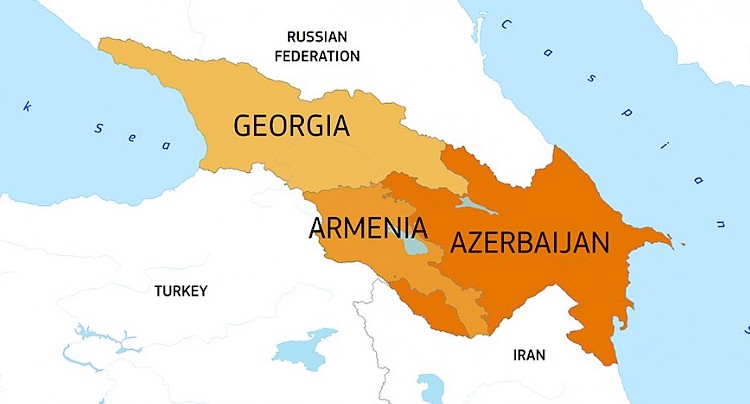
The thirty years of conflict between Armenia and Azerbaijan might become a page in history, though a tragic one. Both countries are working on the draft of a peace treaty, however, the complexity of the region’s history and current geopolitics, along with a wide range of disruptors such as radical elements inside Armenia and the diaspora, make the road to peace an unpredictable one.
The focus of mainstream Western media is on the result of the 2023 lightning operation by Azerbaijan’s forces against separatists in its Karabakh region, which resulted in the collapse of the Armenia-backed separatist regime and the subsequent departure of the Armenian population. Nevertheless, what happened in September 2023 was predetermined much earlier, thirty years ago, when Armenian nationalists launched an irredentist campaign to unite Soviet Azerbaijan’s Nagorno-Karabakh Autonomous Oblast (NKAO) with Armenia under the slogan of miatsum (unification).
Liberals in the West, however, treat the Armenian irredentist movement from a self-determination perspective. This is a skillfully designed narrative that Armenian nationalist leaders and diaspora activists started to promote when Armenia gained independence in 1991. The new narrative was embraced because the idea of miatsum became problematic as it sounded like an irredentist attempt to gain the territory of a neighboring state. In essence, this was indeed the nature of the movement, and it remained so during the whole period when Armenia ruled over Azerbaijan’s Nagorno-Karabakh region. In 2015, rejecting the claims of Armenians about the self-determination of the local Armenians in Karabakh, the European Court of Human Rights (ECHR) recognized Armenia’s “effective control” over the occupied territories of Azerbaijan.
The liberals’ love affair with Armenian separatists and irredentists is not unique. There are examples of other erroneous affections toward certain radical movements. Thus, well-known historian Simon Montefiore, the author of a book about Josef Stalin, has debunked fellow liberal academicians and journalists who regarded the Hamas attack of October 7, 2023, on Israel as a decolonization attempt. Montefiore argued that, although Palestine deserves a free and independent statehood, an ideology that tolerates the slaughter of civilians is incompatible with advocating decolonization. By the same token, the legacy of Armenian control of Azerbaijani territories between 1992 and 2020 is replete with war crimes, massive displacement, illegal settlements, landmine contamination, and total destruction of infrastructure and heritage.
Armenian people also suffered from the conflict, but the core of the problem was and remains miatsum, which nevertheless received support among some Western intellectuals and policymakers, though the latter did not pursue ideological goals, but rather solicited donations to their election campaigns.
The most problematic issue with the Western approach to the Armenia–Azerbaijan post-conflict situation is to treat it as if nothing happened before the 2020 war or the September 2023 operation.
However, the origins of the present situation stem from the events in 1987–1990 when the Armenian leadership decided to fully ethnically cleanse Azerbaijanis from Armenia. The Armenian leaders further promoted the ethnic cleansing of Azerbaijanis from Karabakh. When they lost the war in 2020, the separatist leaders rejected repeated calls for dialogue with Azerbaijan.
For the major part of the period of the occupation (1993–2020), Armenia had the strong support of Russia and was a major advocate of a large Russian presence in the South Caucasus. Russia’s military and political support played a key role in Armenia’s efforts to sustain the occupied territories under its control. In return, Armenia supported separatism in Georgia and Ukraine, including under the leadership of the incumbent Prime Minister Nikol Pashinyan, and sent troops to Syria alongside Russian forces.
These realities on the ground were consistently disregarded or distorted in the Western media and political circles. This is well exemplified by Amendment 907 to the Freedom Support Act passed by the US Congress in 1992, which prohibited military aid to Azerbaijan until Baku takes “demonstrable steps to cease all blockades and other offensive uses of force against Armenia and Nagorno-Karabakh,” while it was Azerbaijan that was subject to invasion at that time, and the massacre of civilians in Khojaly had occurred earlier in the same year.
In January 2024, the US Department of State included Azerbaijan in the second-tier Special Watch List of Religious Freedom Offenders on the recommendation of the US Commission on International Religious Freedom (USCIRF), which focused on the potential danger to Christian Armenian monuments in Karabakh. However, the USCIRF fully disregarded that the entire heritage of Azerbaijani Muslims in Armenia had already been destroyed, including in the same Karabakh when it was under Armenian control.
At the time, such international factors emboldened the occupying country and separatist forces in Karabakh, fueling their resilience against peace calls. Indeed, peace in the region needs a fair approach from major international actors. The South Caucasus has endured too much bloodshed, and Western media and intellectuals are partly responsible for that, by feeding a one-sided nationalist narrative and supporting the irredentist project.
Farid Shafiyev is the Chairman of the Center of Analysis of International Relations. He holds a PhD from Carleton University and an MPA from Harvard Kennedy School of Government.