On April 18, while speaking to his country’s parliament, Armenian Prime Minister Nikol Pashinyan acknowledged Azerbaijan’s sovereignty over Nagorno-Karabakh, the disputed province at the heart of a protracted conflict between the two countries. Pashinyan’s brevity belied the magnitude of his statement.
After explaining that peace in the South Caucasus is possible only if Armenia accepts internationally recognized borders (according to which Nagorno-Karabakh belongs to Azerbaijan), Pashinyan confirmed that “the Republic of Armenia fully recognizes the territorial integrity of Azerbaijan, and we expect Azerbaijan to do the same.” He also stressed that Armenia must affirmatively renounce territorial claims against other countries, and that Armenian society must internalize this stance.
It was an extraordinary speech, not least because it offered an outstretched hand to Azerbaijan, which has asserted time and again that the status of Nagorno-Karabakh is a domestic matter.
That is increasingly true: Azerbaijan now controls the area adjacent to Nagorno-Karabakh that Armenian forces had held since the first war between the countries ended in 1994, as well as a substantial part of Nagorno-Karabakh itself. A Russian peacekeeping force patrols the rest of the territory, which is still governed as a breakaway region by its ethnic Armenian majority.
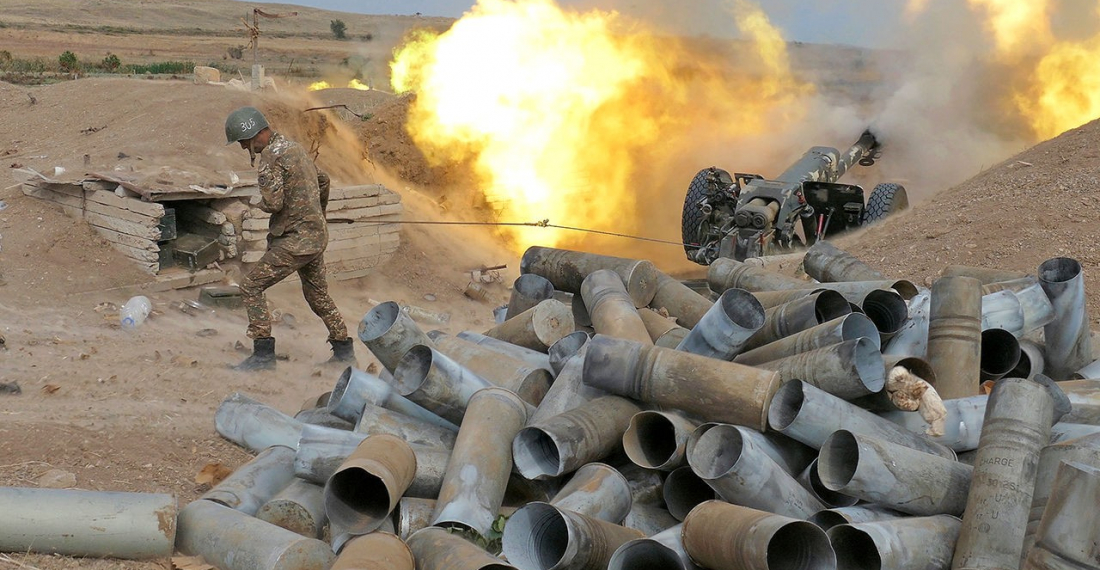
The current status quo reflects Azerbaijan’s successful offensive in the enclave, which began in September 2020 after years of intermittent fighting. With more than 7,000 casualties over the course of six weeks, the second war was one of the bloodiest in the post-Soviet space – at least until Russia’s invasion of Ukraine – and ended only when the Kremlin brokered a ceasefire.
In the immediate aftermath of the ceasefire, the Armenian opposition organized anti-government protests. But two and a half years later, in the wake of Pashinyan’s appeal to recognize Azerbaijan’s borders, the streets have remained quiet, indicating that the opposition’s capacity to create serious disruptions has weakened. This aligns with the outcome of the 2021 snap parliamentary election: Pashinyan’s Civil Contract party won 71 seats in the National Assembly, while the opposition alliance gained only 29. Armenian society, beaten down by war and tired of being isolated from neighbors, seems to be ready to embark on a new development path.
As usual, major regional players are jockeying for influence, which both Armenia and Azerbaijan have tried to leverage. Armenia uses its membership in the Russian-led Collective Security Treaty Organization and the Eurasian Economic Union, as well as the influential pro-Armenian diaspora in the United States and certain European countries, to pressure its adversary. Azerbaijan, meanwhile, relies on its role as an essential regional energy supplier to bolster its influence. For example, European Commission President Ursula von der Leyen signed an agreement in July with Azerbaijan to double imports of natural gas by 2027, calling the country a “crucial” energy partner.
The European Union has been positioning itself as a key mediator in the conflict, especially with Russia distracted by its war in Ukraine. In addition to participating in the European Neighborhood Policy and the Eastern Partnership program, both countries agreed to a two-month EU-led monitoring mission in Armenia at the end of 2022. Azerbaijan objected, however, to the European Council’s decision early this year to establish a larger civilian mission in Armenia, though its mandate appears to be limited. “Many Armenians believe there’ll be a spring offensive by Azerbaijan,” Markus Ritter, head of the civilian mission, said last month. “If this doesn’t happen, our mission is already a success.”
Turkey has supported Azerbaijan in the Nagorno-Karabakh conflict, supplying weapons and training to its fellow Turkic state. But as a strong regional player, Turkey’s government understands the importance of improving relations with Armenia, with which it shares a 204-mile (328 kilometers) border that has been closed since 1993. Notably, the two countries recently declared their readiness to normalize relations.
Yet Russia remains the most powerful force in the region, even though its influence has waned. As Azerbaijani President Ilham Aliyev put it in October 2020, “Russia, as our neighbor, as a country that has a common history with Azerbaijan and Armenia, certainly plays a special role.” Russian President Vladimir Putin has used those “special” ties to station troops in Armenia as a way to intimidate both states.
Still, after Pashinyan’s clear signal, nothing is preventing Armenia and Azerbaijan from signing a peace treaty. With the constant threat of violence impeding growth in both countries, both sides have a strong incentive to move quickly.
Official sources suggest that Azerbaijan is prepared to invest significantly in war-torn Nagorno-Karabakh. The 2022 budget allocated $1.3 billion for restoration efforts. But rebuilding the regional economy will not happen overnight: it may take up to ten years and cost more than $10 billion. Any meaningful development will require more than just a temporary truce.
The crucial issue in a lasting settlement is demilitarization. Armenia denies maintaining a military presence in Nagorno-Karabakh and has previously insisted that Armenians living in the enclave have the right to preserve their self-defense forces. Azerbaijan considers this condition unacceptable. And yet the Azeri armed forces were the decisive factor in the 2020 war. While full demilitarization is important in the long term, the immediate focus should be on accelerating peace negotiations.
Tensions in the South Caucasus benefit no one, not even Russia, although it often seems inclined to foster instability in the region as a means of sustaining its influence. Armenia and Azerbaijan must act swiftly and decisively to take advantage of the olive branch provided by Pashinyan. A definitive agreement on borders is the only way to start building the trust needed to secure the peace both sides need.
Djoomart Otorbaev, a former prime minister of Kyrgyzstan, is the author of Central Asia’s Economic Rebirth in the Shadow of the New Great Game (Routledge, 2023).