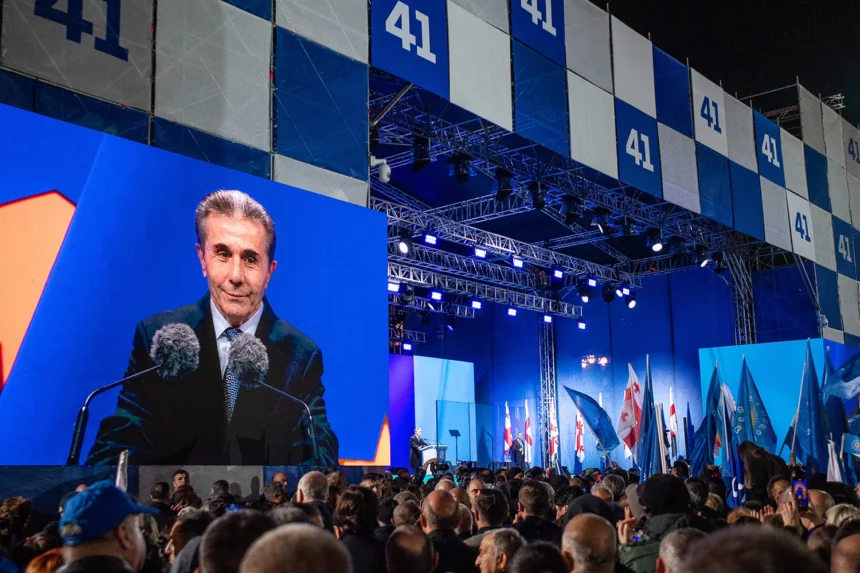
On October 26, Giorgi Kalandarishvili, Chairman of Georgia’s Central Election Commission, announced the completion of parliamentary elections, presenting the official results. The ruling Georgian Dream party secured approximately 54% of the vote. Opposition parties collectively garnered 37.78%, yet abroad, Georgian Dream received only 13.3% of the vote, while approximately 77% went to pro-Western opposition parties. This disparity underscores the divide between voters within Georgia and the Georgian diaspora, which largely favors a pro-European path for the country.
Amid criticism of the government’s relations with Russia, Prime Minister Irakli Kobakhidze confirmed that Georgia has no plans to restore diplomatic ties with Moscow. He emphasized that 10% of Georgia’s territory (Abkhazia and South Ossetia) remains under Russian occupation, precluding any meaningful dialogue with the Kremlin. “There are no plans for that,” he stated when asked about diplomatic relations with Moscow, underscoring that Georgia adheres to its national interests.
Parliament Speaker Shalva Papuashvili noted that both the campaign period and election day were calm and free from significant violations. International observers, including the OSCE, validated the legitimacy of the elections. “The Georgian people have given their verdict, supporting the peaceful development of the country and its aspiration to join the European Union,” Papuashvili said. Nevertheless, opposition forces rejected the election results, claiming that the ruling party had used administrative resources and exerted pressure on voters to strengthen its hold on power.
Reaction from International Actors
As expected, the United States expressed concern over the election results. Secretary of State Antony Blinken called the elections untrustworthy, accusing the ruling party of leveraging state resources to pressure voters and demanding an investigation into alleged violations.
Matthew Miller, head of the U.S. State Department’s press service, added, “We do not rule out further consequences if the Georgian government does not change course.” However, Miller did not specify what these consequences might entail.
The European Union called on Georgian authorities to conduct a “swift, transparent, and independent” investigation into numerous reported election violations, including intimidation, coercion, and vote-buying. The OSCE’s joint observation mission acknowledged the election’s organization but noted a “tense environment” with “widespread pressure on voters,” undermining the secrecy of the ballot and raising serious concerns about the election’s integrity.
In a joint statement, the European Commission and High Representative Josep Borrell stressed the need for “constructive and inclusive dialogue among political forces” in Georgia. European leaders emphasized that addressing violations and restoring trust in the electoral process are essential steps toward rebuilding confidence and strengthening democratic institutions. Furthermore, Brussels has criticized Georgian Dream’s legislative initiatives as undermining democracy and emulating elements of Russian-style authoritarianism. Specifically, a law establishing a register of foreign-funded media and NGOs has led to the suspension of Georgia’s EU accession process.
The EU’s stance reflects a broader deterioration in relations with Georgia under Kobakhidze’s leadership, delaying Georgia’s long-awaited integration into the European community. European leaders have expressed serious concerns over Georgian bills threatening to outlaw the opposition and curbing LGBT rights. The EU urged Georgia to implement democratic and sustainable reforms aligned with European integration principles, stressing that any laws that undermine citizens’ fundamental rights and contradict EU values must be repealed.
European Council President Charles Michel called on Georgian authorities to “seriously” address the reported irregularities. Michel also announced that EU leaders would discuss next steps in relations with Georgia at an upcoming summit in Budapest, where the latest political developments in the country will be a key topic.
In contrast, Hungarian Prime Minister Viktor Orbán was one of the first to congratulate Kobakhidze on his “overwhelming victory” and announced a planned visit to Tbilisi. According to a European Commission spokesperson, Orbán’s visit is part of bilateral relations between Hungary and Georgia and was not coordinated with the European Council. This move by Orbán may intensify disagreements among EU leaders at the upcoming summit, especially given the challenging political situation in Georgia and Brussels’ critical stance.
The Russian Foreign Ministry also responded to the election results. Foreign Ministry spokesperson Maria Zakharova addressed Georgian President Salome Zourabichvili, who had refused to recognize the results, calling them a step backward from the country’s European future and urging Georgians to protest. Zakharova posed a rhetorical question to President Zourabichvili: “What makes Georgia’s future inferior to Europe’s?” She also noted that Zourabichvili’s sister, French politician Hélène Carrère d’Encausse, had expressed disappointment in the EU, which, according to Zakharova, should prompt Georgia to reconsider the European Union’s role in its future.
Lackluster Opposition Protests
On October 28, two days after the election, the opposition held its promised protest in Tbilisi, but turnout was significantly lower than expected. The protests lasted around two hours, ending peacefully and without incident. Protesters projected the message “We will return” onto the parliament building, signaling their intent to continue the struggle. However, the event left an impression of demobilization and disappointment, lacking enthusiasm and organization.
Interestingly, no protests were organized on election day itself, which might have been a more potent display of public dissatisfaction. Instead, the low turnout indicated that the public did not view the election results as especially outrageous or shocking.
Expert Opinions
Georgian political analyst Irakli Gogava, commenting on the election results for Azerbaijani media, called them predictable, noting that the majority of the population supported stability and the country’s sovereignty. He expressed concern that approximately 850,000 citizens, in his view, were influenced by “false propaganda” from the opposition, which he claims is funded from abroad. Gogava added that Georgian society largely votes “for,” not “against,” supporting sovereignty and traditional values.
Ukrainian analyst Leonid Shvets, meanwhile, highlighted that the main mistake of the opposition was its lack of unity before the elections and insufficient organization. The opposition failed to establish a reliable monitoring system at polling stations or adequately substantiate allegations of violations. According to Shvets, Georgian Dream approached the campaign systematically and persistently, using various methods, including controversial ones, such as instilling fear of a potential war with Russia: “You don’t want what happened in Ukraine, do you?”
In contrast, the opposition relied on what it saw as the natural fatigue of the population with the ruling government but failed to offer a clear alternative or engage effectively with voters. This likely contributed to its defeat.
Conclusion
The victory of Georgian Dream in the parliamentary elections and the rapid cooling of protest activity suggest a potential period of stability in the near future. However, widespread public discontent and growing fatigue with Ivanishvili’s rule could create conditions for change in the longer term. Georgia’s political landscape remains fluid, and those who feel overly secure in their current position may soon find themselves facing unpredictable shifts.