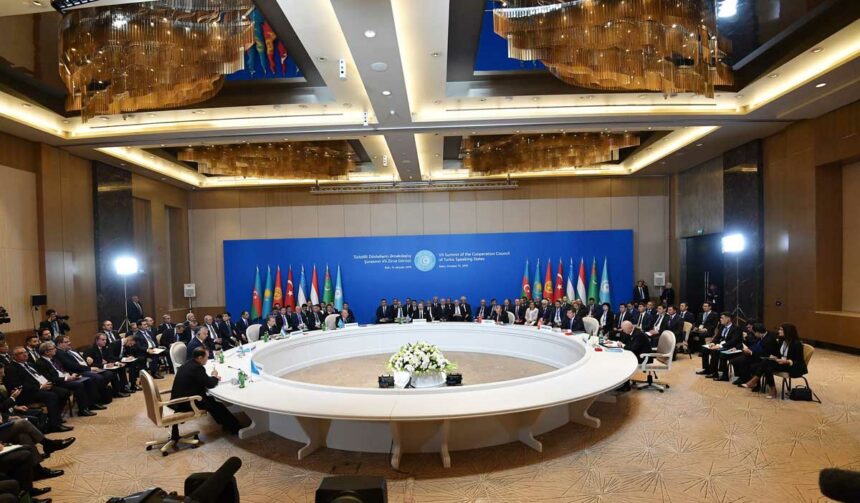
On November 3, 2023, the 10th Summit of the Organization of Turkic States (OTS) commenced in Astana, the capital of Kazakhstan. This summit brought together the heads of state and official representatives from both full and observer member countries of the organization. During the summit, the heads of state signed various key agreements, including the OTS Tenth Summit Declaration. Additionally, pivotal decisions were made, such as declaring Astana as the “Turkish World Financial Center” in 2024 and Istanbul as the “Turkish World Financial Center” in 2025. Another significant decision involved granting the Economic Cooperation Organization (ECO) Observer Status before the OTS, demonstrating a commitment to expanded regional cooperation. Numerous other decisions contributing to the organization’s objectives were also signed during this summit.
As a result of the Astana Summit, member states adopted the comprehensive Astana Summit Declaration consisting of 156 articles. In the Astana Declaration, leaders expressed support for the continued institutionalization of the OTS and encouraged the strengthening of cooperation among its members under the umbrella of the OTS Secretariat. This indicates a willingness to merge or coordinate the activities of other subsidiaries that had previously operated with more independence.
The declaration emphasizes cooperation on political, foreign policy, and security issues. Within this context, the parties reaffirm their commitment to enhancing comprehensive cooperation and solidarity among the Turkic States within the framework of the OTS. Regarding economic and sectorial cooperation, the declaration commends the signing of the Agreement Establishing the Turkic Investment Fund (TIF) in Ankara on March 16, 2023. This agreement was signed by Azerbaijan, Turkey, Kazakhstan, and Kyrgyzstan. Notably, it has received approval from the parliaments of all signatory countries except Kyrgyzstan.
Since the collapse of the Soviet Union, cooperation between Turkic states (Azerbaijan, Turkiye, Kazakhstan, Turkmenistan, Uzbekistan and Kyrgyzstan) has gone through various stages and reached today’s organizational level. The initial seeds were planted at the Turkic States leaders’ summit in Ankara in 1992. This early cooperation later evolved into the Cooperation Council of Turkic-Speaking Countries (Turkic Council), formalized through an agreement signed in Nakhchivan in 2009. A significant milestone occurred during the 8th summit in Istanbul in 2021 when the council underwent a transformation. It rebranded itself as an organization, changing its name from the Turkic Council to the Organization of Turkic States (OTS).
The Azerbaijan Karabakh Victory in 2020, involving a founding member of the Organization of Turkic States (OTS), brought heightened attention to the organization. Consequently, interactions among the Central Asian Turkic Republics, Azerbaijan, and Turkey increased both bilaterally and within the framework of the organization. It is possible to say that after the victory, institutionalization and activity within the framework of OTS increased even more. The global geopolitical landscape, marked by the Russia-Ukraine war and the escalating US-China rivalry, has elevated the importance of Central Asia. The consecutive 5+1 meetings held in 2023 involving Central Asian countries, Russia, China, the USA, the EU, Azerbaijan, and Turkey underscore the increasing significance of the Central Asian Turkic states in global politics.
The main issues on the agenda of OTS is deepening and broadening institutionalization; increasing cooperation on foreign policy and security issues; deepening cooperation in the field of economy and trade and increasing cooperation in the field of transportation. Cooperation among the member states based on common culture and history, has now managed to write a common history book up to the 15th century, and studies on the period after the 15th century are currently being carried out. Studies are currently being carried out towards the use of the common alphabet.
The “Turkic World Vision-2040,” identified as a crucial document for the future of the OTS, aims to articulate a comprehensive vision for the establishment of a more effective international system. The vision underscores the importance of creating a cooperative and equitable representation while advocating for the promotion of universal values. In light of the prevailing international uncertainty, the document recognizes that regional organizations, bear increased responsibilities. It emphasizes the necessity for enhanced cooperation among member states to effectively address these tasks and challenges of the contemporary geopolitical landscape.
The document, which defines OTS’s future goals and objectives, is divided into four sections. This document’s ultimate purpose is to create integration and, eventually, unity among Turkish states. Some experts believe the intention is to build a supranational entity similar to the EU. In this perspective, it is feasible to see that the recent talks and agreements reached demonstrate unity and cooperation in many areas.
The Turkic World Vision-2040 has set targets in the field of Economic and Sectoral Cooperation, specifically ensuring the free movement of commodities, capital, services, technology, and people between Member States and strengthening cooperation between various economic regions to encourage intra-regional investments. Harmonization of industrial structures and integration of product markets among member states. Important agreements were made within the Organization in this direction to establish favorable conditions and reduce trade barriers, including the “Freight Transport Agreement,” “Simplified Customs Corridor Agreement,” and “Trade Facilitation Strategic Document.” It was agreed at the ministerial meeting to implement new generation instruments that will strengthen economic and commercial cooperation between countries, such as the signing of the Digital Economy Partnership Agreement between member states and the establishment of the TURANSEZ Special Economic Zone (Turkish special economic zone). The key objective here is to expand regional trade volume to 10% of overall trade volume of member states at this stage.
One of the key aims in the field of transportation and customs was to make the International East-West Central Corridor across the Caspian Sea the quickest and safest transportation route between the East and the West.There are three main reasons for attempts to establish transportation cooperation. First, to be an alternate route in the expanding trade routes between Asia and Europe; second, the closure the northern route due to the Russia-Ukraine war; and third, and most crucially, to boost trade and cooperation among the member states. Because without transportation lines, trade would not grow and economic dependency will not be created. As a result, they began work on the Middle Corridor in 2012. Initially, Azerbaijan and Turkey took the lead in this initiative, Kazakhstan eventually joined to this process too.
Although the OTS was established on a common foundation of culture and history, foreign and security policies have recently gained importance in tandem with the geopolitical transformation. It aims to establish a permanent structure to strengthen political cooperation. In addition to this, it has developed permanent mechanisms at the levels of the foreign ministry, national security councils, and intelligence ministries. Furthermore, at Azerbaijan’s request, the first meeting of heads of state was convened at the level of foreign policy advisors. As a result, the organization may act on common ground on issues affecting Turkic states. For example, they backed Azerbaijan’s territorial integrity and had a unified approach on the Israel-Palestinian conflict.
In recent years, it has also sought to expand multidimensional cooperation with regional and global organizations. The growth of multi-layered cooperation between European institutions, particularly the Visegrad Group, was stated as an objective in the 2040 Vision Act. The purpose in the field of security was to establish a network for cooperation and the exchange of data among Member States in order to address the risks of radicalization, violent extremism, Islamophobia, xenophobia, and terrorism, as well as ensure border security. In short, by focusing on global regionalization opportunities, OTS is transforming itself into a regional player of rising importance.
As outlined in the Turkic World Vision-2040, the primary objective for member countries of the OTS is integration. It can be said that there is a serious political will in all member countries on this issue. Integration will cover cultural, commercial and economic areas. Meanwhile, an agreement was reached to adopt a common foreign and security policy on issues related to the interests of the Turkic world. The declarations from the summit, statements by leaders, and the activities within the framework of the OTS collectively indicate a trajectory that aligns with the European Union (EU). Much like the EU’s model of integration, the OTS seems to be moving toward fostering closer cooperation and unity among its member states, reflecting a shared vision for the future.
Cavid Veliyev