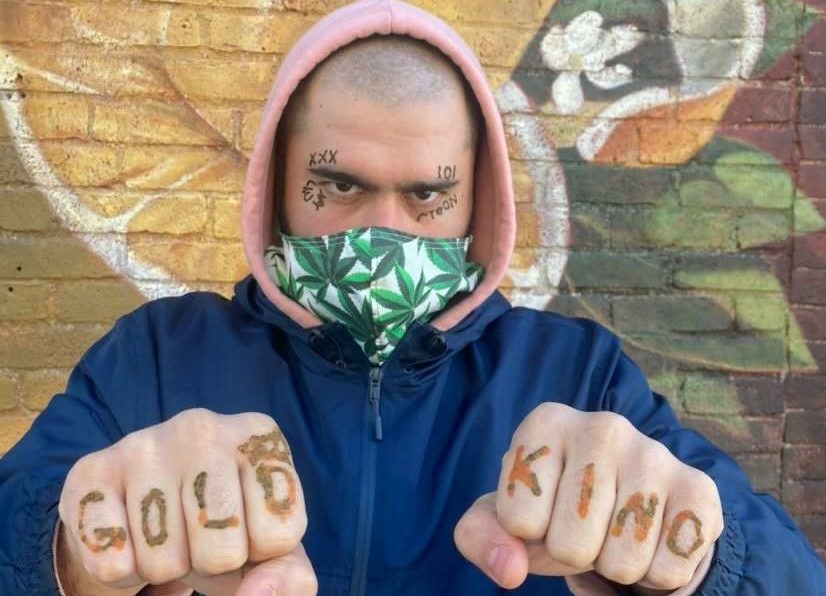
Orkhan, a few years ago you ended or took a break on your film career in Azerbaijan and moved to the US. What did you find in your new country? Are you happy? What are your plans?
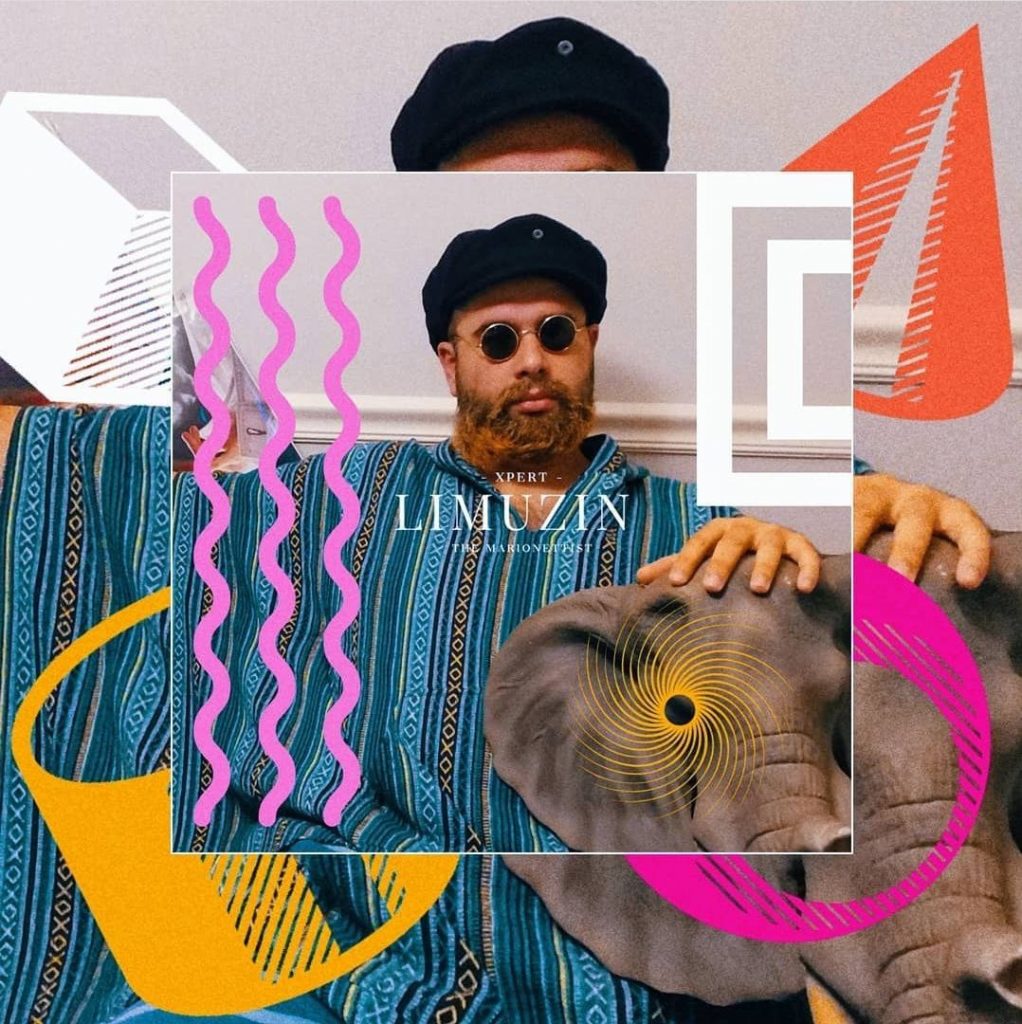
I did end my film career in Azerbaijan, that’s really what happened—I did not take a break. At least that’s how I feel. Despites the geographical changes, I still continue my acting practices one way or another. I think moving to USA was the right decision, I don’t regret it. And when it comes to happiness, I don’t want to give a dry answer to this but I guess I have to, now, does anyone really know the recipe? Is there a formula for it? Whatever I say, it’ll be conventional. More importantly, it’s easier and faster to get the finances that I need. Moving to USA brought a whole new wave to our team and triggered new dynamics. Apart from our main Youtube channel “101 Moon Ave”, our collaboration project with Xpert—“101 Moon Records” and “Krisha Show” that we started with my brothers are just a few examples. Also, the Mauser Show that we presented with you also holds a special place for me even though it was a short-term project. In general, AzLogos is a very dear platform to me, my interview with Lars von Trier was also published here. I consider all of these as important components of my portfolio. By the way, Krisha Show is getting ready for a new season, with new updates. We are working on the changes at the moment.
You’ve done multiple different projects with Hip-Hop artists, you’ve been in some of their music videos and even rapped at some point. How do you see your role and your position in the world of Hip-Hop?
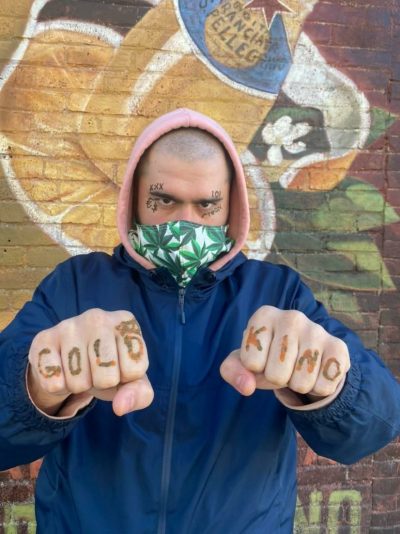 I see myself as a professional or at least trying to be a professional manager/organizer so I’m working with several artists at the same time and improving it. As I mentioned above, along with representing Xpert, I have also established a partnership with OGB. Another partnership we have is with Russ Cru$h’s label North Side which is based in Canada. It’s a new partnership and we are trying to create value together, in other words, trying to monetize the music. Officially I’m working at 101Moon Records, my job is to create visual concept. I’m not on my own, I have Ayxan Tan with me and other Azerbaijani and foreign art directors partnering with us as freelancers. We are together for quality sound and better visuals, we want to contribute something to Hip-Hop culture. Giving interviews is not one of my best skills, so this is all I can say about the rap world and my jobs.
Okay, let’s stray away from all that and talk about realities of Azerbaijan. The war is over, guns are relatively quiet, and we have made some kind of agreement with Armenians. Are you happy with the consequences? What was the reaction to war and its outcome in the US? What were they discussing, or still are?
There is nothing unusual or marginal about my attitude to this conflict: it is crystal clear to me who is in the right and who is in the wrong. The collapse of diplomacy took the conflict to the battlefield, which was to be expected. The right side, that is, Azerbaijan, was also the strong side this time, so it got what it wanted or most of what it wanted on the battlefield.
Now Im more interested in the process of returning people to the lands they belong to, the lands they or their parents fled from in early 1990s. Technically, there is going to be a whole new settlement, a fresh start, a new page. I wonder how they are going to organize it, how are they going to build the new villages, cities? Considering that the whole world is watching, that many countries will be directly participating, I think it will need a great deal of quality and vision and, of course, safety measures must be taken.
For instance, people often say Shusha is the culture capital of Azerbaijan. I wonder how Shusha is going to regain that status after decades, what is going to make Shusha a culture capital, and if it is going to be possible at all. Is it going to be a dynamic, lively city where people, ordinary people reside or a synthetic sanctuary of a sort, an open-air museum with aqlay-faced buildings? I mean, is it going to have a soul or is it not? That’s what I’m wondering, really wondering.
As for reactions from fellow Americans, there were many but the main one was “What do you mean Azerbaijan is having a war within its own territory?” For the descendants of colonizers, there was something strange, something inexplicable about it. We would refer those who really wanted to know what was happening to some of the trusted sources, sharing useful articles, links. We lack so much when it comes to trustable sources, the ones without the stink of propaganda, this is probably not a secret to you. I also have to mention that Reza Deghati’s Instagram account was of great help. Seeing the conflict through Reza’s stories and photographs, some Americans were able to get a better idea of who was right and wrong in this war. Of course, in our favor. On the other hand, my Brazilian friend from Brussels who works for the UN wrote to me saying that there was a flood of e-mails from Armenian organizations, almost bombarding them with their narration and propaganda. We kept close contact until the war ended, we talked almost every day where he was trying to hear our side of the story.
I tried my best to convey the information in a trustworthy way. In my opinion, I did something helpful in the fight to deliver the truth, even if it sounds idealistic and romantic. I can say that this war had a very serious impact on my heart and spirit. Some things can’t be articulated, let them stay with me.
We last met in person in Copenhagen in 2015. At that time, you were preparing for film school, EFC (European Film College — ed.). Later you graduated from that school. This school should have been a serious turning point in your film career. That’s what you told me. So, what happened? Are you satisfied with your education?
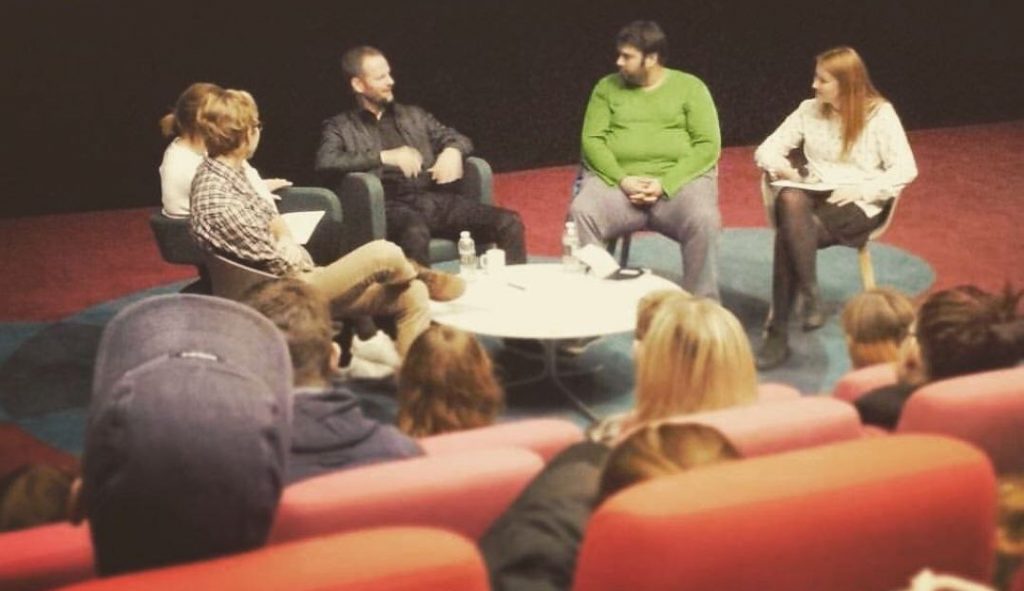
I am one hundred percent satisfied because I had an opportunity to get quality education. EFC showed me more than one way to become an author, taught me techniques and methodology, and broadened my creative horizons. I became a professional taking lessons from masters like Petru Maier, Micah Magee, James Fernald, Pia Bovin, Chris Waitt, whom I will never forget and will always appreciate. School is a very important stage for a creative person. By the way, I had also received an offer to star in Chris Waitt’s film, just before I graduated, and after graduation we made the film. I am looking forward to the premiere with great excitement. Another thing I considered a success was my screenplay, which was selected as a workshop at the Los Angeles Film Festival. And, of course, the fact that the film The Island Within, directed by Ru Hasanov, won the Best Director award at the Sarajevo Film Festival is one of the most important stages in my career as an actor. I competed for the Best Actor award at the festival.
Interestingly, before our conversation, to prepare for the interview, I looked at the website of the school where you graduated, social media accounts, but I never found any information about you. Well, at the very least, I didn’t see there what you have just told me. How is this possible? Doesn’t the school care about the achievements of their students and graduates as actors and screenwriters? Or were greater achievements expected of you?
It is very strange that some topics are really difficult to express verbally, no matter how much you think about it. For example, your question requires an answer that the Danes will not like for one reason, and our readers for another reason.
The Danes won’t like it because the artificial political correctness of the Europeans requires them to remain silent on such issues. Our people will not like it because of their awe and desire to be in your shoes, that is, “You have lived and studied in a country like Denmark, and you are saying something like this? I wish I were you, but I’m not as lucky.” In general, Azerbaijanis without European or Western experience, and post-Soviet people in the broadest sense, demand only one thing from their compatriots who do have it: “Tell me fantastic, beautiful things so that I can listen to you with my jaw hanging, don’t tell me anything negative, don’t ruin my imaginary world. I live in the worst place, in the worst country, so I can’t stand you saying negative things about Europe, the West, my ideal.” By the way, Europeans also know this and use it expertly. Therefore, as many post-Soviet people as possible should experience Europe and the West, so that blind infatuation and fascination credit are exhausted, a real image emerges in everyone’s brain, putting an end to the Westerners’ luxury, this a priori positive characteristic comfort. I must also say that what other people think about them is very important to them, more than we can imagine. They know how to hide it, pretending they don’t care who thinks what, but they are terrified when someone exposes their anatomy, when someone reads them like a book, when they reveal what is hidden in their depths.
To be honest, I didn’t expect such a detailed answer. It’s as if you needed such an explanation beforehand to justify or validate what you were about to say after.
You got it right, so be it. When it comes to specific Danes, we need to understand one thing: for a Dane, the “world” is his own little Denmark. Even the boundaries of his “home,” his “family,” his “self.” Outside of this world, the “sphere of enemy domination” begins. After all, the outside world is not only alien, but also a world that threatens the Danes. There is no country to which the Danes are positive, or at least neutral. There is no other country or people with a positive image in the Danish media and mainstream other than themselves. That is to say, the Danes’ self-loathing and discriminatory, negative attitude towards others, their peculiar, odd jealousy are indescribable to me. I admit that I find them difficult to explain. You probably have to live there to understand that, otherwise you can’t put it into words.
Prejudice: the Danes work only with each other, they do not let non-Danes into their world. They also prefer their own language in the international environments. For example, you see a Danish teacher who speaks in his/her own language to an international audience, ignoring foreign students. This is very common. Their belief in their superiority is so strong that you can’t bring them down to earth. Day and night, the media is busy with the propaganda of superiority—the propaganda of the supreme race, as bad as it sounds. You and your identity are both alien and uninteresting to them. If you succeed all of a sudden, you will be envied and even hated. By the way, I’ve read somewhere that Denmark is the country where most foreigners commit suicide in Europe.
I don’t know if I was able to answer the question or not. I don’t want to give such a banal answer as “envy”, I am disappointed in my pride, but what can I do, it is called envy, jealousy.
If the excitement of talking about this makes you forget who you are talking to, this must be a really painful and sensitive issue for you… You forget I have been living in Switzerland for almost ten years and I will say that the Danes are angels compared to the Swiss. I have to. Or I might say I wish we could switch places. No need to go far, look what tourist reviews say about the Swiss, look at their image of world literature and cinema, and then look at the Danes. You won’t find much about the Danes, but I can confidently say that no one loves the Calvinist Swiss. Objectively, they are extremely unlovable people and they could give an envy master class to the Danes …
That is possible. Everyone’s evaluations are based on their experience. It is normal.
 You are right. Let’s get back to the school. You know, I didn’t find your name on the “our successful students” list when I searched for it, but I learned by chance that the EFC was rife with sexual scandals. It is a typical scene and a typical reaction. Long story short, do you not regret choosing this school? Maybe, like in the West-East dilemma in the interview with Lars von Trier, you should have chosen the East? Do you think that European and Western art is not exhausted? Strict rules are introduced in cinema, black people, sexual minorities and the disabled get the parts, the art of political correctness reigns supreme… Is art possible in the environment of neo-liberal ethical fascism?
First of all, I must say that choosing this school was the right decision. I have no regrets. I went through a serious training, the school’s founder is Milos Forman, and there is a living legend like Werner Herzog on the board. There are also old Hollywood companies that supported the school, such as Walt Disney and Warner Brothers. There are many more names, these are the ones that come to my mind now.
As for the sex scandals, this is a typical scene and a typical reaction, as you say. Such things often happen in the West, especially in closed, religious institutions, and the reaction is always as if this happens the first time, as if this is something foreign to these societies, something anti-flesh, something unusual, while it actually isn’t. Most of all, this sex scandal seems ironic, against the backdrop of the school ignoring the achievements of its non-Danish students. It’s really funny and sad at the same time. It was not good for the EFC to be mentioned in such a low-level scandal.
The Swedes have a nice saying: only dead fish float downstream.
The East-West choice, as Lars von Trier puts it, is based on many years of experience. Speaking of myself, even though I live in the West, I am the East, I represent the East. The world accepts this, and so do I. The West may be exhausted in terms of subject matter, as they themselves admit—suffering, angry, but unable to resist the flow, unable to do so by themselves and their clichés. I have learned the mechanism and discipline of work in the West, I have benefited from it, and this is what a professional artist needs. The rest is mainly the West’s own problems, they know better. The current situation is that the West is rapidly advancing towards the peak of self-censorship, boxing itself in, virtually stalled and exhausted. I completely agree with you, you made a very interesting statement: neo-liberal ethical fascism is incomparable to the freedom and mystery of the East.
You can’t find here potential themes of the recent Karabakh war, even if you bring the whole of the West together. It needs work.
Interview by Alekper Aliyev
Aze.Media