Both Baku and Yerevan have shown interest in restoring a railway link along the Araxes River. Azerbaijan’s President Aliyev has pushed for the reopening of the section across Armenia’s Syunik Region to transit between Azerbaijan’s Nakhchivan Autonomous Republic and mainland Azerbaijan. This thrust translated into point 9 of the ceasefire agreement, which states that “transport connections in the region shall be unblocked,” and specifically that Armenia shall allow transit between Nakhchivan and mainland Azerbaijan. It also translates into the project of reconstructing the Horadiz–Aghbend section of the Araxes Rail Link, for which President Aliyev laid the foundation in February 2021. On March 20, Armenia’s Prime Minister Nikol Pashinyan pointed out that reopening transit across Nakhchivan and Syunik would also benefit Armenia by providing “a reliable railway and land communication with [Russia] and [Iran].”
This memo argues that the European Union could play a chief role in supporting this project. The EU could notably draw from its experiences in border management support in sensitive areas, including in the former Soviet Union. Along with assisting in border crossing management, the EU could also contribute to financing the infrastructure and supporting confidence-building to pave the way for a broader normalization of relations between Yerevan and Baku. The involvement of the EU would require that both sides agree to cooperate, and to request EU assistance.
Birth and Disintegration of the South Caucasus Railway Network
The South Caucasus railway network was built between 1865 and World War II, and slightly expanded in the 1980s and 2010s (see Figure 1). Due to the territorial conflicts that emerged with the dissolution of the Soviet Union, several sections of the network have been idle for the last three decades, hampering cross-border trade and regional development (see Figure 2).
Figure 1: Timeline of Construction of Cross-Border Railways in the South Caucasus
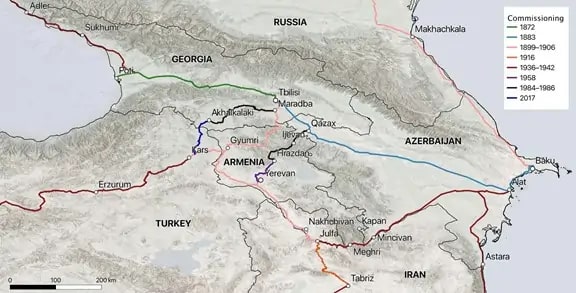
Notes: Location names are as per Wikipedia. Designations employed here do not imply the expression of any opinion from the authors concerning the legal status of any country, territory, city, or area, or of its authorities, or concerning the delimitation of its frontiers or boundaries. Sources: Database of Global Administrative Areas; Openstreetmap; Google Maps; ESRI World Hillshade (figures by the authors from open-access data).
Figure 2: The Current Status of Cross-Border Railways in the South Caucasus
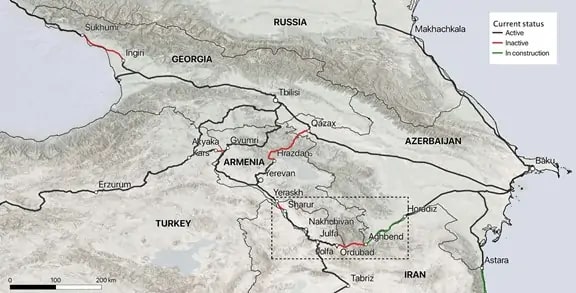
Notes: Location names are as per Wikipedia. Designations employed here do not imply the expression of any opinion from the authors concerning the legal status of any country, territory, city, or area, or of its authorities, or concerning the delimitation of its frontiers or boundaries. The dashed rectangle highlights the area covered by Figure 3. Sources: Database of Global Administrative Areas; Openstreetmap; Google Maps; ESRI World Hillshade.
Benefits From the Araxes Rail Link
Facilitating Armenia’s foreign trade
In the late 1980s, about 85 percent of Armenia’s imports were shipped by rail, mostly from Russia and through mainland Azerbaijan and Nakhchivan. Russia remains Armenia’s top source for imports (29 percent in 2019), with bulky products such as petroleum, base metals, and cereals accounting for about $300 million of Armenia’s bilateral imports. As railway shipping is particularly economical for such products, the Araxes Rail Link would thus lower shipping costs for Armenia’s imports from Russia. Conversely, Russia is Armenia’s second-largest export market (22 percent) after the EU. Exports to Russia also include products that could be shipped by railway, including Armenian Brandy (28 percent of bilateral exports) and textiles (12 percent), together accounting for about $290 million per year.
Reopening the Araxes Rail Link could provide momentum to reopen the Gyumri–Kars railway. The Gyumri–Kars railway would not only facilitate trade between Armenia and Turkey, but also between Nakhchivan and Turkey, providing an additional incentive for its reopening. As of 2019, Turkey was Armenia’s fifth-largest supplier, with imports from Turkey reaching $255 million (5.1 percent of imports). Geopolitics aside, the additional cost caused by the crossing of Georgian territory is among the main impediments to Armenian exports to Turkey. The reopening of the Gyumri–Kars railway would be conditional on normalization of relations between Yerevan and Ankara, which Armenian and Turkish leaders have recently called to revive.
The Araxes Rail Link would also offer access to cheap, long-distance shipping from the Southern part of Armenia’s Syunik region. The border between Armenia and Azerbaijan was never properly delimited. As a result, certain sections of the road linking Yerevan to the Iranian border are objects of territorial disputes. As Azerbaijan took control of its territories adjacent to Karabakh following the ceasefire agreement, it has established checkpoints along the road between Goris and Kapan, constraining transit from, to, and across the Syunik Region. This situation has also created tensions with Iran, as Iranian truckers use the road for trading with Armenia and Georgia. The Araxes Rail Link would offer an alternative, which could contribute to reducing current tensions. The Araxes Rail Link would notably facilitate shipping large volumes of metal ores from Syunik.[1] It would also support the development of the Meghri Free Economic Zone (FEZ), established in 2017 on the border with Iran. The FEZ aims to attract foreign investment, develop manufacturing, agro-processing, and logistics businesses, capitalizing on Armenia’s preferential access to Russia’s market (via the Eurasian Economic Union, EAEU) and to Iran’s market (via the free trade agreement under negotiation with the EAEU).
Facilitating transit between Nakhchivan and mainland Azerbaijan
Since the 1990s, transit between Baku and Nakhchivan has only been possible through Iran (700 km) or through Georgia and Turkey (1,200 km). The Araxes Rail Link would cut transit distance to about 550 km and provide a cost-effective transportation mode for bulky products and long-distance shipping. It would support the development of Nakhchivan. Due to prohibitive transport costs stemming from its isolation, Nakhchivan’s mineral resources can hardly be exploited, including molybdenum, lead, and marble. Similarly, income from barley, cotton, tobacco, and wheat exports are eroded by the high transport costs. For consumers, isolation inflates prices, particularly for imported products.
Putting the South Caucasus at the heart of a Persian Gulf–Black Sea rail link
The Araxes Rail Link would lower freight costs for trade between Armenia and East Asia and between Azerbaijan and East Asia. South Caucasus imports from East Asia are currently mostly unloaded at Poti, in Georgia, and brought to their destination by truck. East Asia accounts for 17 percent of Armenia’s imports and 10 percent of Azerbaijan’s imports. Unloading these goods in Iran’s Bandar Abbas port would shorten a journey from Shanghai to Yerevan or Baku by about 25 percent or six days.
Using preliminary but conservative assumptions and assuming that 30 percent of trade between Armenia and Russia would be reallocated from road to rail ($650 million per year), the Araxes Rail Link would avoid the emission of at least 40,000 tons of CO2 per year—1 percent of Armenia’s annual emissions.
By providing an alternative transport route, the Araxes Rail Link would also provide relief to Vekhny Lars, the only land border crossing point between Georgia and Russia. Although a tunnel is under construction to bypass the 2,379-meter high pass along the road, the border checkpoint will remain a bottleneck, with trucks forming lines sometimes up to 30 km.
Supporting prosperity and confidence-building in the South Caucasus
The three South Caucasus states have pursued conflicting geopolitical agendas over the past twenty years. Georgia has engaged in Euro-Atlantic integration since the 2003 Rose Revolution, notably through the signing of the Deep and Comprehensive Free Trade Agreement (DCFTA) with the EU in 2014 and greater cooperation with NATO. On the other hand, Armenia is part of the Russian-led EAEU and Collective Security Treaty Organization. Azerbaijan has promoted an equidistant foreign policy, balancing relations with Russia and the West while strengthening ties with Turkey.
If successfully implemented, the Araxes Rail Link would demonstrate that practical technical cooperation is feasible even between conflicting parties, thus contributing to broader peacebuilding in the South Caucasus and supporting regional stability and prosperity. Russia has undeniable clout over the Nagorno-Karabakh conflict, as enshrined in the ceasefire agreement. However, this does not exclude an EU involvement in its settlement. In fact, the press secretary of the Kremlin stated that: “if mediation efforts bring stability and predictability, and facilitate the implementation of the existing agreements, they should be welcome.” And Russia has already accommodated EU border assistance missions in conflicted areas of the former Soviet Union, including in Transnistria.
Mechanisms, Requirements, and Potential EU Support
The Araxes Rail Link requires rebuilding 180 km of railway, including 90 km that Azerbaijan has committed to reconstructing. The railway is still active at both ends of the rail link—between Yerevan and Yeraskh in Armenia, and between Horadiz and Baku in mainland Azerbaijan (see Figure 3). Between Yeraskh and Horadiz, 130 km between Sharur and Ordubad (Nakhchivan) are still active, leaving 190 km to rebuild, and Azerbaijan has announced the reconstruction of the 110 km Aghbend–Horadiz section. This leaves 80 km to rebuild: 35 km in Nakhchivan (Heydarabad–Sharur, and Ordubad–Armenian border), and 45 km across Syunik.
Figure 3: The Current Status of Sections of the Araxes Rail Link
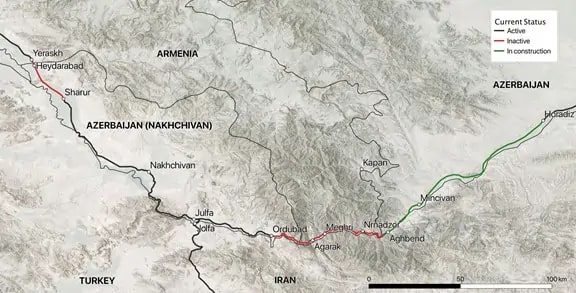
Notes: Location names are as per Wikipedia. Designations employed here do not imply the expression of any opinion from the authors concerning the legal status of any country, territory, city, or area, or of its authorities, or concerning the delimitation of its frontiers or boundaries. Sources: Database of Global Administrative Areas; Openstreetmap; Google Maps; ESRI World Hillshade.
The railways inactive since the early 1990s have been dismantled, but rights of way and earthworks have mostly been preserved. As a result, the cost of rebuilding the railway should be lower than for building new railways, possibly under $2 million per km. For Armenia, this would represent an investment of about $90 million for the 45 km in Syunik. For Azerbaijan, the cost would be around $70 million for the 35 km in Nakhchivan, besides the reconstruction of the Aghbend–Horadiz section.
The EU could contribute to the financing directly or via the European Investment Bank (EIB), which is already financing part of the Gyumri–Yerevan highway. The EU could also leverage the voting power of its members in multilateral development banks. An EU contribution to the implementation of the ceasefire agreement would contribute to stability and prosperity in its Eastern Partnership region. EU involvement would also give new impetus to the Eastern Partnership. Moreover, it would be directed towards two countries with which the EU has not signed a DCFTA—the highest stage of trade and cooperation agreement.
An EU technical contribution to the resumption of the Armenia–Azerbaijan railway connection would (1) provide technical expertise to the law enforcement agencies (LEA) in charge of border management in both countries, and (2) develop confidence-building measures aimed at facilitating cooperation between these agencies—a prerequisite to the resumption of train traffic. As a first step, a needs assessment mission could be first proposed to Yerevan and Baku by the European External Action Service (EEAS).
The EU has set up several border management programs in its wider neighborhood, in the framework of its Common Security and Defense Policy (CSDP). These programs include three European Union Border Assistance Missions (EUBAM): in Moldova and Ukraine (2005), Rafah (2005), and Libya (2013). Since 2007, the EU has also provided border management support to Kosovo and Serbia through the European Union Rule of Law Mission in Kosovo (EULEX).
EUBAM Moldova and Ukraine provides the most relevant experience for EU support to the Araxes Rail Link as it intervenes in a context that shares features with the conflict between Armenia and Azerbaijan. Since it was launched in 2005 at the request of both Moldova and Ukraine, EUBAM Moldova and Ukraine has contributed to the Transnistrian conflict settlement process through a technical approach. It played a key role in facilitating transit across the Transnistrian region. It assisted with the negotiations for resuming train services between Chisinau and Odessa, in 2010 for passengers and in 2012 for cargo, after it had been suspended since 2005. EUBAM also contributed to making these train services more attractive by supporting LEAs from Moldova, Ukraine, and the Transnistrian region by simplifying border crossing procedures. Suggestions by EUBAM notably led to joint customs clearances and controls. EUBAM also contributed to the reopening in 2017 of the Gura Bicului–Bychok Bridge, which connects the Transnistrian region to the rest of Moldova and which had been closed to vehicle traffic since 1992.
EUBAM Moldova and Ukraine has also contributed to confidence-building measures. It facilitated the establishment of 11 working groups—including on transports, customs, and infrastructure—gathering representatives of LEAs from both sides, together with EUBAM experts.
Potential Issues and Risk Mitigation Features
Ensuring a minimal level of trust and cooperation between LEAs is a prerequisite to the resumption of rail traffic. Since the independence of both countries in 1991, such cooperation has never materialized, in a wider context characterized by the absence of bilateral diplomatic relations and the fact that the border is closed and still mostly not demarcated.
The EU could leverage its experience to achieve cooperation among LEAs. In an initial phase, the EU mission could serve as an intermediary between the LEAs from both sides, which would perform customs controls and clearances on their respective sides of the borders. Then, the EU could support the gradual implementation of integrated border management measures, by which border police and customs inspections would be jointly implemented.
The EU could also support the establishment of a conflict management system. A conflict management system would include pre-established communication channels mediated via the EU mission as well as a multi-level institutional issue resolution framework, drawing on the experience acquired by the EU through its EUBAM programs. Another way to prevent tensions is the prior establishment of a reciprocal list of products allowed for transit through Nakhchivan and Syunik by a dedicated bilateral working group with the EU’s technical support.
According to the ceasefire agreement, transit between Nakhichevan and mainland Azerbaijan through Armenian territory “is to be overseen by the Border Guard Service of the Russian Federal Security Service.” The roles of the EU mission and of the Russian Federal Security Service should be clearly defined to avoid any confusion. This would require clarifying the extent to which Russian LEAs would intervene in the transportation process. There is, however, a successful precedent as the presence of Russian peacekeepers along the boundary between the Transnistrian region and the rest of Moldova has not prevented EUBAM from operating.
The EU mission should also engage with neighboring countries in a broader discussion forum. While the EU mission should proceed from a trilateral agreement with Armenia and Azerbaijan, a broader discussion framework should also involve Georgia, Russia, and Turkey, focusing on broader connectivity issues in the South Caucasus.
Conclusion
Following the ceasefire agreement that ended the Second Karabakh War in November 2020, leaders in both Baku and Yerevan have expressed interest in unlocking regional connectivity. The EU would be well placed to facilitate the resumption of this railway connection, thanks to the experience acquired from various EUBAM missions, particularly in the Transnistrian region. EU involvement would be consistent with its thrust to support stability and prosperity in the framework of its Eastern Partnership.
Emmanuel Dreyfus is a Russia Research Fellow at the Institut de recherche stratégique de l’École militaire (IRSEM), France, and a Visiting Fellow at the Institute for European, Russian, and Eurasian Studies (IERES) at The George Washington University.
Jules Hugot holds a PhD in economics from Sciences Po Paris (Paris Institute of Political Studies).
[1] Three of Armenia’s largest mines are located in Southern Syunik: the Kajaran copper and molybdenum mine, the Kapan gold mine, and the Ankasar copper mine.