After the peace process between Armenia and Azerbaijan became derailed at the end of 2022 – despite much optimism and hope invested in the possible peace deal throughout the year – it was fortunately revived with the combined efforts of the EU and the United States in May-June 2023. Some experts refer to this as ‘the single most active period’ in the post-war talks.
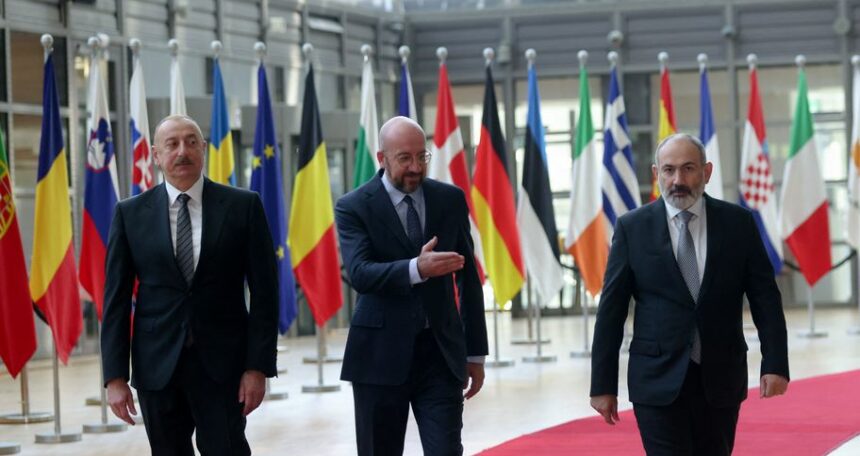
The revival has become very dynamic and produced a series of meetings along both the Western (EU/US) and Russian tracks, as well as in informal settings: the leaders and high-ranking officials of the belligerent nations have met in Washington, Moscow, Brussels, and most recently in Chişinău and Ankara.
The returned optimism was accompanied by and led to bold statements such as the one made by US Secretary of State Antony Blinken, who claimed that ‘the sides are within reach of an agreement’ in early May, following the Washington-hosted session between Armenian and Azerbaijani foreign ministers. Azerbaijan’s Ambassador to France Leyla Abdullayeva went even further and predicted the signing of a peace agreement in the Moldovan capital during the European Political Community summit in early June.
The resumption of the peace process went parallel to another episode in the evolution of the Armenian discourse on Karabakh with Yerevan open to discuss the acknowledgement of Karabakh as part of Azerbaijan. This evolution has impacted the relevant narratives of Brussels: during his May press conference, Charles Michel, the EU chief who usually hosts the talks between Ilham Aliyev and Nikol Pashinyan, has also referred to 29,800 square kilometres and 86,600 square kilometres, the territorial sizes of Armenia and Azerbaijan respectively. Note that the aforementioned figure, the total Soviet-era area of Azerbaijan, includes Karabakh.
While the rhetoric of involved officials and prognosis by experts are promising, the entire peace agenda based on five principles agreed upon by Azerbaijan, with Armenia proposing to add its own (mutual recognition of territorial integrity, mutual refraining from territorial claims, mutual refraining from use of threats, delimitation and demarcation of borders, and opening transport and communications) may be hard to achieve in one instalment. In this context, the opening of transport and communication routes could be the more realistic and less painful item in terms of implementation within this normalisation, despite conflicting statements by Armenian and Azerbaijani officials.
A sense of urgency
Driven by a sense of urgency, Azerbaijan is apparently hurrying to reach a peace deal with Armenia and wants to move with big leaps toward the reintegration of Karabakh for several reasons.
Baku is eager to materialise its post-2020 war upper hand into a tangible result while Russia, which traditionally sees the entire South Caucasus as its own backyard and has established its presence in Karabakh after the Second Karabakh War, is stuck in Ukraine. Regardless of the outcome of the war in Ukraine, Russia`s comeback to the region can be expected: as a winner, the Kremlin might be more assertive in consolidating its power in the post-Soviet space. The worst-case scenario in Eastern Europe might also trigger Russia to switch its attention to more vulnerable targets in order to make up for its losses in Ukraine.
With Baku perceiving the rise of a new conflict in the South Caucasus, it feels the urgent need to finalise the Karabakh/Armenia chapter of its contemporary history: the Azerbaijani-Iranian confrontation, which is to dominate the regional geopolitics in the coming years, will certainly absorb more energy and resources from Baku.
Moreover, the Azerbaijani side wants to make the peace agreement happen while the government in Yerevan is run by Pashinyan, who is a more convenient counterpart to deal with and seems readier to prepare his population for hard decisions and compromises with Azerbaijan. One of the undesirable scenarios for Baku could be the activity of radical factions in Armenia, despite their marginal support, who can stir up domestic politics and lead to big changes in the government, as Armenian political culture has demonstrated several times in recent years.
Although the Western and Russian powers (traditional mediators in the Armenia-Azerbaijani talks) had usually been on the same page – one of the rare cases of international collaboration between them – in the Karabakh case, they may be engaging in a zero-sum game. While the Russians are interested in preserving the status quo and, as Vladimir Putin once offered, to leave the problem for future generations to deal with, so that he could keep his leverage on both Armenia and Azerbaijan and maintain Russia’s military foothold in Karabakh, the EU and the US seem to seek speedy solutions to the conflict to reduce Russian influence in the region. At the same time, the US and some EU countries insisted on internationalising the Karabakh case, and, by addressing the rights and security of the Armenians in Karabakh, getting compromises from Azerbaijan for autonomy.
Considering Karabakh solely a domestic issue, Baku, in turn, is quite reluctant to internationalise the conflict. Having never had full sovereignty over its de jure territory since its independence in 1991, Azerbaijan is adamant to reintegrate the territory step by step and to get rid of the Russian troops. By avoiding the empowerment of the Armenian community as it was done in 1923 when autonomy was granted to Nagorno-Karabakh, Azerbaijan does not want to repeat past mistakes and create another time bomb. The international mechanisms are not welcomed by Baku either as the elites and expert community in Azerbaijan are certain that these mechanisms will reflect geopolitical interests and not altruistic ambitions of external powers.
A paradox of peace through war
According to the Azerbaijani perception, all tangible progress within the Armenia-Azerbaijan context during and after the 2020 war has usually happened thanks to Baku`s political and military pressure. Aliyev claims that the Armenian side is only interested in preserving the status quo and procrastinating the negotiations – as it had done during the Interwar period (1994-2020) – until more favourable geopolitical conditions arise for itself (such as the internationalisation of the Karabakh conflict, more Western or French involvement in favour of Armenia, the weakening of Azerbaijan`s key allies Türkiye, Israel, etc.). Thus, Azerbaijan may put on standby coercive measures when it comes to the Armenian compromises regarding the border demarcation or Karabakh. The Lachin checkpoint was the latest one in the list of such coercive steps.
This leads us to a paradoxical pattern that the Armenian-Azerbaijani normalisation process contains: the closer the common vision of peace, the higher the tensions and the probability of military escalation. On the one hand, it seems that peace between Azerbaijan and Armenia has never been closer or as Azerbaijani Foreign Minister states that the countries are ‘at the doorstep of a peace treaty’. On the other hand, the ambiguity (according to the Azerbaijani perception) of the Armenian position on Karabakh, border demarcation and transport lines challenges this progress. For instance, the afore-mentioned statement by Pashinyan about Azerbaijan’s 86,600 square kilometres which include Karabakh came in a package with a condition: the rights and security of the Armenians of Karabakh must be secured through Baku-Khankendi dialogue and international mechanisms.
According to some expectations, Moscow could be interested in and trigger another round of escalation by using illegally armed forces in order to derail the normalisation process between Baku and Yerevan and to further legitimise its military presence in Karabakh. This is why there have been discussions on and calls for a ‘preventive and counter-terror campaign’ in Karabakh in closed discussions and sometimes public statements in Baku.
Thus, the low-level violence and exchange fire between Armenian and Azerbaijani military amid the intensive diplomatic efforts for normalisation in recent weeks should not come as a surprise. The military bodies of both countries reported fighting on several days in June and traded mutual accusations of provocation.
Ahead of the next meeting, either between foreign ministers in Washington or between the leaders in Brussels, the Armenian-Azerbaijani peace talks have been marked by significant dynamism: both progress, which can lead to a tangible result (opening of transport lines or a peace deal) and tensions, which can explode into a new episode of flare-up.
Rusif Huseynov