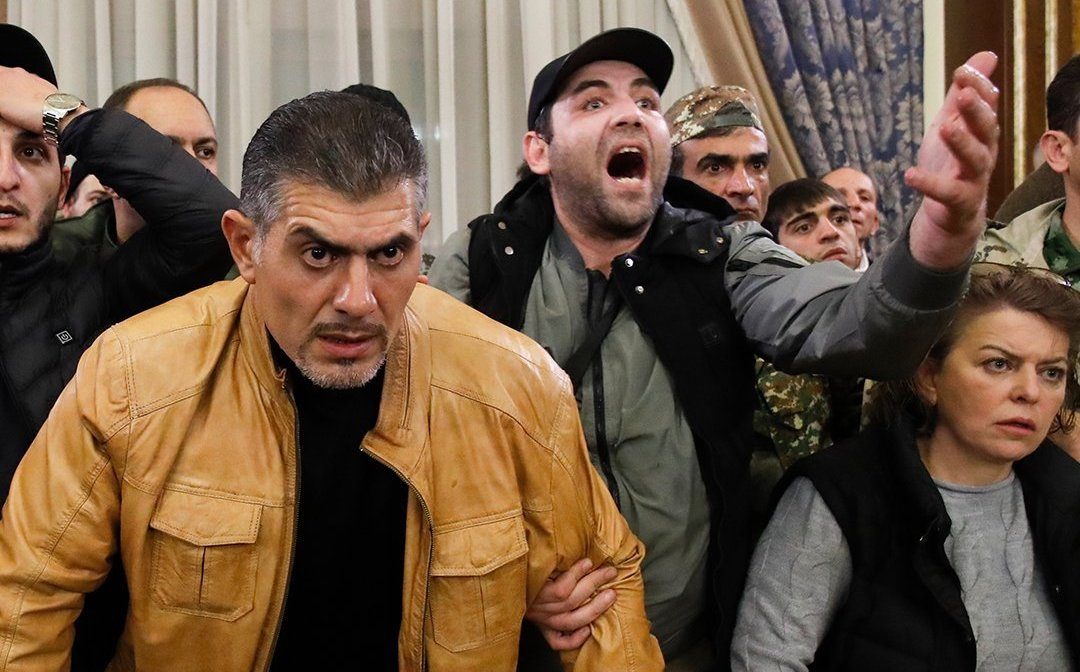
Armenia is living in a state of “countdown” to the parliamentary elections scheduled for June 7. Nikol Pashinyan has officially nominated a candidate for prime minister from his party. The campaign machinery of both the ruling Civil Contract and its opponents is running at full capacity. Political tensions are rising—this is evident even from a recent incident at the entrance to one of the churches, where the head of government was nearly struck on the back of the head.
Predicting in March–April the outcome of elections set for June is a thankless task. Still, one may ask: how will events unfold if the revanchists win? For example, supporters of Robert Kocharyan or Samvel Karapetyan? Their campaign slogans certainly provide plenty of material for reflection. Pashinyan’s opponents, it should be recalled, promise not only to normalize relations with Russia. More importantly, at least from Azerbaijan’s perspective, are the constant accusations that Nikol Pashinyan is a “traitor,” that he is “carrying out political orders from Baku,” and so on. And, of course, all of this is generously seasoned with talk of “different conditions for peace.”
There is a form of falsehood: to speak what seems like the truth, but in such a way that the listener is bound to misunderstand you. Perhaps some in Armenia imagine a “dream scenario”: Robert Kocharyan or Samvel Karapetyan wins the elections, restores previous relations with Moscow, and returns to the “Kazan document,” the “Lavrov plan,” or something similar. However, the reality is that the issue of Karabakh has already been resolved and closed. Azerbaijan has restored its sovereignty over its entire internationally recognized territory, the occupying junta has been dissolved, some of its leaders are serving sentences in Baku, while others have fled to Yerevan. Russian peacekeepers have been withdrawn from Karabakh. In such circumstances, expecting a revival of previous settlement plans is not just a mistake—it is a reminder of the well-known saying that while everyone dreams, the most dangerous are those who dream with their eyes open.
Another point is also clear—and perhaps the most important one. Election rhetoric has its own rules, but once in power, leaders of a revanchist bloc will be bound by their previous statements about “better peace conditions,” the “traitor Pashinyan,” and “carrying out Azerbaijani orders.” They will no longer be able to simply sign an agreement prepared by the “traitor” Pashinyan.
However, any attempts to alter the terms of the peace agreement—which, it should be recalled, has already been initialed—would mean derailing the peace process. Azerbaijan does not play a “double game” itself and does not allow its counterparts to do so. As repeatedly emphasized in Baku at the highest level, the agreement was not with Pashinyan personally, but with Armenia. With revanchists who try, by any means, to “adjust” the results of Azerbaijan’s military and diplomatic victory, Baku simply will not engage in dialogue—with all the consequences this would entail for Armenia.
This has been said many times since Armenia’s final defeat, but it bears repeating: today, a peace agreement is far more necessary for Armenia than for Azerbaijan. Azerbaijan continued to develop successfully even when 20% of its territory was under occupation. During those years, the “Contract of the Century” was implemented, the Baku–Tbilisi–Ceyhan pipeline was built and launched, the Southern Gas Corridor was practically prepared for operation, and a modern, well-equipped army was created—one that ultimately fulfilled its main task by liberating Karabakh. As for attempts to launch a new “military scenario” in the region—something Pashinyan himself has warned about—this would be a true catastrophe for Armenia. If in the early 1990s, when the world had not yet decided whether to treat the former Soviet republics as fully independent states, such scenarios could go unpunished for the aggressor, today the situation is entirely different. Any such moves would be met with an immediate response.
All that remains is to hope that Armenian voters will have the prudence not to vote for a nationwide catastrophe.
Nurani