Azerbaijan and Kazakhstan share similar economic visions and goals aimed at enhanced growth and diversification of hydrocarbon-dependent domestic markets. Both countries have been broadening their economic strategies by shifting from the oil and gas sector to agriculture and trade in bilateral cooperation.
Baku and Astana want to use this opportunity to realize their plans for diversification and gain more influence regionally and internationally.
The Trans-Caspian International Transport Route (TITR), also known as the Middle Corridor, has gained significant attention and importance amidst the Russia-Ukraine conflict. TITR is considered a viable alternative to traditional routes between Europe and China and provides Europe access to the growing markets of Central Asia and the Caucasus region. Azerbaijan and Kazakhstan are also aware of the potential that the Middle Corridor carries and are interested in utilizing such an opportunity to concurrently strengthen their own economies and regional ties.
Azerbaijan and Kazakhstan perceive refocusing from the oil and gas industry to other economic sectors as a way to strengthen not only the economic security of domestic markets but also that of the wider Caspian region. Diversified bilateral relations between these two countries can lead to increased regional influence and economic sovereignty. The Azerbaijan-Kazakhstan reinforced partnership represents a major connection between the South Caucasus and Central Asia. These two regions have been struggling to maintain much needed regional connectivity ever since the collapse of the Soviet Union. However, amidst the war in Ukraine, growing U.S.- China tensions and significant geopolitical shifts in the Middle East have contributed to increased connectivity between the South Caucasus and Central Asia. Azerbaijan and Kazakhstan have remained the two leading nations when it comes to promoting and pursuing active regional foreign policy aimed at intensifying regional cooperation and productivity.
Reality and prospects of non-energy Azerbaijan-Kazakhstan relations
Although energy remains key to the Azerbaijan and Kazakhstan bilateral cooperation, non-hydrocarbon relations have gained more attention in both countries recently. Baku and Astana are interested in utilizing the current geopolitical opportunity to boost and enrich their bilateral cooperation. Both countries still consider energy a valuable foundation of their partnership and continue to grow their cooperation in the oil and gas trade. Both countries are exploring the potential to increase the transit energy volume.
In 2023, SOCAR, the state-owned national oil and gas company in Azerbaijan, and the Kazakh national energy company KazMunayGas signed an agreement enabling the transit of 1.5 million tons of Kazakh oil annually through the Baku-Tbilisi-Ceyhan (BTC) pipeline. Although currently non-operational, the Baku-Supsa pipeline is also considered in the Azerbaijan-Kazakhstan diplomatic talks for future significant transportation of Kazakh oil.
However, Azerbaijan and Kazakhstan want to follow global trends that emphasize diverting from the oil and gas industry and favoring alternative renewable energy and green technology. To satisfy such a tendency, both countries have to start diversifying their economies in a more comprehensive way. However, replacing hydrocarbon-based economies might not be possible in the near future, because of lucrative revenues and the need for significant investment and financial support to reconfigure existing energy markets and channels of energy production. Additionally, the oil and gas industry provides significant leverage to both countries, especially given the current geopolitical situation and sanctioned Russian energy exports. Europe is hoping for alternative energy suppliers and import routes, while developing its own renewable sources of energy and green technology solutions, a process that poses its own challenges.
For the sake of long-term prosperity and economic growth, Azerbaijan and Kazakhstan have to take further steps in developing other key economic sectors and bilateral economic cooperation. Baku and Astana have started developing and implementing joint projects in the digital field. One such project, which aims to improve the quality of internet connections in the countries of Central Asia and the South Caucasus, is the construction of fiber optic communication lines (FOCL) along the bottom of the Caspian Sea. As part of the broader Digital Silk Road project, the FOCL initiative concurrently contributes to enhanced bilateral digital cooperation between Azerbaijan and Kazakhstan, as well as digitalization and connectivity in the wider region, making the two countries important regional digital hubs.
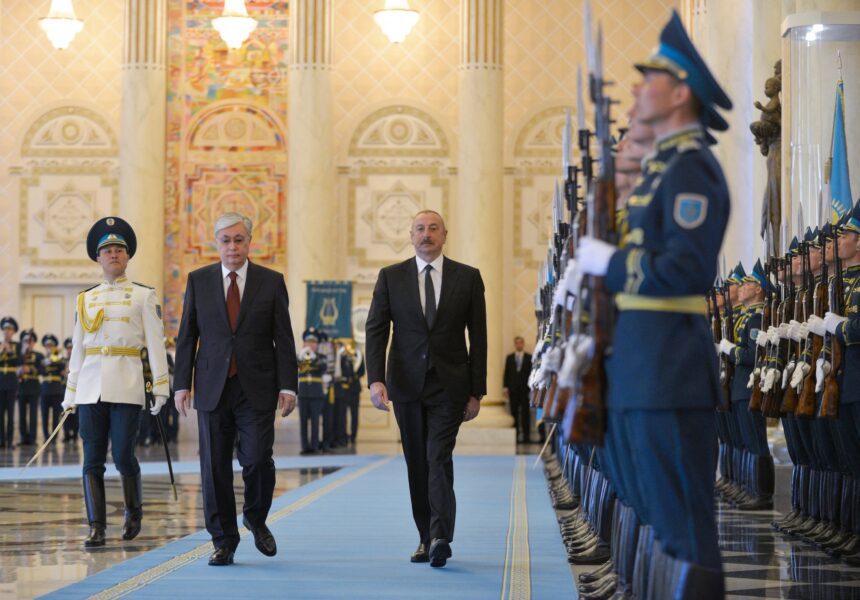
Azerbaijan and Kazakhstan have also achieved significant accomplishments in trade and economic cooperation, with bilateral trade rising by 40% to reach $500 million. Moreover, according to Kazakhstan’s President Kassym-Jomart Tokayev, the two countries can reach $1 billion in trade if they implement agreements that advance mutual trade and economic cooperation.
Baku and Astana place significant emphasis on the further development of the transport-logistics infrastructure along the Middle Corridor. The initiative is valuable and economically beneficial for both countries. Alongside the development and diversification of domestic markets in Azerbaijan and Kazakhstan, regional economic interaction and business flourish as the Corridor becomes more active and operational. European leaders have shown great interest in the Middle Corridor because it provides a much-needed alternative route to the traditional Northern Route. For Azerbaijan and Kazakhstan, the Middle Corridor represents an important opportunity to strengthen relations not only between each other but also with Europe, which is perceived as a significant market for economic growth and cooperation.
Even though non-energy relations between Azerbaijan and Kazakhstan are worth developing and investing in, a few issues need to be considered while assessing the prospects of such cooperation in the future. First of all, replacing energy-based markets in both countries is unlikely to happen in the foreseeable future. The oil and gas industry will remain a key factor in Azerbaijan-Kazakhstan bilateral relations. Both countries are not yet ready to transition away from profitable oil and gas production and the geopolitical advantages of being important energy exporters and suppliers.
However, Azerbaijan and Kazakhstan have recently started investing more seriously in non-hydrocarbon bilateral relations. Sectors such as transportation, ICT, agriculture and trade are still not developed enough to replace or even equalize the oil and gas industry in either country. In the transportation sector, Azerbaijan and Kazakhstan have praised the opening of the Middle Corridor, which would bring intensified trade and business, including non-energy products, not just between these two countries but across wider regions as well. However, this route still requires significant investment in logistics, security and infrastructure. Due to the current transportation uncertainties on the Northern Corridor, Azerbaijan and Kazakhstan have the opportunity to expand their seaports and transit networks to accommodate the Middle Corridor’s operations.
Seaport developments also carry certain limitations: the part of the Middle Corridor that passes through the Kazakh Port of Aktau and enters the Port of Alat/Baku in Azerbaijan is considered a serious congestion point that hinders effective transportation and needs considerable investments. The solution requires improvements in either port’s transshipment capacity, and increase in the number of cargo ships, which can be difficult to resolve in the near future. Nevertheless, the rising demand for the Middle Corridor favors development and connectivity between Azerbaijan and Kazakhstan as well as the wider Caspian region.
The thriving bilateral relationship between Azerbaijan and Kazakhstan is mirrored in the undertaking of ambitious joint digital projects, frequent senior official visits and the signing of numerous memorandums of understanding. Officials in Baku and Astana have shown great interest in enhancing bilateral cooperation, especially in non-energy areas. Even though diversification and shifting away from traditional oil and gas cooperation can pose challenges to both countries, Azerbaijan and Kazakhstan have shown readiness to embark on such an ambitious plan and strengthen their positions through strategically tailored bilateral relations.
Nina Miholjcic-Ivkovic, a researcher based in Serbia with a background in international relations and diplomacy.