As global supply chains move away from Russia-dependent routes and congested maritime chokepoints, the Middle Corridor – stretching from China to Europe via Central Asia and Türkiye – is emerging as a major Eurasian trade artery, strengthening Türkiye’s role as a central hub connecting East and West.
The corridor spans from China’s Lianyungang province through Kazakhstan, across the Caspian Sea, Azerbaijan, and Georgia, before reaching Türkiye. It is increasingly seen as an alternative to Russia-dependent routes and traditional maritime pathways, which face rising costs and security pressures.
Institutional coordination accelerated after a 2013 agreement among Kazakhstan, Azerbaijan, and Georgia, with China later joining the framework. The completion of the Trans-Kazakhstan railway and the 2017 launch of the Baku-Tbilisi-Kars line enabled uninterrupted rail travel from China to Europe. Meanwhile, the long-discussed Zangezur Corridor, linking mainland Azerbaijan to Nakhchivan via Armenia, remains under negotiation but could further streamline trans-Caspian connectivity into Türkiye.

Freight volumes surge as transit times fall
A Boston Consulting Group report released in November noted that global trade lanes are being restructured amid rising Suez Canal risks and geopolitical pressures on Russia-based routes. Cargo volumes transported through the Middle Corridor rose 62% in 2024 to 4.5 million tons and are projected to reach 5.2 million tons by year-end.
Transit-time savings are among the corridor’s biggest advantages. While China-Europe routes via Russia now take 20-25 days, and maritime options stretch to 35-45 days, the Middle Corridor averages about 18 days. Experts believe further harmonization of customs, expanded Ro-Ro capacity on the Caspian, and full utilization of rail infrastructure could reduce transit times to 14 days.
Türkiye’s expanding intermodal capacity
The strategic partnership agreement signed by Azerbaijan and China in October is regarded as a critical step in scaling up the Middle Corridor, committing both sides to closer coordination on customs, logistics and multimodal infrastructure aimed at speeding cargo movements and improving overall route reliability.
Türkiye’s strategic role has become more visible with the first train departure from the new Railport intermodal terminal in northwestern Kocaeli province in November. Once fully operational, Railport will handle 360,000 TEU containers, 1.5 million tons of general cargo, and 125,000 trailers annually, significantly reducing transfer times between Europe and Asia.
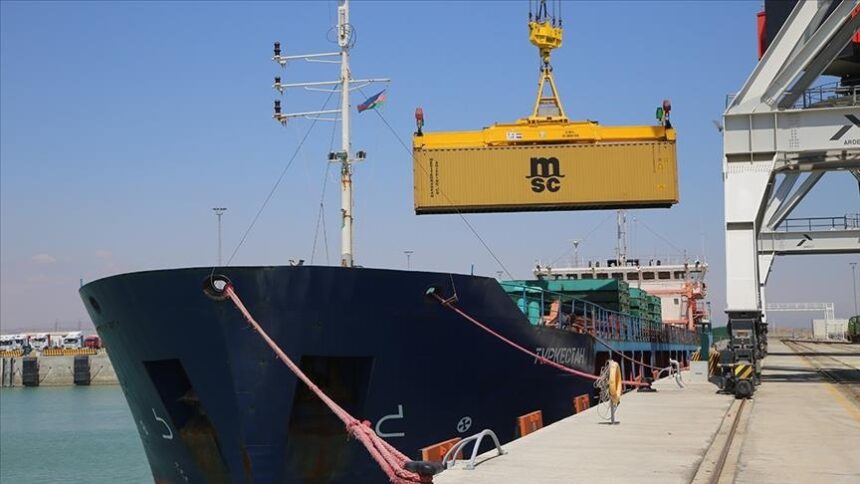
Türkiye, Kazakhstan, and private-sector partners have signed a memorandum of understanding to expand multiparty Ro-Ro operations on the Caspian Sea to alleviate bottlenecks. Port expansions in Aktau, Kuryk, and Baku are also underway to increase regional throughput. The EU has assessed the corridor as a “strategic alternative” for Europe, with capacity projected to reach 11 million tons by 2030 if issues like rail-gauge differences and border procedures are resolved.
Türkiye turns geography into strategic power
Ergun Ariburnu, chairman of OMSAN Logistics, said shifting global supply chains are amplifying the corridor’s importance and transforming Türkiye from “a transit country” into a “full-fledged logistics hub.”
“Türkiye’s greatest advantage is its unique geography,” Ariburnu told Anadolu. “Its position at the intersection of Europe, Asia, the Middle East, the Caucasus and North Africa makes it a natural crossroads for trade and logistics.”
Ariburnu said this advantage has now evolved from a map-based reality into “a strategic power” that directly affects energy flows, trade and freight costs.
“In recent years, the expansion of multimodal transport infrastructure has turned Türkiye into a critical hub on both the east-west and north-south axes,” he said.
“At the same time, Türkiye’s strong industrial and manufacturing base enables not only transit traffic but a two-way, sustainable flow of trade. Türkiye is moving steadily toward becoming not just a country that goods pass through, but one that actively shapes the Middle Corridor itself.”
Ariburnu said full digitalization across the route, enabling real-time tracking, unified customs procedures, and integrated booking systems, would reduce uncertainty and inefficiencies.
“Türkiye has the infrastructure and experience to play a leading role in designing and managing this digital integration. As OMSAN Logistics, we position ourselves within this framework,” he highlighted.
‘Türkiye should position itself as a standard-setting actor’
Ariburnu noted that as geopolitical shifts accelerate, logistics has become not just a matter of transportation but a strategic economic and security lever.
He said Türkiye should reinforce its logistical advantage by “sustaining strategic infrastructure investments, increasing the share of rail transport and strengthening port-rail integration.”
“Türkiye needs to be not just a participant, but a standard-setting and agenda-shaping actor in projects such as the Middle Corridor, the Development Road and the Zangezur Corridor,” he added.
‘Viable, independent pathway’ for Central Asia
Eric Rudenshiold, senior fellow for Caucasus Affairs at the Caspian Policy Center, said the Middle Corridor has become “one of the most strategically significant trade routes of the 21st century” because it offers Central Asia and the South Caucasus “a viable, independent pathway to global markets that does not run through Russia or China.”
He noted that the region’s landlocked economies had long depended on transport links through Russia or China, exposing them to political pressure, opaque pricing, and limited access to Western markets.
“Since the imposition of sweeping international sanctions on Russia after its second invasion of Ukraine, Russian export routes became economically restrictive and politically risky. The Middle Corridor is an indigenous effort to link Central Asian countries across the Caspian Sea to Azerbaijan, Georgia, Türkiye, and soon Armenia through an alternative passageway that is both insulated from sanctions and geopolitically more stable,” Rudenshiold said.
He said the corridor gives regional countries true economic sovereignty.
“Through this route, states can connect directly to Türkiye and, from there, to European and Mediterranean markets,” he said, adding: “The region can bypass the ‘middlemen’ that once controlled transit, dictated fees, and influenced commodity prices. Central Asian exporters can now tap into global markets and establish commercial relationships on competitive, transparent terms. This shift enables producers – whether of energy, strategic minerals, agricultural goods, or manufactured products – to capture more value at home.”
The route also strengthens the region’s negotiating leverage. With access to alternative markets, Rudenshiold said trans-Caspian states are now “better positioned to negotiate with larger neighbors on their own terms, defending national interests and reducing vulnerability to external pressure.”
Türkiye’s indispensable role
Rudenshiold said Türkiye’s industrial and logistics capabilities, when linked with Central Asia’s production capacity, position the broader region as an increasingly important node in global supply chains.
“Sitting at the western terminus of the Middle Corridor and acting as both a regional power and a NATO member, Türkiye provides the political stability, infrastructure, and market access needed to connect Central Asian and Caucasus economies to Europe and the wider world,” he said.
Pointing to Türkiye’s ports, railways, energy terminals, and growing involvement in strategic minerals as key assets that make large-scale trans-Caspian trade feasible, Rudenshiold said: “Türkiye becomes not just a transit point but a central economic partner shaping the next phase of Eurasian connectivity.”
Türkiye’s logistics ambitions rise with railport
Rudenshiold said Türkiye’s expansion of intermodal capacity, including the launch of Railport, signals that the country is emerging as “one of Eurasia’s most important logistics hubs.”
“What differentiates Türkiye’s approach today is not only investment in hard infrastructure…but its commitment to partnering with Central Asian and South Caucasus states on an equal footing,” he said. “A resilient East–West artery requires shared ownership, shared standards, and shared benefits.”
He added that the proposed US initiative, Trump Route for International Peace and Prosperity (TRIPP), could integrate the South Caucasus more deeply into the Middle Corridor and expand freight capacity and energy-transmission potential.
To strengthen its position along Eurasia’s logistics spine, Türkiye should focus on several priorities, Rudenshiold said. These, he added, include harmonizing customs procedures, integrating digital trade platforms, supporting multimodal freight hubs, and deepening energy connectivity with the Caspian basin.
AA