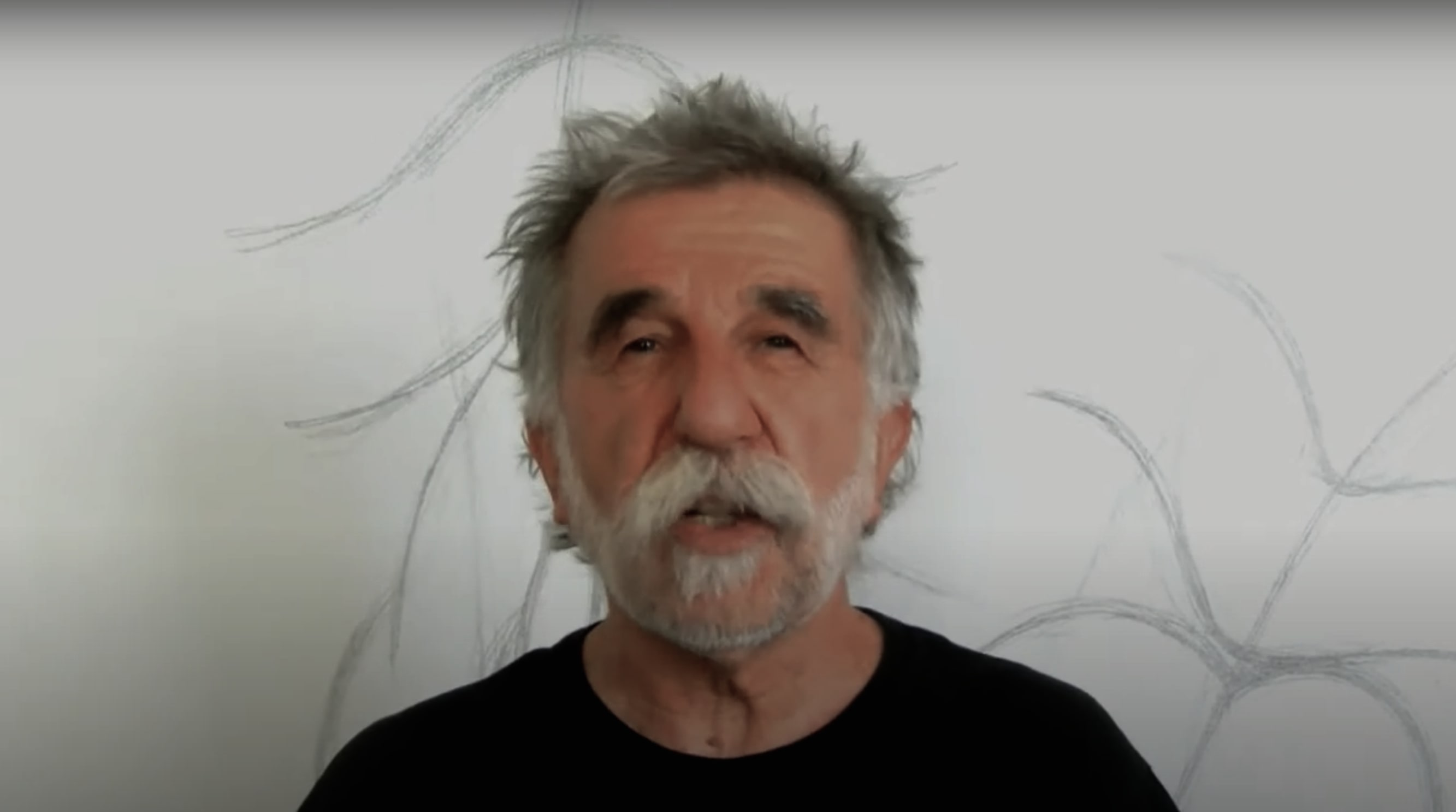
In 2001, at the invitation of the “Ministry of Culture” of the separatist regime established in the occupied territories of Azerbaijan, he arrived in Shusha as the first artist-in-residence from the Armenian diaspora and spent just over five months there. The man was so overwhelmed by his compatriots’ brutal accounts of the atrocities committed against Azerbaijanis that he moved around the city accompanied by a bodyguard.
Upon his return to America, he wrote a book, Savage Chic: A Fool’s Chronicle of the Caucasus, in which he recounted what he had witnessed in the cultural capital of Azerbaijan. Since then, some Armenians, including his own family, call him a traitor, while others call him the most honest Armenian writer.
In an interview with Media.Az, K. Onnig spoke about his trip to Shusha, his reaction to the beginning of the 44-day Patriotic War, the hope for peace between the Azerbaijani and Armenian peoples.
What was Shusha like in 2001?
The city was almost completely destroyed. On the main street there were only three ugly houses, built by rich Americans after the end of the First Karabakh War. These houses were completely out of place in the architecture of the “old” Shusha. The “minister of culture” [of the separatist regime] gave one of them to me. I lived in it and set up a workshop there. I wanted to teach doll-making to teenagers, so I put up ads on my fence for people who wanted to learn this art. In the end, I had only seven or eight students.
… Many houses in Shusha were ravaged and burned. Of the houses built by the Azerbaijanis, only one had survived intact. An Armenian businessman lived in it.
Why was it the only one left intact?
I wondered about that myself. The businessman told me he had served in the Soviet army in Kazakhstan back in the day. He went through his entire military service side by side with his Azerbaijani friend. When they were discharged, the Azerbaijani friend built this house in Shusha, while the businessman went to live in a village near Aghdam, but the two friends visited each other all the time. When the first Karabakh war broke out, the man knew that the Armenians were destroying Azerbaijani cities. That’s why he came to Shusha and literally with his own body defended the house of his old friend who was now a refugee, and after the war ended, he moved into it.
All the time I was in Shusha, he spoke with trepidation about his friendship with the Azerbaijani, saying he wanted to see him again, give him a hug… I heard dozens of these stories. Some Armenians missed their Azerbaijani friends. After all, they used to live next door to each other, gather around the same table…
How many people lived in Shusha at that time?
While the city’s population had once reached 17,000, in 2001 there were at most 1,000 people living there. And all of them lived in poverty, though it would be more appropriate to say they were surviving. After all, almost no money was invested there, those places were cut off from the rest of the world.
… One day my student was finishing a doll in the churchyard, when a bus full of tourists from the United States arrived. They were surprised to see the boy making art in the street of a ruined city, and they asked him why he was doing it. He replied that he was making them for sale. And I added that the price of such a piece would be $35 [AZN 59.50]. The Americans bought the doll. The child was over the moon because his father, a teacher, earned $30 [AZN 51] a month. The boy said that from now on he would often sit in this courtyard and make dolls in the hope that foreigners would come there again.
In Shusha, you moved around with a bodyguard. Why?
Imagine, Shusha is a cultural center, it had palaces, mosques and sculptures of astonishing beauty… Just look at Bulbul’s monument… And all this was turned into ruins by the Armenians. The Azerbaijani population was expelled, the streets were dead… When I met people in Shusha, I realized that every one of them was an accomplice to this terrible crime. They were proudly telling me how many Azerbaijanis they had killed and how they had killed them. It was unbearable to listen to this, so I made it clear that this was not something they could talk about in my presence.
Moreover, the locals were taking credit for murders that had never even happened. When members of the Armenian diaspora from all over the world and tourists from Armenia came, the man who took the life of one Azerbaijani would talk nonsense about how he had killed ten people. Armenians were coming there for these kinds of stories, they were eager to hear about the “feats” of their compatriots.
How safe do you think it is to be in a society where people talk about such crimes, as if it were nothing, even in front of their children! That’s why I was provided with a bodyguard, who was also my driver. Although he too had blood on his hands up to his elbows… Admittedly, he shared with me stories about his Azerbaijani neighbors and how they used to play in the same courtyard as children…
Some Armenians knew that even they were not safe living in Shusha. At first, I would leave my fence and windows open. But then I was told I should lock everything up, as the locals could easily break into the house…
Why so much hatred?
Armenians were taught from an early age that they must kill every Turk they meet and that Azerbaijanis are barbarians. Armenian children were indoctrinated with this.
Were you indoctrinated in the same way?
I too used to hate Turks when I was a kid. It consumed me from the inside, and it began to affect all areas of my life afterwards. But the good thing was that I realized that I could be angry at people, I could avoid talking to them, but I could not hate them…
… I traveled with my students all over Shusha, showing them the rich spiritual heritage of the Azerbaijani people and asking, “How can we call people with such a culture barbarians?” We went into mosques, into burnt houses, because there were beautifully painted walls and floors in every one of them … I was amazed. It’s unbelievable… You see, every corner of Shusha is a cultural object.
By the way, I have to show you something [takes out something]. This was in one of the mosques in Shushi. When I left for the US, I took this piece with me. I have had it with me all these years. In Shusha, I was always trying to pick up pieces of destroyed buildings right from the ground, to collect and preserve them, and tell stories about them in the future… It was emotionally difficult.
Why do you keep them in your home?
It is very important to respect other people’s culture. Armenians looked at Azerbaijani mosques as the enemy territory, they were unable to see in them the epitome of beauty. This is what my book is about. I ask in it: “How dare you go there and destroy the sacred places of another people? Just how sick as a nation can we become after that.”
Was Shusha the only city you visited in Karabakh?
No, I went to several cities, for example, Aghdam. I remember standing there on top of the minaret, where you could see the whole of Aghdam. And the city was completely empty, it had been razed to the ground… “Oh God, these people had to flee from their homelands overnight, I thought, and then I fell to my knees and cried. Why do people do this to each other?” That picture evoked such strong emotions in me, because I remembered my father’s story. At the age of four, he and his family were forced out of his home and chased into the Syrian desert, where he buried his two-year-old sister.
It is so hard now to forget the conflict between our peoples. So hard… But I am not giving up hope, because once upon a time Azerbaijan, specifically visiting Shusha, was my dream. And this dream came true.
Why did you leave Shusha after only five months?
The atmosphere of violence and horror that reigned in the city was weighing on me. I could no longer stay there. The last straw was an incident in a restaurant, when I was invited to Yerevan. I remember that some high-ranking Armenian officials were there that night. The then President Robert Kocharyan and Charles Aznavour [French chansonnier, composer, poet, writer and actor of Armenian origin] walked into the restaurant. After a while, an old (and probably drunk) friend of Kocharyan’s came up to them and apparently said something humiliating to him. Then Robert Kocharyan left together with his security detail. However, the bodyguards soon returned, took the offender to the toilet and smashed his head with their guns. Jazz music continued to play in the restaurant, and more than a hundred customers didn’t dare even move… It’s inconceivable. That’s when I finally realized that my life was in danger and decided to leave.
And when you came home, you chose not to keep quiet about the crimes you had witnessed…
Yes… I wrote a book, Savage Chic: A Fool’s Chronicle of the Caucasus, and I wanted to promote it in Armenia and Russia. Only 20 years after it was published, a student at the American University of Armenia translated it into Armenian and published it in Yerevan. The book is especially known in the eastern part of the country.
I do this because I try to live true to my conscience, to live honestly… When Armenians say something about Azerbaijanis, I tell them, “Do you know what our compatriots did in Karabakh? This cannot be erased from our memory.” At the same time, I never take either side, because I can understand both.
It would make me sad if this interview provokes negative emotions [tears up]. I am crying already… I do not want to become an even bigger enemy to Armenians or a superhero to Azerbaijanis. That is not my goal. As it is, I go to sleep every day, thinking that my own brother, my family are not talking to me, because, according to them, I am a traitor.
I want to become a revolutionary who will unite Azerbaijanis and Armenians without firing a single shot. People can help me, creative people are already doing that. I try to connect with both Armenians and Azerbaijanis, because I don’t discriminate between people based on their ethnicity. My heart is open to everyone, but that doesn’t mean I love everyone [smiles].
Will you be able to go to Armenia after these revelations?
I have not been to Armenia for a total of 22 years. In my book I wrote about the crime that took place in a restaurant in Yerevan. After Pashinyan came to power, I sent him a proposal to create in Armenia a monument to the man killed by Kocharyan’s security that night. Then I found out at the Armenian Embassy in the United States that I was banned from entering the country.
And would you like to visit Azerbaijan?
My wife says that even if I get an official invitation to Azerbaijan, she will never let me go. Maybe I will go to Azerbaijan if I take two bodyguards with me: one Armenian, one Azerbaijani [laughs].
Tell us how you felt when you learned about the beginning of the war in Karabakh in 2020?
The only thing I would picture at night was how the Azerbaijanis would come back and see their ruined houses. The thought broke my heart. I don’t keep track of what is happening in Karabakh now. But I hope that the Russians [the Russian peacekeeping forces temporarily deployed in the territory of Azerbaijan] are faithfully carrying out their mission.
By the way, when the war started, my team and I published a booklet in Armenian called “Where do we go from here” in Yerevan, translated into English and Russian. It contains an interview with my now grown-up student, who moved from Shusha to Yerevan in 2020 [after the liberation of the occupied territories of the Republic of Azerbaijan]. He talks in it about the ideas I had instilled in him and the other kids in 2001. For example, I kept telling them that you have to be human first, and only then you can represent your nation with your culture and traditions.
We thought that these words would be a good signal for the Russian peacekeepers. So, we decided to disseminate the booklet among them. The student who had translated my book and another Armenian (as you can see, not all Armenians are filled with hatred towards Azerbaijanis) were in charge of this mission. They went to Karabakh, to the territories controlled by the Russian peacekeeping forces. One day at the border they saw three young Azerbaijanis and gave them booklets too. A little dialogue ensued. I was shocked when I found out about it, because my work brought Armenians and Azerbaijanis together.
You believe that Azerbaijanis and Armenians can live peacefully in Karabakh…
They will live together again, but it will be with bitterness and sadness from the pain caused. There is no other option. Azerbaijanis and Armenians interact here in the US, why can’t they do it in Karabakh?! The main thing is to want to change and to start changing. I, for one, am longing for changes. I cannot wait to drive from Khankendi to Shusha, where there will be no more animosity.
In that interview with the student from Shusha, we asked him if he could live with Azerbaijanis. He answered, “It would be very difficult now.” But you could tell by his voice that he believed it was possible. After all, there are many examples in history when people of the same ethnicity and religion killed each other or exterminated other peoples. But now they live in peace as if nothing had happened, because those tragedies are in the past, and we should do our best to make sure we live safely in the present.
What could be the beginning of the changes you are talking about?
At the very least, it is necessary to start a dialogue not at the global level with the involvement of Russia, but between citizens. For example, an Armenian soldier stands guard at the border and sees an Azerbaijani passing by on the other side. Let them say hello to each other.
People should understand that there are problems more important than the number of people killed on both sides in the past, and then changes will begin to happen…
What do you mean?
The number of murders and suicides is on the rise all over the world, and incomprehensible events are taking place in various countries. And all of this is the handiwork of human beings. We should be crying every day because we are destroying the human race. It is time we started to think globally about a new level of efforts to save the planet. Otherwise, the changes that will come will be changes that none of us are ready for. This is not the kind of legacy I want to pass on to my grandchildren.
I am very concerned about children and their future. I love them so much, and I have even written several children’s books. Now I create toys based on the drawings of boys and girls under the age of eight from all over the world. I ask them to use their imagination and draw non-existent characters which I then bring to life. I would be delighted if Azerbaijani children also sent me their art. I will make and send them toys for free.
Leyla Eminova
Translated from Media.Az