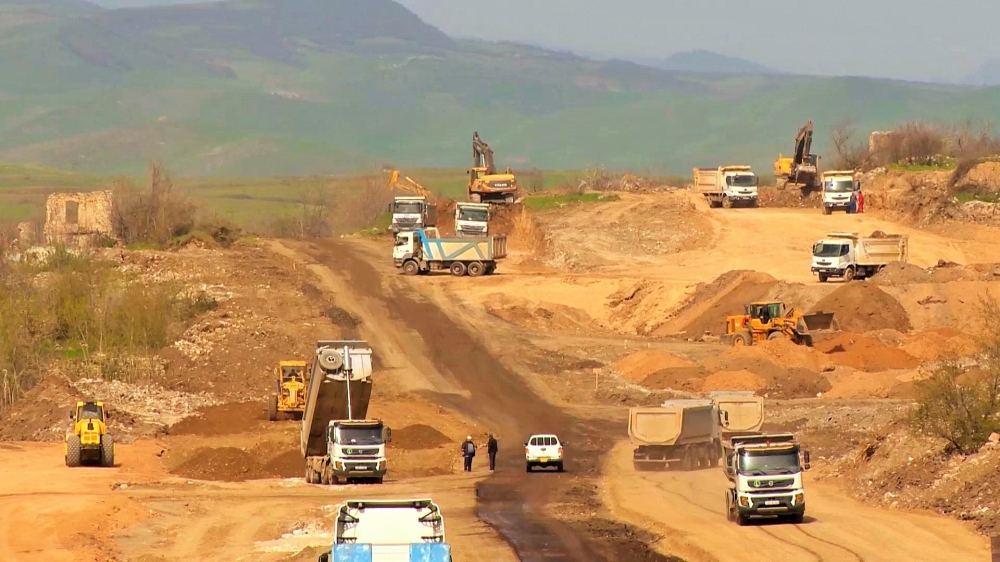
On November 16, the head of state signed a decree approving the First State Program of the Great Return to the liberated territories of the Republic of Azerbaijan. This ambitious document, which covers the period until 2026, envisages the implementation of a large-scale action plan in 25 areas. Hundreds of projects are to be implemented in various fields, first and foremost in economy, as the economic well-being of the liberated region largely determines how comfortable it will be for people returning there. The priority conditions for comfortable living are the availability of electricity, gas and water.
Electrical energy
The 100 MW Khudaferin hydropower plant and 40 MW Giz Galasi hydropower plant will be built under the State Program. By 2025 23 small power plants destroyed by the Armenian invaders will be rebuilt. Nine small power plants have already been put into operation: Gulabird, Sugovushan-1, Sugovushan-2, Kalbajar-1, Gasimli, Chirag-1, Chirag-2, Soyugbulag, Meydan.
Other renewable energy sources, such as solar and wind, are expected to be heavily used as well. The 240 MW Shafag solar power plant is to be built in Jabrayil. The relevant addendum to the executive agreement between the Ministry of Energy of Azerbaijan and BP of last year, aimed at joint implementation of the project for the construction of this facility, was signed in June 2022.
The overall renewable energy capacity of the liberated lands is estimated at 10,000 MW. The development of alternative energy sources will not only allow supplying the Karabakh and East Zangezur economic regions with electricity, but will also turn these territories into electricity exporters. The stakes in the development of “smart” cities and villages are also placed on renewable energy, but this work is currently at the research and evaluation stage.
One 500 KV, two 330 KV and eighteen 110 KV power substations are to be built by 2026, with about 1,200 kilometers of transmission lines running from them. The existing Shukurbeyli-Shusha, Dashkesan-Kalbajar, Gubadli-Zangilan, Khindiristan-Agdam-1-Agdam, Gulabird-Lachin and other power lines will get additional branch lines.
The Jabrayil energy hub and the infrastructure for integrating the Nakhchivan Autonomous Republic into the national grid will be built as part of the State Program. For this purpose, new substations will be built and existing ones will be restored, and about 1,500 kilometers of power lines will be installed.
Gas
The work for laying gas lines in the liberated lands began a couple of months after the end of the war. In terms of gas supply, the State Program of the Great Return also envisages large-scale projects. More than 600 kilometers of gas pipelines, 10 gas distribution stations and 11 gas compressor stations are expected to be built in the Karabakh and East Zangezur economic regions.
In 2025, a new 34-kilometer gas pipeline will run from Aghdam to Khankendi. In addition to the pipeline, SOCAR has been tasked with building gas compressor stations and branch lines. There are also plans to build Aghdam-Aghdara (21.8 km), Goradiz-Lachin (121.5 km), Goranboy-Kalbajar (99.4 km), Boyuk Bahmanli-Shusha (100 km) and other gas pipelines.
You may recall that the Karabakh economic region, including the city of Khankendi, was gasified by Azerbaijan in the 1980s. During the Armenian occupation, most of the utilities were destroyed. After the accident at the end of March this year, Azerigaz carried out some repair and renovation work on the gas pipeline going to the city of Khankendi. In subsequent stages, the gas infrastructure in all these territories will be completely rebuilt and improved by Azerbaijan in compliance with modern standards.
Water
Water supply is another essential aspect of the work aimed at ensuring the success of the Great Return. The State Program includes stage-by-stage construction of new and reconstruction and repair of existing reservoirs, irrigation and diversion canals, sub-artesian wells, waterworks and other water management facilities. Underground and surface water resources will be assessed, a database will be created and electronic maps of water resources will be drawn up. Bargushad, Hakarichay, and Zabukh reservoirs are to be built, the main canals of the Sugovushan reservoir will be rehabilitated, and so on.
Note that 6,426 km of water canals, 1,429 sub-artesian wells, 9 reservoirs, 7 bodies of water, 88 pumping stations, over 7,000 hydraulic structures and other water management facilities were under occupation. The overall water resources of the liberated territories of the country, including rivers, lakes and groundwater, are estimated at about 780 million cubic meters. This is almost a quarter of the country’s water resources. Such reservoirs as Khudaferin, Sarsang, Giz Galasi, Khachinchay, Ashagi Kondelen, Sugovushan, Kondelenchay-1, Kondelenchay-2 and Aghdamkend are located within these territories. The largest of them is the Khudaferin reservoir with a capacity of 1.612 billion cubic meters.
EXPERT OPINION
Azerbaijani economist Elshad Mammadov, Doctor of Economics, Professor, Head of the Department of Economics and Economic Relations at Odlar Yurdu University:
“The approval of the State Program of the Great Return by the President of Azerbaijan demonstrates that the work in the territories liberated from occupation is an unconditional priority for the head of state. For many years to come, the work in these territories will be an indisputable priority for the economic sector of the government and for the relevant executive authorities on the ground in terms of the implementation of state policy in the field of building the social, humanitarian and economic infrastructure.
“I believe that energy industry plays a very important role in the acceleration and sustainability of the Great Return, because it is essentially the linchpin of economic development. And there are very positive and encouraging prospects in this aspect.
“We should keep in mind that, on the one hand, the application of energy-saving technologies, of the energy efficiency mechanism, is what allows us to hope for efficient use of electricity in the liberated lands. And of course, there is a significant water potential concentrated here—according to some data, up to 25 percent of the total water resources of the country. The concentration of such amount of water resources in the liberated territories is a substantial impetus for the development of hydropower in the country. The potential of small hydropower plants is very competitive in the regional context. Moreover, we should not forget that for the development of a number of sectors, in particular agriculture and industry, of course, the availability of water resources makes it possible to effectively implement existing projects and those that will be initiated in the process of restoration of energy infrastructure and economic development in the territories liberated from the Armenian occupation.
“We should also keep in mind that there are very promising prospects for gas supply as well. And despite the fact that even though the territories liberated from occupation are supposed to use a significant amount of green energy, it will be almost impossible to do without gas, without traditional energy carriers. Let us not forget that gas production in the country is growing and allocating new volumes to domestic gas processing in the country will help to a large extent resolve the issues of social and economic infrastructure in the liberated territories. I believe that the gas potential, if channeled into the processing sector in an anticipatory format, will make it possible to obtain higher added value and will stimulate the creation of new jobs, thus contributing to solving the employment problems in the recovering region.”
Leyla Tariverdiyeva
Translated from Day.az