What peacekeeping scenario might they apply to Karabakh based on cases such as Transdniestria, Abkhazia, South Ossetia, Crimea, and Donbas? The absence of a comprehensive peace agreement complicates outlooks, fuels uncertainty, and keeps the door open to more conflict. The EU and particularly the United States have been rather “silent” about the state of affairs, with U.S. Secretary of State Mike Pompeo blatantly saying at the time, “We think outsiders ought to stay out.” Russian control over the secessionist region gives Moscow trading cards with all stakeholders, including with Turkey, which serves as the only neutralizing factor on Moscow’s calculus.
A Deadly War in the South Caucasus
One of the most tectonic, paradigm-shifting events impacting the South Caucasus was last year’s 44-day war between Azerbaijan and Armenia. On September 27, 2020, Baku reported shelling of Azerbaijani villages by Armenian troops located in Karabakh. Following reports of civilian deaths, Azerbaijan launched a counter-offensive operation along the entire line of contact to officially suppress the combat activity of the armed forces of Armenia and ensure the safety of the civilian population. The Armenian side claimed that Baku began the military operation with the launching of a massive offensive across the frontline of Karabakh.
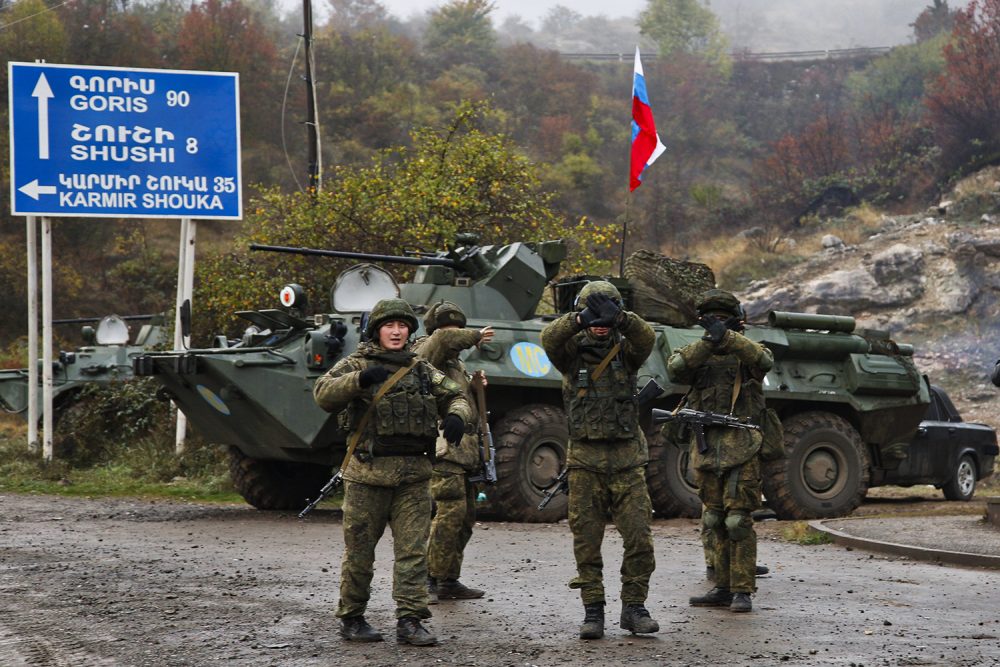
The war took the lives of around 3,000 Azerbaijani soldiers and 92 civilians, who were mostly killed by strikes of SCUD-B ballistic missiles, cluster bombs, and shelling of Azerbaijani towns and villages in Ganja, Barda, Tartar, and other places. The death toll on the Armenian side stood at 11 civilians and around 4,000 soldiers. The war almost ended on November 8 when Azerbaijani troops took the city of Shusha, which has strategic significance as Karabakh’s “capital” (known as Khankendi or Stepanakert in Armenia). Observing the defeat of its ally and seeing the imminent resolution of the Karabakh conflict, Moscow rushed to enter peacekeepers into the area. On November 9, the presidents of Russia and Azerbaijan and the Armenian prime minister signed a joint statement, which, among other points, envisions 1,960 Russian armed troops, 90 armored vehicles, and 380 motor vehicles deployed along the contact line—which includes the Lachin Corridor that connected Armenia to Nagorno-Karabakh. The zone of Russian peacekeeping and their posts along the Lachin Corridor can be seen on maps at the BBC and Caucasian Knot.
The agreement envisages the phased withdrawal of Armenian military forces from territories that would stay under Russian control: Agdam, Kalbajar, and Lachin. The agreement also made provisions concerning the return of refugees and internally displaced persons under the auspices of the UN High Commissioner for Refugees and the unblocking of the transport and economic routes in the region. For Azerbaijan, the November 10 deal was considered a victory, not least because the document did not mention any status for Karabakh, thus confirming Azerbaijan’s territorial integrity. The Armenians perceived the consequences of the war as catastrophic, destroying the myth of the invincible Armenian army, as well as changing the paradigm that the Russian army would rush to save its ally in the Caucasus. The double shock sent Armenian society into a deep political crisis impacting Prime Minister Nikol Pashinyan’s legitimacy, while jubilation took place in Azerbaijan.
Russians in Karabakh: We Are Back!
Russia has not “set foot” on Azerbaijani territory since 1992. For Azerbaijanis, the presence of about 2,000 Russian peacekeepers does not represent a military threat but rather has an “uncomfortable” symbolic and political effect. For their part, the Karabakh Armenian population will not become citizens of Azerbaijan or Armenia but will be under the direct supervision of the Russian military command. All of their security issues, local reconstruction efforts, as well as their relations with Azerbaijan, will be under the effective control of the Russian forces. From this perspective, the situation in Karabakh is analogous to that in South Ossetia before the August 2008 war, where Russian peacekeepers successfully “protected” local populations of the secessionist republic from Georgia’s reintegration efforts. Some experts had hinted at the possibility of Russian passports being distributed among Karabakh Armenians, a majority of whom have Armenian passports, which allows them to travel abroad.
It is in Russian interests to keep Karabakh divided, partitioned, or segregated, which would prevent the reintegration of the Armenian-populated territories with Azerbaijan. The Kremlin’s means would involve limitlessly “administering” security issues. Further, the Russian establishment would like to push Armenia away from partaking in direct negotiation processes and will represent the Karabakh Armenians themselves. The Russians will, however, press Armenia on recognizing Azerbaijan’s borders and will help with reconstruction efforts. Still, Karabakh is now a Russian trading card with Baku. Parts of northern Karabakh can be handed over piece-by-piece over the next decade in exchange for preferences or concessions in other areas, most probably economic but some issues may involve Turkey.
For the Armenians of Karabakh, the Russian intervention was a mixed blessing. Saving them from imminent defeat, the Russians successfully pushed Yerevan out of the discussion, and they are now directly subjugated to Moscow via peacekeepers. While Russian troops control and safeguard the Karabakh population, Moscow discourages them from reintegrating with Azerbaijan and uses them in negotiations with Baku. Also, the cost of supporting Karabakh Armenians will be primarily on Moscow alone since Armenia will financially abstain from supporting them over time.
The absence of the United States and EU during and after the war made the Russian monopoly in the region absolute. Moreover, the controversial positions of France and the absence of clear positions from other EU countries discredited the positions of Brussels in Baku, decreasing the level of trust. France, for example, accused Azerbaijan of starting the hostilities. Also, soon after the conflict ended, the French Senate adopted a resolution that infuriated Azeris on the “Necessity of recognition of the Nagorno-Karabakh Republic.” The Biden administration did not bring forth any new changes to U.S. policies in the region. One can discern that the EU and United States are on the slightly anti-Azerbaijan side, while one also cannot say they stand firmly on the Armenian side. Both Washington and Brussels have pushed for discussions on the status of the Karabakh Armenians, while Baku has said it has closed this chapter in all discussions.
Only Turkey is currently able to prevent Russia’s total dominance in Karabakh. Its influence comes through its ongoing support of Azerbaijan and its presence in the Joint Monitoring Center. Also, Ankara’s military support, such as the use of the notorious Bayraktar drones, shifted balances during the war. Turkey continues to strengthen Azerbaijan via joint military exercises, financial investments, and interference in Moscow-Baku negotiations. This large Turkish shadow over Azerbaijan prevents Russia from pushing Baku harder, for example on joining the Russia-led Collective Security Treaty Organization (CSTO) or Eurasian Economic Union.
Azerbaijan’s Stance: Strategic Patience Works
The victory in the Karabakh war proved that Azerbaijan’s long-standing policy of strategic patience works; a favorable moment arrived, and it changed a long-standing situation. The Russian involvement in the last stage of the war took away Azerbaijan’s full victory.
Either way, Azerbaijan’s policies will be concentrated in a few directions. Its first priority is the massive reconstruction of the territories as well as returning internally displaced peoples (IDPs). To be exact, removing land mines presents the largest danger of all. So far, since the end of the military actions, many, including dozens of Azerbaijani soldiers and civilians, have lost their lives due to mines. Azerbaijan has had to negotiate for maps of land mines, but thus far only received maps for two regions (Agdam and Fizuli). Without a doubt, reconstruction efforts would quicken if all parties cooperated on de-mining.
Meanwhile, the government of Azerbaijan, through its reconstruction efforts, will try to win the “hearts and minds” of the Armenians of Karabakh, showing them the benefits of being under Azerbaijan’s rather than Russia’s control. Thus, Baku will try to slowly turn Shusha, the oldest city and “capital” of Karabakh, into a small version of an Azerbaijani showcase city. President Ilham Aliyev announced in January of 2021 that “settlements recently liberated from Armenian occupation will be re-established based on the concept of smart city.” Although the area consists of small villages and towns, the idea envisions different, better governance systems and economic opportunities. With such modern terms and notions, the government hopes to draw displaced people back to the region.
Azerbaijan will continue to use a “strategic hedging” policy, trying not to yield to Russian demands of joining the CSTO or the Eurasian Economic Union. During a hard period of negotiations, Azerbaijan will draw Turkey in to shield itself from Russian pressure. One can say that the Shusha declaration signed between Turkey and Azerbaijan, as well as discussions about a Turkish base in Azerbaijan, serve the purpose of counterbalancing Russian influence.
A major priority in Baku will be to establish another transportation route to the West and especially to Turkey. Trying to benefit from the Chinese-led Belt and Road Initiative (BRI), Baku seeks to secure a railroad/highway corridor via Armenia to the Azerbaijani exclave of Nakhchivan. The name of the corridor in Azerbaijan is Zangezur, which is the Azerbaijani term for the Armenian province of Syunik. By this, Azerbaijan would get direct access to Turkey and a significantly decreased time of delivering products from Europe to China and back. A resolution of the Karabakh conflict would make it possible to unblock transportation routes between Armenia and Azerbaijan, giving Baku a transportation route to Turkey and Yerevan a route to Russia. Thus, the north-south corridor could join the BRI in Azerbaijan, allowing for mutual benefits. Azerbaijan could become “the” connecting hub where both initiatives meet. Moscow has hailed this idea and pushed Armenia to unblock transportation and communication lines in the hopes that it will then control this 40-km long corridor.
What Comes Next?
Azerbaijan’s victory in Karabakh has reshaped the region’s geopolitical landscape. Baku was able to create a situation when Turkey and Russia do not compete but cooperate. Such cooperative competition puts the South Caucasus in a different situation compared to Syria, Libya, and Ukraine, where the latent confrontation is more pronounced.[1] Cooperation also allows Azerbaijan to avoid being a front line between the West and Russia. Baku’s largest challenge—today and tomorrow—is the presence of the Russian peacekeepers. They can be a destabilizing factor, depending on the “needs” of the Russian authorities in relation to Baku and to Ankara.
Russia has several options for the territories under its peacekeepers’ control. It can recognize their independence, following the South Ossetia and Abkhazia cases. It could distribute Russian passports to the Armenians of Karabakh, citing the willingness of new “Russian citizens” to be annexed, as was the case of Crimea, Abkhazia or South Ossetia, although even ultra-Russian nationalists have never mentioned annexing Karabakh. It could call all negotiations “unsuccessful,” opening up a Donbas scenario. However, Moscow will not overly alienate Baku in order to avoid having another strongly anti-Russia Georgian scenario in its immediate neighborhood.
Conclusion
A situation that probably haunts Azerbaijan’s political establishment is that the Russian peacekeepers will not seek to reintegrate the Karabakh areas under their control into Azerbaijan. Looking out from its newborn presence in Karabakh, Russia has chosen a policy that appears different from other cases and places, as it pushes Armenia aside while conferring unhurriedly with Azerbaijan. To a certain degree, Baku sees the current post-conflict situation as stemming from veiled agreements between Moscow and Ankara. Azerbaijan’s erstwhile policy toward the reconquered territories has been a silent ignorance once the president claimed the ending of the war and the restoration of the country’s territorial integrity. Baku policymakers prefer to disregard stories of separatist regimes under Russian protection. But in the coming years, Baku will have to bargain hard with Moscow over the fate of the peacekeepers’ territories.
[1] Also see: Jason E. Strakes, “The Second Nagorno-Karabakh War in a Global South Perspective,” PONARS Eurasia Policy Memo No. 704, August 2021, and Suhnaz Yilmaz, “To Tango With the Bear: Turkey-Russia Relations ın a Turbulent Regıon,” PONARS Eurasia Policy Memo No. 703, July 2021.
Anar Veliyev, ADA University, Azerbaijan