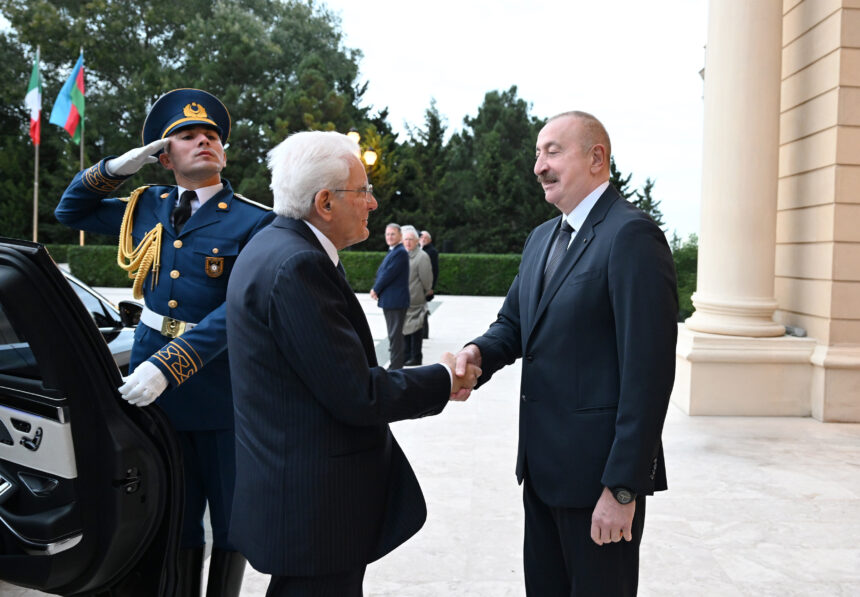
The recent official visit of Italian President Sergio Mattarella to Baku—the second in the last seven years—clearly confirmed that relations between Azerbaijan and Italy have entered a phase of stable strategic partnership, covering not only energy but also a wide range of political and economic cooperation.
For years, Italy has maintained the status of Azerbaijan’s main trade and economic partner in the European Union. The figures support this: in 2023, Azerbaijan’s exports to Italy exceeded $15.2 billion; in 2024, they amounted to about $10.88 billion; and in the first five months of 2025, they grew by another 21.2%, reaching $5.13 billion. In essence, nearly half of Azerbaijan’s total exports during this period went to Italy.
The structure of bilateral trade works in Baku’s favor: while Azerbaijan’s exports to Italy are measured in billions, imports from Italy are much smaller—around $515.8 million in 2024. This asymmetry reflects the energy logic: Italy receives about 57% of Azerbaijan’s oil and 20% of its gas, covering roughly 16% of Italy’s total gas imports—a figure comparable only to Algerian supplies.
However, in 2025, bilateral relations moved beyond the traditional formula of “oil and gas in exchange for technology.” A landmark development was SOCAR’s acquisition of a controlling stake in Italiana Petroli (IP), Italy’s largest fuel retail and refining network. SOCAR purchased 99.82% of IP shares from API Holding, with the deal valued at €2.5 billion. This is not just a financial transaction but a step that radically shifts the balance of power in the European energy market: Azerbaijan is transforming from a hydrocarbon exporter into one of the key players in Italy’s energy infrastructure. The Italian government, in turn, insisted on preserving jobs and stable supply volumes, underscoring the deal’s high importance for Rome.
Equally noteworthy was the reverse capital flow: Azerbaijan’s State Oil Fund (SOFAZ) acquired 49% of a portfolio of solar power plants with a capacity of 402 MW in Lazio and Emilia-Romagna. This move symbolizes Baku’s new energy philosophy: long associated exclusively with oil and gas, Azerbaijan is now actively investing in green energy abroad, with Italy becoming a key testing ground for these investments within the EU. Thus, mutual capital penetration is taking shape—SOCAR consolidates its presence in Italy’s fuel market, while Azerbaijani resources are channeled into renewable energy projects in Italy.
Mattarella’s visit was not limited to energy negotiations. Presidents Aliyev and Mattarella also focused on transport and logistics, discussing Italy’s potential involvement in the development of the Trans-Caspian route and the Middle Corridor—key links between Europe and Asia where Azerbaijan plays the role of a major transit hub. For Rome, this means an opportunity to integrate into new global supply chains; for Baku, it offers a chance to attract Italian investments into non-energy sectors, including machinery, agro-processing, and industrial design.
The political dimension of the visit further reinforced the impression of close coordination between the two countries. Italy is one of the few European powers that has consistently recognized Azerbaijan’s territorial integrity throughout the conflict with Armenia and has never questioned Karabakh’s belonging to Baku. In April 2024, Italian Deputy Foreign Minister Edmondo Cirielli sharply rebuked his French counterpart Stéphane Séjourné for comparing Azerbaijan’s actions with Russia’s in Ukraine, calling such statements “short-sighted” and “not conducive to peace.” He stressed that it was Paris that undermined the negotiation process in the South Caucasus. This episode symbolized Italy’s objective stance and its support for a fair resolution of the Armenian-Azerbaijani conflict.
The visit also gained special significance as it coincided with preparations for the summit of the Organization of Turkic States. Although Italy is not a member, through Azerbaijan it gains indirect leverage in the region and secures its interests in the transport and energy architecture of Greater Eurasia.
Amid global turbulence and rising risks in the Middle East, Sergio Mattarella’s visit to Baku sent a powerful signal: Italy views Azerbaijan not merely as a supplier of hydrocarbons but as a strategic ally in energy, transport, investment, and regional security. For its part, Baku, by diversifying its economy and opening new sectors to investment, demonstrates readiness to deepen the alliance.
All this makes the Italy–Azerbaijan partnership one of the most stable and promising within the “EU–South Caucasus” framework. Mattarella’s visit can thus be regarded as a milestone, cementing the transformation of Baku and Rome into interdependent strategic actors bound not only by economics but also by shared geopolitical logic.
Ilgar Velizade