The visit of J.D. Vance to Azerbaijan symbolizes the emergence of a new milestone in the complex — and historically contradictory — relationship between Baku and the world’s most powerful superpower. At the dawn of Azerbaijani statehood, the United States, together with its Western allies, acted as a guarantor of Baku’s sovereignty in the face of Yeltsin-era turmoil and Iranian theocratic expansion, enabling the implementation of major geo-economic energy projects. An important role in strengthening Western support for Azerbaijan was played by Türkiye under Demirel — an American outpost of the “NATO arc” — as well as the military-political alliance with the main U.S. ally in the Middle East, the Jewish state.
In the mid-2000s, especially after the Obama administration came to power, ideological antagonism and the desire for geopolitical dominance began to shake the previously established system of relations, ultimately leading to a geopolitical rupture and Azerbaijan’s gradual drift into the space of Eurasian cooperation. Yet in terms of values, Azerbaijani authorities and society undoubtedly remained closer to the Western vector of civilizational and economic development, largely due to their deep integration into the global carbon and transit system. This shift toward another geopolitical pole was forced and tactical.
Washington advanced an unreasonable and politically risky dialectical triad in its relations with Azerbaijan, first articulated during Hillary Clinton’s visit to Baku. Acting in concert with the Old Continent, the United States dictated a new framework of cooperation: political liberalism was placed on equal footing with energy and security interests. Azerbaijani authorities repeatedly warned about the dangers of imposing political liberalism — risks of decentralization, social upheaval, and chaotic instability — especially given that Azerbaijani society was still recovering from the severe consequences of a brief period of revolutionary liberalism decades earlier. These arguments met stubborn misunderstanding and fierce resistance. Washington demanded a change in Baku’s political paradigm. However, Azerbaijan’s leadership, guided by a national idea centered on the reintegration of occupied Karabakh, rejected decentralization and any weakening of the executive vertical, refusing to abandon its chosen model of paternalism and state primacy. At its core, the dispute reflected a clash of values and civilizational outlooks.
Everything began to change with the rise of right-wing conservatives led by Donald Trump during his first presidency. Although Trump’s administration was significantly constrained by a liberal-leaning Congress, a meaningful shift in U.S.–Azerbaijan relations became visible after the first Republican victory.
Trump — an ardent proponent of political pragmatism, traditional values, and strong statehood — recalibrated the Azerbaijani agenda. Sharp edges were smoothed. Moreover, as a proponent of geopolitical condominium and a pragmatic observer of emerging multipolarity, Trump avoided undermining the interests of other global actors. Right-wing conservatives view political liberalism not as a universal global doctrine but as an internal choice of each nation. Consequently, interstate dialogue under Republican conservatives focuses primarily on economics, energy, and security.
Trump’s second term, unfolding amid the collapse of the old world order, stricter American isolationism, and the rise of a new multipolar system, has opened a unique opportunity for Azerbaijan to build qualitatively new relations with the United States — or rather, to return to the starting point of the turbulent 1990s.
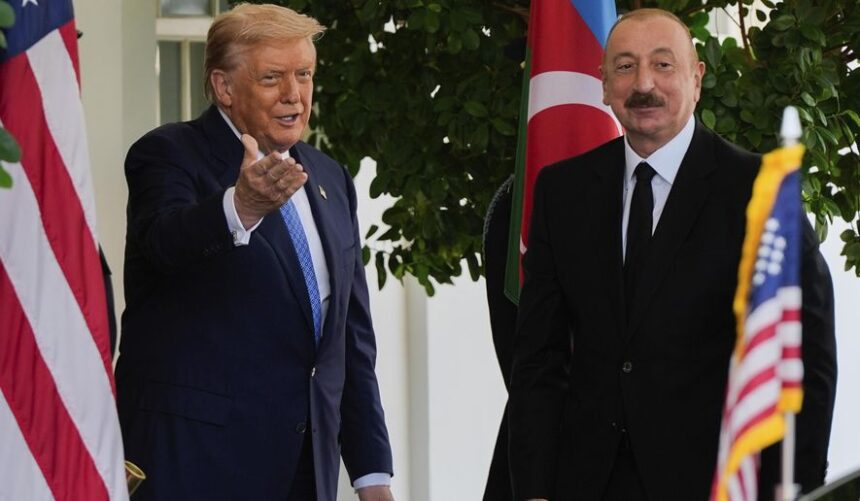
Aliyev and Trump represent a similar political philosophy centered on strong authority, a resilient state, and traditional values. This philosophy found expression in the Charter signed by Aliyev and J.D. Vance. The United States and Azerbaijan will develop their partnership in the name of economic cooperation, energy, and security. Vance himself emphasized this by placing Aliyev alongside Trump, noting that few leaders manage to maintain balanced relations with actors as mutually hostile as Israel and Türkiye — and one could add Iran to that list as well.
Not a word was said about political liberalization, as the United States itself has begun clearing dissent from the front pages of what were once avant-garde American media outlets. For the small Azerbaijani protest movement pushed into the underground, it is difficult to accept the new Euro-Atlantic trend and the rewritten rules of the global political elite. Yet political liberalism and the right to choose have now become the prerogative of societies themselves. In many ways, the philosophy of Trumpism is gaining ground even in Western European capitals, which have turned inward and no longer contemplate eastward expansion. In the new world, there may simply be nowhere left to expand.
Eynulla Fatullayev
Haqqin.az