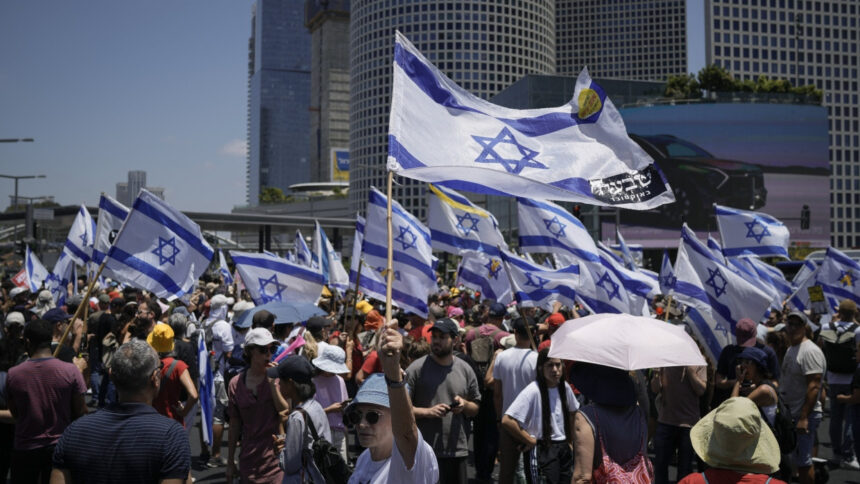
For the last ten months, Israel and Iran have been engaged in a wide-ranging proxy war from Gaza and Lebanon to Syria and Yemen. In the aftermath of several high-profile assassinations of leaders of Iranian proxies, it appears possible the conflict will escalate even further. The Israeli-Iranian conflict, in turn, is deeply enmeshed within an ongoing cold war between a Western bloc led by the United States and a Eurasian bloc led by China, Russia, and Iran.
To the casual observer, it is apparent that the Israeli-Iranian conflict is raging across the Middle East. Analysts, including the authors, have also highlighted Israeli and Iranian involvement in the Russo-Ukrainian War. Beyond these central theaters, however, the Israeli-Iranian cold war is also being waged across the Caucasus and Central Asia. Taking advantage of geopolitical flux, both Jerusalem and Tehran are trying to expand their footholds in these pivotal regions.
The onset of the Russo-Ukrainian War led to Russia’s attention being diverted from these regions, two of its traditional spheres of influence. Taking advantage of this growing vacuum, Israel and Iran have stepped into the fray. The former has been cementing its partnership with Azerbaijan and building new bonds with the Central Asian states, while the latter has been expanding ties with Armenia and refortifying its position in Central Asia. Meanwhile, Turkey, a geopolitical swing state, shifts between the Western and Eurasian camps.
Traditionally, Russia has dominated both the Caucasus and Central Asia. Even after these former Soviet republics escaped Moscow’s direct control with the collapse of the Soviet Union, Russia continues to view the Caucasian and Central Asian states as integral parts of its “near abroad.” It maintains close political and economic ties with them. Moscow enjoys robust diplomatic and economic relations with the Central Asian states and maintains military bases in Armenia, Georgia, Kazakhstan, Kyrgyzstan, and Tajikistan.
Despite these strong ties, there are signs that Russian primacy in these regions is beginning to fray. Armenia, Georgia, and Azerbaijan have been diversifying their foreign and economic policies, in part due to their wariness of Russia’s aggression toward Ukraine. Georgia has strengthened its relations with Europe and China, Armenia has moved closer to Iran, and Azerbaijan has drifted toward Turkey. Iran has been developing roads through Armenia and Georgia, seeking to build solid links between Iran and Georgia’s Black Sea ports. Both Armenia and Georgia have also upgraded ties with Saudi Arabia.
Like their neighbors on the opposite bank of the Caspian Sea, the Central Asian states have also started pulling away from Moscow. None have supported its invasion of Ukraine, none have recognized the so-called people’s republics in Donetsk and Luhansk, and all have abided by Western sanctions against Russia. In October 2022, Kyrgyzstan canceled Russian-led Collective Security Treaty Organization military exercises that were scheduled to be held on its territory. Kazakhstan, Kyrgyzstan, Uzbekistan, and Turkmenistan have begun focusing on non-Russian projects, especially the Turkish-led Organization of Turkic States.
Israel has escalated its efforts to build closer bonds with states in these regions. With the erosion of Russian primacy in the Caucasus and Central Asia and Iran’s deepening ties to Russia, Jerusalem has begun shoring up ties with states in the Eurasian heartland. Although Jerusalem has neither the capability nor the desire to replace Russia as regional hegemon, it has spotted an opportunity to expand its foothold and solidify existing partnerships to counter the Russo-Iranian axis in this region.
Azerbaijan is a particularly important partner for Israel because of its location on Iran’s northern border. Azerbaijan has reportedly allowed Israel to use its bases to launch reconnaissance flights into Iranian airspace as well as to send intelligence operatives into Iran to undermine Tehran’s nuclear program. Any future Israeli strikes against Iranian nuclear facilities will likely pass through Azerbaijan. Meanwhile, between 2016 and 2020, Azerbaijan received 69 percent of its major arms inputs from Israel, which represented 17 percent of Israel’s total arms exports during those years. Israel also imports 30 percent of its oil from Azerbaijan. Baku has utilized Israeli weapons in its periodic conflicts with Armenia over Nagorno-Karabakh. As a sign of the blossoming relationship between Jerusalem and Baku, the latter opened an embassy in Israel in March 2023.
Israel’s efforts to reinforce its relationship with Azerbaijan do not appear to have been significantly blunted by the burgeoning strategic partnership between Azerbaijan and Turkey, despite the latter’s support for Hamas following the terrorist attacks of October 7. The strength of Jerusalem and Baku’s shared interest in countering Iranian aggression has thus far proven resilient enough not to be infected by Turkey’s intense antipathy toward Israel. Nevertheless, the Turkish-Azeri relationship may eventually prove to be a ceiling limiting how robust Azeri-Israeli relations can become, highlighting the continued importance of traditional allies, such as the United States, for Jerusalem. Israel and Armenia, Azerbaijan’s historic rival, meanwhile, have not significantly expanded relations despite their similarities as small, embattled states facing existential threats from larger enemies. Major geopolitical realignments are no easy task.
Wariness of Iranian influence in Central Asia has led Israel to increase its activity in that region as well. Iran has a well-established economic presence in Central Asia: with no access to the sea, the Central Asian states rely on Iran’s Bandar Abbas port on the Persian Gulf to get much of their fossil fuels to market. Nevertheless, the Central Asian states are wary of Tehran’s regional designs, especially of its sponsorship of radical Islamic groups. After the fall of Kabul to the Taliban in 2021, the renewed possibility of jihadist fighters crossing into Central Asia via the Afghan border magnified concerns about Islamist terrorism, whether of the Shia or the Sunni variety. ISIS-K, whose March attack in Moscow was linked to the group’s Central Asian and Middle Eastern outposts by U.S. intelligence, is the most recent example of radical Islamic terrorism spreading out from this region.
Israel has spotted an opportunity and has been trying to build ties with Central Asian governments. In 2016, Benjamin Netanyahu became the first Israeli Prime Minister to visit Kazakhstan. In December 2022, the Israeli Foreign Ministry hosted government officials from the five Central Asian countries for a tour of Israel focused on defense.
As Israel and Iran jostle for influence across the Caucasus and Central Asia, Turkey acts as a geopolitical wild card, moving back and forth between the Western and Eurasian blocs. On the one hand, Turkey’s President Recep Tayyip Erdoğan has stated that Ukraine “deserves” NATO membership and finally supported Sweden’s bid to join NATO after a long delay. However, the Iranian, Russian, and Turkish positions toward the Israeli-Palestinian conflict have converged since October 7, with Turkey hosting Hamas leaders, calling for a ceasefire that would hurt Israel, halting trade with Israel, and even suggesting that it could deploy military forces against Israel. As such, while it is a geopolitical swing state in the context of the larger clash between the Western and Eurasian blocs, Turkey has been acting more as an adversary toward Israel in its corner of Eurasia.
As the Middle Eastern conflict simmers and the broader new cold war continues, observers would also do well to keep one eye on the Caucasus and Central Asia. Supreme Leader Khamenei’s Iran will continue its quest to dominate the Middle East and facilitate Israel’s destruction. In the process, its ambitions will continue to spill over into adjacent regions, including the Caucasus and Central Asia. Israel’s military might, likely supported to varying extents by the United States, will continue to oppose it. The fight for the heartland has only just begun.
Anthony De Luca-Baratta, Mollie Sharfman, William Erich Ellison, Joseph Schneider Malamud