As the Jewish state makes further diplomatic and economic inroads into the Caucasus region, it faces both opportunities and challenges.
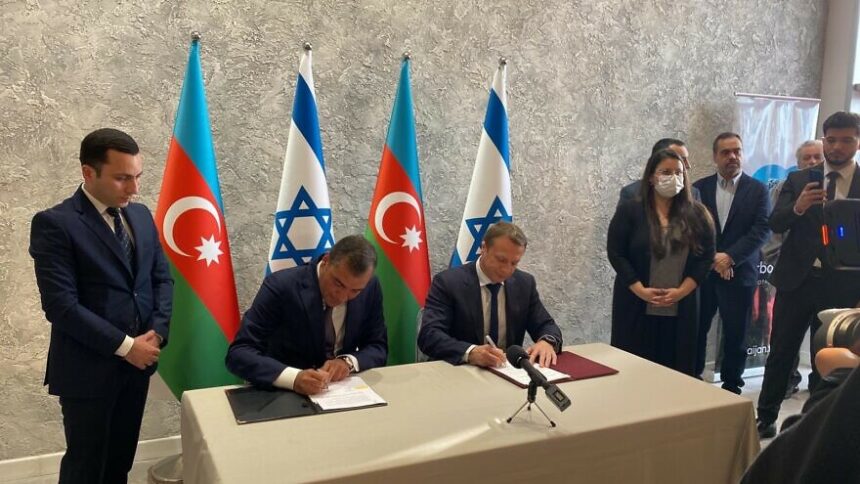
Azerbaijan made history earlier this year when it became the first majority-Shi’ite Muslim (albeit secular) country to open an embassy in Tel Aviv. Israel has had an embassy in Baku since 1993, but due to Iranian threats and appeals from much of the Islamic world, had never hosted an Azeri embassy.
Azerbaijan provides some 40% of Israel’s oil, and purchases many of its weapons–especially drones, which helped Baku triumph over Yerevan in a 2020 war over Nagorno-Karabakh (known as Artsakh to Armenians). Azerbaijan also has historically hosted a large Jewish population, with little antisemitism. The country’s strategic location bordering Iran–Israel’s nemesis–played a large role in the opening of the embassy in Tel Aviv.
As tensions have ramped up between Baku and Tehran in recent months, Azerbaijan clearly feels that a deeper partnership with Israel and the West is needed as a counterbalance. Following the opening of the Azeri embassy in Israel, an Iranian attacked and killed an employee of Azerbaijan’s embassy in Tehran, resulting in its closure and evacuation. The same day as the evacuation occurred, there was an attack, widely attributed to Israel, on Iranian military facilities.
Meanwhile, Israel is also deepening ties with Armenia and expanding into Central Asia. According to Sophie Kobzantsev, a research assistant with The Institute for National Security Studies (INSS) who focuses on Eurasia, “The relations between Israel and Armenia are indeed warming and there has always been a mutual understanding between the two countries.”
The two countries, she told JNS, “always shared their respect for history and tradition and benefited from fruitful bilateral tourism. At the same time, as we saw in the recent Nagorno-Karabakh war, as a result of the close ties between Israel and Azerbaijan, and the aid Israel provided to Azerbaijan during the war, as well as its rapprochement with Turkey—it immediately affected the relations with Armenia and distanced it from Israel. It also created a strategic threat to Iran in the region.”
Kobzantsev further noted that Israel understands the importance of Central Asia and the South Caucasus to Iran, culturally, historically and geopolitically.
“The Zangezur corridor is one of the crucial transit routes to the Caucasus, as the land route through Iran and Armenia that reaches Georgia is a main part of the Persian Gulf-Black Sea corridor. This is a strategic move, and both Tehran and Moscow have a great interest in completing it,” said Kobzantsev. “Since Russia’s ability to help and intervene in Armenia is weakened at present due to the Ukrainian war, I believe that Israel understands it might bring Armenia and Tehran closer and therefore is interested in preventing it. Moreover, Tehran may attempt to play a mediating role between Azerbaijan and Armenia to stabilize the region and to secure transit access.”
Ariel Cohen is a nonresident senior research fellow at the Atlantic Council, and the author of “Russian Imperialism: Development and Crisis.” He shares similar views on the regional situation.
“The South Caucasus is a relatively niche market, and Israel has a presence with medicine, agriculture, telecoms and military sales,” Cohen told JNS. “This will continue and deepen, and I don’t think Turkey has any interest in pushing Israel out of the region.”
Cohen and Kobzantsev both pointed out the fact that Israel has not been the cause of Russia’s decline in Central Asia or the Caucasus, although they noted that its military assistance to Azerbaijan harmed Iran’s ability to project power in the region. According to Kobzantsev, the Jewish state has always understood this region to be economically and strategically important, particularly for curtailing Tehran’s ambitions.
Israel’s proven military expertise has drawn many regional capitals much closer towards its orbit, especially after Baku’s victory over Yerevan in the 2020 war. The U.S.-Israel relationship along with the Abraham Accords also granted Jerusalem further legitimacy in the Islamic world, especially in this region.
“In my opinion, several things happened at the same time that increased Israel’s influence in the region and encouraged other countries to cooperate with it,” Kobzantsev concluded. She noted that the protests within Iran and Russia, the failures of the distracting Ukraine war, and vast international sanctions have severely weakened the reach of the Kremlin and the ayatollahs.
“The fact that Israel has also become an energy power opens up possibilities for significant regional cooperation, against the backdrop of the developing energy crisis in Europe, and Europe’s growing dependence on the Middle East and Central Asia’s oil and gas,” she said.
According to Cohen, “Racism in Russia [against people from the South Caucasus and Central Asia] is the general reason for Moscow’s declining influence in the area,” in addition to its flailing war effort in Ukraine and international sanctions on the Kremlin. He added that, post-2008, “Russian-Georgian tensions remain, while [Armenian President Nikol] Pashinyan distrusts Moscow, and Azerbaijan is afraid of Russia.”
While the Islamic Republic does maintain ties with Yerevan, “it doesn’t have much to offer,” said Cohen. “The peoples of the South Caucasus have always been traders, and want to be open to the outside world–something neither Iran nor Russia can provide.” He also pointed out Iran’s silence on the opening of an Armenian embassy in Tel Aviv–compared to its loud protest over Azerbaijan doing the same.
“I don’t think [the internal political crisis] is harmful vis-a-vis Israel’s diplomacy in the world,” Cohen said. “Yes, the United States has made some noise about these issues, but Israel maintains strong ties with Tbilisi and Baku, while there’s room for improvement with Yerevan. I think the multi-vector policy with Armenia will be interesting if they distance themselves from Moscow and Tehran, which are dragging their economy down. Relations with Israel and the West can bring more investment to Armenia, and create a free trade zone throughout the region, especially if there’s a peace deal with Baku.”
Cohen further noted that China is only just beginning to invest in Azerbaijan and Georgia, compared to its larger projects in Central Asia, and is also not yet a large force in Armenia. While he believes that Israel is increasing its economic engagement with China, he said Beijing has begun to spread itself thin.
“When Israel is being forced to choose between the United States and China … it’s of course choosing Washington, D.C.,” he said.
Kobzantsev agrees that Israel will not jeopardize its critical relationship with the White House. She did say, however, that Israel will continue to engage in major economic and technological projects with the Chinese, given its important Mediterranean location and natural gas supplies.
“Since the Abraham Accords, there has been growing openness in other Arab and Muslim countries to join the process of normalization with Israel. This has made China pay attention to the new trade and corridors between the Arab countries and Israel … I believe that in the near time, Israel will manage a foreign policy of delicate balance, hedging and risk management, namely, developing its economic and technological partnership with China while maintaining its strategic partnership with the United States,” she said.
Israel’s new strategy in the South Caucasus and Central Asia is perhaps not that new. Just as Israel was the “Old-New Land” of Theodor Herzl, it appears this strategy is also an old policy in an updated form.
Yiddish was a commonly-spoken language on the Silk Road, with Jews as well as Armenians playing important roles as merchants and setting up communities across the ancient Near and Far East. Large Jewish communities also existed in Georgia, Azerbaijan and Bukhara (Central Asia) for centuries, with very little antisemitism. Smaller Jewish communities existed in Armenia as well. With Iran and Russia’s grip on the region looking tenuous and China and Turkey in less-than-stellar economic situations, Israel looks poised to enter the region at just the right time.
Dmitri Shufutinsky