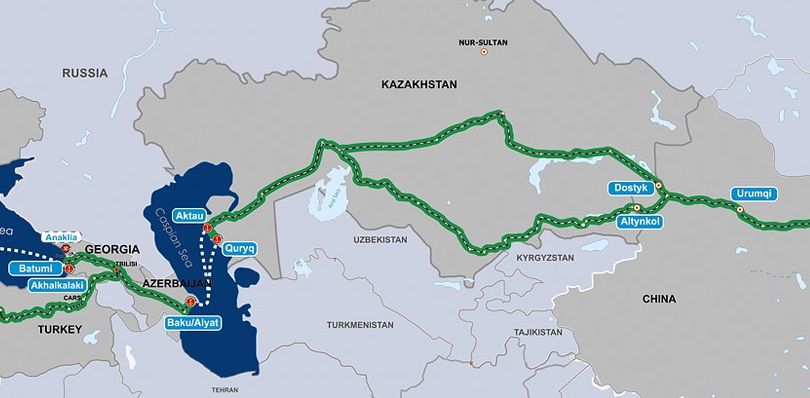
The Middle Corridor AKA the Trans-Caspian International Transport Route, is a multimodal transport corridor connecting China to Europe. At over 4,700 km (and 2,000km shorter than Russia’s Northern Corridor according to the Caspian Policy Center), the Corridor is the shortest route and most sustainable transport corridor, between Europe and Western China. The Corridor received renewed attention after the start of the Russia-NATO war in Ukraine as it will enable Europe to trade with China and Central Asia while avoiding shipping goods via Russia and the Northern Corridor, and avoiding the route via the Red Sea and the Suez Canal which is threatened by Houthi attacks on Israel-linked shipping.
Per the World Bank: “The Middle Corridor links China, and Kazakhstan by rail through Dostyk or Khorgos/Altynkol, crosses Kazakhstan by rail to the Aktau Port, crosses the Caspian Sea to the Port of Baku/Alyat, and Azerbaijan and Georgia by rail to then either continue by rail to Europe through Türkiye or crossing the Black Sea.”
Of the five Central Asia states, only Kazakhstan has assumed a significant role in the Corridor by hosting rail lines, but the China-Kyrgyzstan-Uzbekistan (CKU) railway which begins construction in October 2024 will add another leg to the East-West corridor. But, according to The Diplomat, the project is an “enormous undertaking with unclear financing” even though the World Bank reports it will “triple freight volumes and halve travel time by 2030.” One impediment to securing financing is that “it will remain mostly a regional corridor, with transcontinental trade representing a small fraction of the volumes,” according to the Bank.
The European Bank for Reconstruction and Development identified an ambitious menu of priority infrastructure investment needs in the Central Asia republics. Though the Bank says soft connectivity challenges are the greatest challenge to improved transport connections, eventually the bricks and mortar have to be paid for. Mr. Edward Chow of the Center for Strategic and International Studies argues that it is “fanciful” to discuss the MC without considering a role for China as a large volume of goods is needed to finance the required infrastructure, so a project sold as a way to minimize Russian involvement in the region’s supply chain may instead be opening the door to more China.
Europe is shedding Russian natural gas and fertilizer and, without cheap energy, is facing a wave of deindustrialization as industrial capacity shrinks, most starkly illustrated by Germany’s contracting chemical and heavy industry sectors. And there’s another thing Europeans aren’t making more of – Europeans. Eurostat reports, “Almost 2 times fewer children born in the EU in 2022 than 6 decades ago” so Europe will have fewer workers and consumers in the future.
Europe’s limited prospects are opposed to Asia which will see an increasing share of global GDP rising from about 45% today to around 58% by 2030. And Forbes reports “Asia is expected to contribute about 60% of economic growth in 2024.”
And then there’s Africa which will be the “second-fastest-growing region after Asia,” according to the African Development Bank. The Bank also notes that ten African countries “will be among the world’s top 20 fastest- growing economies in 2024, sustaining the trend of the past two decades,” though the outlook is mixed across the continent.
And the growth of Africa’s population will have the biggest impact on global demographics this century, increasing by a factor of almost five from 2000 to 2100. “GDP per person employed” as measured by the World Bank is vastly higher for Europe than for Africa, but a market of Africa’s size can’t be ignored.
Countries mostly trade with their neighbors and the Central Asia republics are no exception. Their challenge is that the neighbors include Russia, Iran, and Afghanistan, all targets of Washington’s enmity for unfinished business: Tehran, the 1979 revolution; Kabul, the 2021 defeat of NATO; and Moscow, the peaceful end to the Cold War.
And opportunities to the South are sizeable: Pakistan (population over 240 million), Iran (almost 90 million), India (1.4 billion), and the Arab Gulf petro states (Gulf Cooperation Council states are classified by the World Bank as “High income,” and Iraq is “Upper middle income”).
Turkmenistan and Iran share over 2,200 km of land and maritime borders. During the first half of 2022 their trade $233 million, a big jump over 2021 trade of $227 million.
Turkmenistan wants to be a Central Asia transit hub and can link Russia, Iran, the Central Asia republics, and India via the North-South Transport Corridor, which Ashgabat joined in 2023.
Uzbekistan has publicly engaged with the Taliban in 2018 and in 2022 hosted a 30-nation conference on the future of the region in the wake of the Taliban victory. Tashkent also wants improved relations with Iran and access to the seaports of Bandar Abbas and Chabahar. Uzbekistan’s president Shavkat Mirziyoyev visited Iran in 2023 and the two sides inked agreements in agriculture, energy, customs affairs, Chabahar port, the environment, industry, and tourism, and announced their intent to increase trade to $3 billion annually.
Tashkent’s key regional initiative is the trans-Afghan railway to connect Central Asia to Pakistan, and to facilitate the exploitation of Afghanistan’s mineral resources, believed to be worth $1 trillion. The $6.9 billion project will face engineering challenges but a bigger risk is unresolved Taliban-Pakistan tensions. But if Pakistan and the Taliban can’t resolve their dispute, Uzbekistan has Plan B, Iran’s ports and the North-South Transport Corridor.
Or, as Andrew Korybko has observed, even if the rail line gets no further than Afghanistan, that may allow Uzbekistan to backhaul the minerals for processing in Uzbekistan, or to export them to Russia or China.
Kazakhstan hosts the Middle Corridor but is also interested in Southern routes, in line with Astana’s multi-vector foreign policy, reinforced in early 2024 when Kazakh president Kassym-Jomart Tokayev noted that the Middle Corridor complements China’s Belt and Road Initiative.
Kazakhstan plans to increase trade with Iran, and in 2023 Kazakhstan’s prime minister noted that Iran is a strategic partner of Kazakhstan in the Persian Gulf. In 2022 Tehran and Astana inaugurated a rail link that connects Kazakhstan to Turkiye via Iran.
In November 2023, Tajikistan’s president Emomali Rahmon hosted a visit by Iran’s late president, Ebrahim Raisi, Raisi’s second visit in 18 months, in an effort to continue improving relations. In October 2023, Iran’s defense minister visited Dushanbe, and in May 2022, Iran’s chief of staff of the armed forces arrived and announced the launch of local production of the Ababil-2 drone.
Tajikistan’s foreign trade is with Kazakhstan, Switzerland, China, Turkey, Uzbekistan, and Russia. Tajikistan shares a 1,200 km border with Afghanistan that was a major smuggling route for Afghan opium before the Taliban banned opium harvesting so the countries have established transport route that can be repurposed to legitimate cargo.
The Central Asia republics value their ties to the U.S. but are uninterested in helping Washington with its “unfinished business” in Iran and Afghanistan, and would rather make up for the lost decades of the 2001-2021 American intervention in Afghanistan.
The republics will use the Middle Corridor to increase trade with Europe, but can’t ignore their neighbors to the South who unfortunately have been targeted by U.S., European Union, and United Nations sanctions. Washington can “tsk-tsk” all it wants but it won’t make up the lost opportunity that comes with ignoring trade with (and via) Iran and Afghanistan, or make up for the region’s “lost decades,” create jobs for their large youth populations, or manage potential rural-to-urban migration as a result of climate change-induced water shortages.
Trade with Afghanistan is part of being a good neighbor, and that trade will help Afghanistan find jobs for the 1.5 million Afghan refugees who have returned from Pakistan and Iran. More jobs may lessen the appeal of fighting for the Islamic State of Al-Qaeda which will benefit the West, and satisfy a key objective of the Central Asian republics: stability along the border with Afghanistan.
And the republics understand they can’t ignore geography: Tass reports Afghanistan is ready to ink a transit agreement with Turkmenistan, Russia, and Pakistan; Kazakhstan and Turkmenistan plan to build a logistics hub in northwestern Afghanistan to facilitate the export of Russian oil to South Asia by road and rail. These projects will do more than generate cash; they will start integrating Afghanistan into the affairs of the region and teach the Taliban the local “rules of the road” and so build confidence between the governments of the region.
Washington’s economic warfare on Iran and Afghanistan is a tax on the region, with no offsetting benefits. The completion of the Middle Corridor will please the Americans and will benefit the region, but it is an “and” solution not an “or” solution for Central Asia’s future connectivity and economic growth.
James Durso