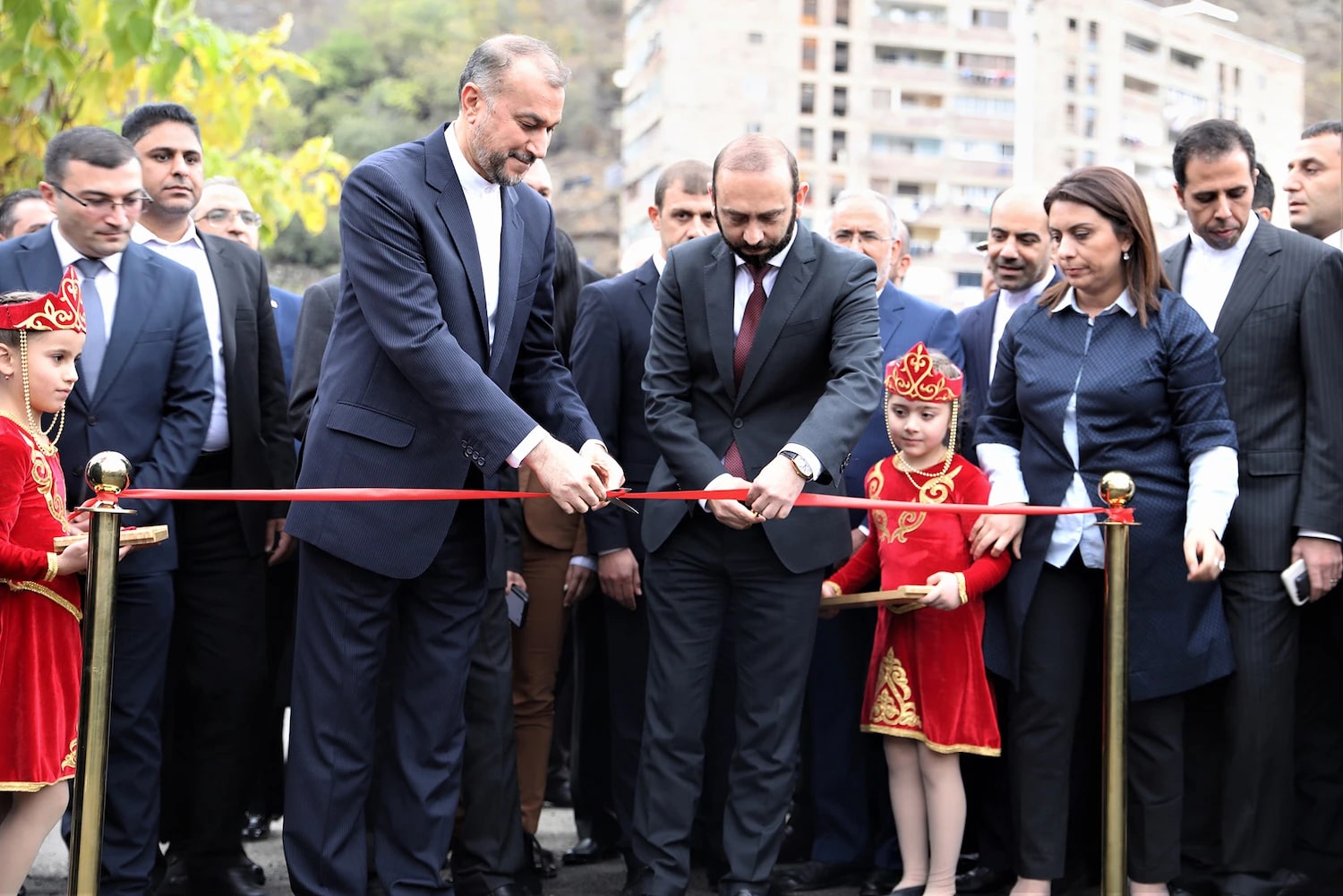
But in October, Armenian officials gathered in its central square to cut the ribbon on a brand-new consulate—and welcome the delegation arriving from the Islamic Republic of Iran.
Just two miles away from the site of Tehran’s newest international mission is the border with Azerbaijan. The surrounding Armenian region of Syunik—of which Kapan is the capital—is at the heart of the growing dispute between Yerevan and Baku, which fought a brief but bloody war over the disputed Nagorno-Karabakh region in 2020. Now, Tehran is wading into the dispute, throwing political and military support behind Yerevan.
Days before the consulate opened, Iran’s Islamic Revolutionary Guard Corps announced its troops were staging “massive” war games on Iran’s border with Azerbaijan. According to Iranian Brig. Gen. Mohammad Pakpour, the drills were designed to send a message of “peace and friendship” to countries in the region, while demonstrating their ability to “respond decisively to any threat.”
In response to the escalating tensions in the South Caucasus, U.S. State Department spokesman Ned Price told reporters in early November that Washington has been “very clear that Iran represents a threat to the region” and will continue “ultimately to stand against the kind of destabilizing influence that Iran presents and—in its region and perhaps beyond.”
As a relatively liberal democracy that prides itself on being the world’s first Christian nation, Armenia is an unlikely partner for Iran. However, after Armenian towns and villages along the border came under heavy bombardment from Azerbaijan briefly in September—with Western officials blaming Baku for firing first—Yerevan is looking for support wherever it can find it.
Despite Yerevan’s membership in the Moscow-led Collective Security Treaty Organization (CSTO) military bloc, Russia has so far refused Armenia’s calls to intervene. Iran, meanwhile, seems more than eager to fill the power vacuum and open another front against Azerbaijan and its backer, Turkey, which Iran has long mistrusted and seen as a potential rival in the region.
In November 2020, Yerevan and Baku signed a Moscow-backed cease-fire agreement following more than a month of fierce fighting over Nagorno-Karabakh, which is inside Azerbaijan’s internationally recognized borders but has been held by Armenian forces since the 1990s. After a string of defeats on the battlefield, Armenia acquiesced to handing over control of swaths of territory and committed to “guarantee the safety of transport communication” between mainland Azerbaijan and its enclave of Nakhchivan through the Syunik region—which divides the two—“with a view to organize the unimpeded movement of citizens, vehicles and cargo in both directions.”
Since then, Azerbaijani officials have made it clear that they interpret the pact as meaning they should be granted a sovereign highway, billed as the “Zangezur corridor,” that would run through the southernmost part of Syunik, potentially dividing Armenia and Iran. Yerevan, however, insists that demand has no basis in the 2020 deal. Analysts were quick to attribute September’s hostilities to Baku’s growing frustration over the failure to get what it wants through diplomatic channels.
Distracted by its war in Ukraine, the Kremlin appears unwilling or unable to act as a security guarantor for Yerevan, even though it is a member of the CSTO and obliged to step in if its partner is attacked. Russia’s decision not to send troops to the country after September’s clashes led to mass protests in Yerevan, with Armenian demonstrators calling for withdrawal from the CSTO. In November, Azerbaijani President Ilham Aliyev declared that talks about the Zangezur corridor were taking place with Moscow, not Yerevan, and that Armenia would be unable to resist the plan if the Kremlin was on board.
Iran has long opposed any changes to the status quo along its northern border, in part because it doesn’t want Turkey, Azerbaijan’s long-standing ally, to expand its influence near its own borders. “If there is an effort to block the border between Iran and Armenia, the Islamic Republic will oppose it because this border has been a communication route for thousands of years,” the country’s supreme leader, Ayatollah Ali Khamenei, warned in July at a meeting with Turkish President Recep Tayyip Erdogan.
“Tehran doesn’t want Turkey to militarize or securitize that corridor, and they don’t want it to become nonnegotiable for Azerbaijan. I think that’s what the consulate opening is trying to achieve,” said Hussein Banai, an associate professor at Indiana University Bloomington who specializes in the region. “Iran is stepping up now because its leaders don’t feel Russia is doing enough to keep everyone in check.”
Iran has also become more concerned about Azerbaijan’s close ties with Israel, as the two countries have begun exchanges on military technology, and Baku already supplies 40 percent of the country’s energy needs. One Iranian MP, Mohammad Safai, said in October that “the Zionists seek to undermine the influence of the Islamic Republic in Central Asia,” but “they will never succeed.” In an apparent response to Iran’s consulate opening in Kapan, the Azerbaijani parliament in November voted to open an embassy in Israel, which would make it the first majority-Shiite Muslim country to do so.
According to Banai, “Iran’s foreign policy is an extension of its domestic paranoia.” Tehran’s actions abroad, he said, seek to put up “buffer zones of resistance against what it sees as Zionist and Western imperial designs on its territory.”
If Tehran’s foreign policy is driven by paranoia back home, its diplomats are likely now on high alert given the unprecedented protests across Iran in recent weeks that the government has blamed on Western powers. With the threat of outright rebellion posing a major challenge to the regime, the prospect of unrest in areas with large numbers of often-disenfranchised minority groups is a growing concern—particularly in Iranian Azerbaijan, a region in northwestern Iran where many of the country’s estimated 15 million ethnic Azeri citizens live. Large-scale protests there, centered on the city of Tabriz, broke out in November after a 23-year-old student was killed by security forces.
In November, Aliyev made a veiled swipe at Iran’s treatment of its Azeri community, saying that “their security, their rights and well-being are of the utmost importance to us” and that “we will continue to do everything to help the Azerbaijanis who have found themselves cut off from our state.” A number of protest groups have appeared calling for Iranian Azerbaijan to secede from Iran and be governed by Baku instead, while Aliyev’s security forces have made arrests after breaking up what they claim is an Iranian influence cell.
“The recent talk we’ve heard from President Aliyev is a new development,” said Rusif Huseynov, an adjunct faculty member at Azerbaijan’s diplomatic academy and director of Baku-based think tank Topchubashov Center. “In the past, Azerbaijani leaders have been very measured in their rhetoric and careful not to irritate Iran. It’s unprecedented, and I see it as a reaction to this subversive approach from Iran.”
Iran’s interests in maintaining the status quo, Huseynov added, come from its fears that “when the conflict with Armenia is over, Azerbaijan will be strong enough to be more attractive for Iran’s Azeris and pose a danger for Iran’s own security.” For Tehran, Baku is apparently less of a threat if it continues to have a deeply entrenched domestic conflict on its own soil—and doesn’t have the capacity to build bridges with its would-be countrymen across the border.
There are, however, other reasons that Iran has pushed for closer ties with Armenia, one of the only friendly countries in its immediate vicinity—namely, the benefits that come from Yerevan’s neutral relations with the West.
“The Iranian government is using Armenia as a point of contact with the outside world,” said David Hovhannisyan, a former Armenian diplomat who is now the director of the Arabic studies department at Yerevan State University. According to Hovhannisyan, senior regime figures go to Armenia to get a rare respite from the strictures of their own government, and they turn a blind eye to other well-connected Iranians doing the same. “They can come here, buy goods that aren’t available there, listen to our music, drink alcohol, and so on.”
Washington has imposed sanctions on two Armenian companies that it alleges acted against U.S. interests by trading across the border with Iran, leading to speculation that the country’s businesses help Tehran circumvent restrictions on the import of sensitive equipment and other goods. At the same time, Armenia’s financial institutions have long offered a potential lifeline for Iranian banks and investors trying to move money into or out of the country. A high-level trade delegation from Tehran also visited Armenia in March as part of efforts to strengthen economic ties and bring back much-needed revenue.
Meanwhile, unable to risk alienating its neighbor, Armenia joined 27 other countries in voting against a United Nations motion in November condemning Iran for human rights breaches, including the detention of peaceful protesters.
But ultimately, the ties are seemingly more about convenience than ideological alignment. Zohrab Mnatsakanyan oversaw a policy of closer ties with Iran as Armenia’s foreign minister from 2018 to 2020. The partnership, he told Foreign Policy, is a practical one given both fear of their neighbors and renewed regional hostilities. “As tensions remain unresolved in the region, the convergence of interests of Armenia and Iran under these circumstances most ostensibly concerns the security of their common border,” he said.
Banai, at least, warns that the international community should be worried about Tehran taking advantage of Yerevan’s vulnerability to strengthen its hand. “The West should be worried about the prospect of Iranian influence growing in Armenia—or anywhere,” he said. “The region could easily become a hotspot as the domestic situation in Iran gets worse.” With Iran’s regime facing increasingly fierce resistance at home, its actions overseas could become more belligerent—with potentially dangerous consequences given the fragility of peace in the South Caucasus.
“The tragedy of this situation is that while we have this great power competition going on, Armenia really has no choice but to get what it can out of this odious alliance because it is being forced into a corner,” Banai added. But what Armenia might see as a regrettable necessity, Iran seems intent on treating as a major opportunity.
Gabriel Gavin is a British journalist covering Eurasian politics and society.