Russia and Iran are advancing the idea of a transportation route termed the International North-South Transport Corridor (INSTC), which, despite some problems, is progressing and could reshape Eurasian connectivity.
The Islamic Republic’s Eurasian pivot is not only about finding a balance to the pressure Iran has been experiencing from the US. It is more concerned with successfully positioning the country as the crossroads of Eurasia: linking Central Asian countries to the Persian Gulf, and India with Russia.
The INSTC can connect the Persian Gulf and Indian ports with Russia, a dream that fired the Russian imagination during its 19th century imperial expansion, and triggered what was termed as the Great Game with the British Raj. Access to warm water ports works for Russia, and for India and provides an alternative to lengthy sea routes for trade to Russia, Turkey, and the rest of Europe. Ideally, the route would take 18 days from the Baltic Sea to reach India through Azerbaijan and Iran.
Talks about the corridor have been underway since the early 2000s and are now nearing their final stages. What remains to complete is the Rasht-Astara railway section between Iran and Azerbaijan — a critical link that has been lacking because of US sanctions imposed on Iran for its pursuit of nuclear weapons. Presently the connection is only 70% complete and much will depend on a possible nuclear agreement — the talks are currently deadlocked — which might remove major sanctions and allow the Islamic Republic to engage the South Caucasus more actively.
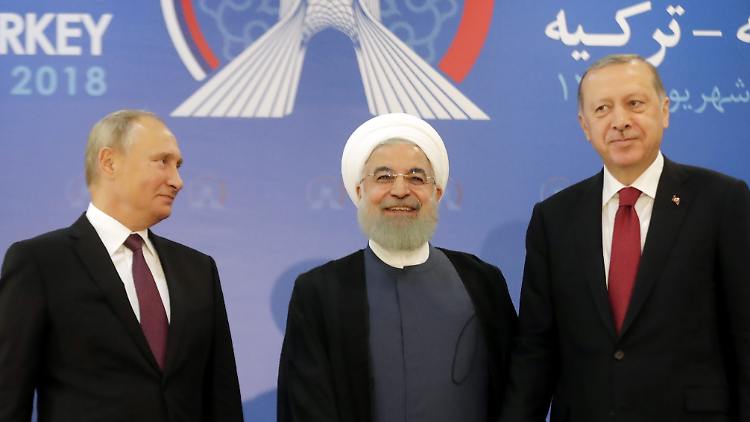
Russian President Vladimir Putin’s visit to Iran in July brought about a flurry of comments on the corridor, perhaps a sign Russia now realizes just how important the project is. Previously, the Kremlin had been ambivalent. To be sure, it supported the idea from the very beginning but has never really seriously pushed for implementation. But with the consequences of Putin’s war in Ukraine now clear, there is a considerable incentive to revive the flagging scheme, which could help the two Eurasian powers dodge Western sanctions.
The fresh impetus is clear from official comments. The director of the Iranian Construction and Development of Transportation Infrastructure Company, Abbas Khatibi, said in the wake of Putin’s visit that the country is willing to complete the project. On June 11, two containers set off from St. Petersburg to Astrakhan, then to the Iranian port of Anzali on the Caspian sea, and ultimately to Bandar Abbas on the Persian Gulf. The freight was a test, but the timing is telling, as it coincided with Russia’s trade troubles and Putin’s visit to Iran. This followed the Iranian Roads and Urban Development Minister Rostam Qasemi’s trip to Moscow in April where a comprehensive agreement on transportation cooperation was signed with the Russians. On September 11 Iran, Russia and Azerbaijan signed a special declaration on INSTC.
For Iran, the corridor opens access to the 10 cities of 1 million consumers or more along the River Volga, but also as a connection to Central Asia and the Black Sea. From Azerbaijan, Iranian goods could head eastward to Kazakhstan’s Aqtau port. Yet another possibility is to look westward toward Georgia’s Black Sea ports and the European market.
Countries in the South Caucasus have been especially active on transportation links recently. Georgia and Azerbaijan stand out in particular. For instance, the development of the Trans-Caspian International Transport Corridor was the subject of a quadrilateral statement by Georgia, Azerbaijan, Turkey, and Kazakhstan on March 31, which produced a joint statement on the need to strengthen the corridor. In May, together with Kazakhstan, and Turkey, Georgia discussed the Middle Corridor (which runs from the Black Sea to Central Asia via the South Caucasus, avoiding Russia.) in a meeting held in Ankara. Later that month, the Georgian railway company announced that it was collaborating with companies from Azerbaijan and Kazakhstan to create a new shipping route between the Georgian port of Poti and Constanta in Romania.
Apart from this Georgian leadership has been active through a series of visits to Central Asian states. Similar visits were made by the Azeri leader. The major topic in all visits was connectivity, especially so as the necessary infrastructure is already in place. The 2017 launch of the Baku-Tbilisi-Kars railway and the expanding network of regional roads connecting the Caspian Sea to the Black Sea provide a solid foundation for trade cooperation between China and the EU in the South Caucasus.
Yet it is true that the INSTC is made more complicated because of the sanctions now imposed on Russia. Moreover, despite a mutual desire to push back against the West, Iran, and Russia also share a number of differences when it comes to the Caucasus and the Caspian Sea. There is also a deeply ingrained mistrust between the two.
Nonetheless, the war in Ukraine creates momentum. Should the West restore the nuclear deal with Iran, the two countries will seek to complete the corridor project: expect a possibly significant growth in sanctions evasion as a result.
Emil Avdaliani is a professor at European University and the Director of Middle East Studies at the Georgian think-tank, Geocase.