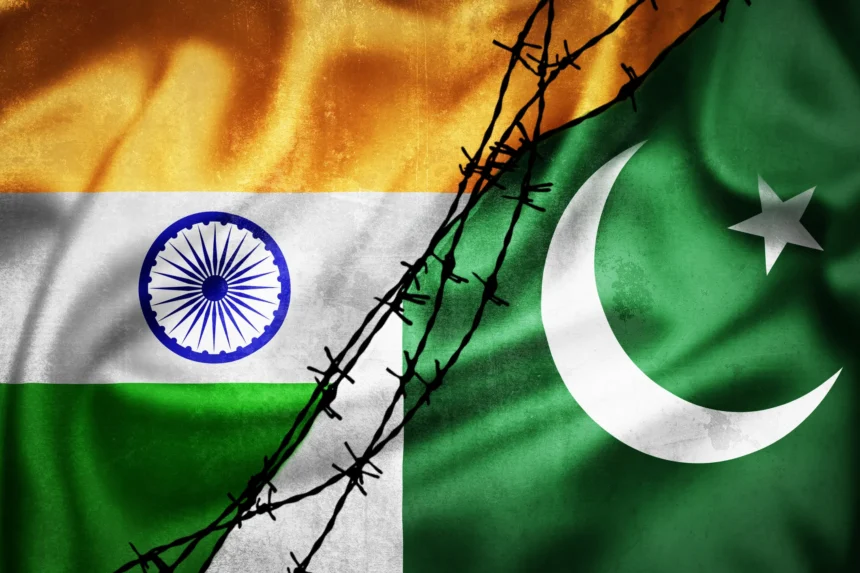
The attack on tourists in Pahalgam (in the Indian-controlled part of the Jammu and Kashmir region), which claimed the lives of 26 people, has once again triggered a sharp escalation of tensions between India and Pakistan. However, behind this incident lies something deeper than mere groundless accusations against Islamabad. We are witnessing the gradual transformation of natural resources—specifically water—into a tool of strategic pressure. Interestingly, this process bears a striking resemblance to the well-known realities faced by Azerbaijan during the years of Armenian occupation of Karabakh.
India’s violation of the terms of the Indus Water Treaty is no longer just another episode in the series of bilateral disputes. It is about undermining the fragile architecture of regional security, where natural resources are becoming a tool of pressure. Such actions, whether in South Asia or the South Caucasus, require a unified assessment: water, held hostage by politics, is a testament to the moral bankruptcy of states resorting to such methods.
Politics of Accusations Instead of Investigation
After the attack in Pahalgam, the Pakistani government took an extremely measured stance: it condemned the violence, expressed condolences to the victims, and proposed an international, transparent investigation. This initiative, in line with international law, was ignored by India, which preferred to accuse Pakistan almost immediately, without any evidence linking Islamabad to the attack.
However, this tactic has long been ingrained in India’s political doctrine: every tragedy is automatically blamed on Islamabad. This allows New Delhi to avoid criticism for its own failures in internal security, while simultaneously consolidating the nationalist electorate within the country. But there is also a more pragmatic goal — beneath this rhetorical veil, initiatives are being advanced that are far more destructive than statements made in front of cameras.
Water security as a new frontline
Among the most alarming steps taken by India are the successive actions aimed at limiting the flow of rivers that feed Pakistan, which violates the 1960 Indus Waters Treaty. This document, signed with the mediation of the World Bank, became a historic precedent: even after several wars between the two countries, it continued to be adhered to, allowing the region to avoid a humanitarian catastrophe.
However, today, New Delhi is deliberately stepping beyond the bounds of the agreement. India has suspended water flow through all four regulating gates that control the supply of water through hydraulic structures and irrigation networks. Furthermore, India is ramping up dam construction on the western tributaries of the Indus, which, under the terms of the treaty, are designated for Pakistan. Specifically, this includes projects on the Chenab and Jhelum rivers. By disrupting the hydro-political balance, New Delhi is effectively blackmailing Islamabad, threatening its agricultural and food security.
Geopolitics of thirst: Lessons of Karabakh
The Azerbaijani public is well aware of the consequences of such practices. For nearly 30 years, while Armenian armed forces held Karabakh, control over the region’s key water resources became a form of pressure on Azerbaijan’s frontline districts. The most striking example is the Sarsang Reservoir. The Sarsang Reservoir was built at the initiative of national leader Heydar Aliyev and was commissioned with his participation in 1976. The capacity of this water reservoir is 560 million cubic meters. Sarsang is the fourth largest in the country after the Mingachevir, Shamkir reservoirs, and the Araz hydro-junction. Before the occupation, its water irrigated hundreds of thousands of hectares of farmland in the Tartar, Barda, Yevlakh, Goranboy, Aghdam, and Aghjabadi districts.
Since 1992, the Sarsang Reservoir has been under illegal control by Armenian armed forces, depriving the frontline regions of Azerbaijan of the opportunity to use this hydraulic structure. Over more than 20 years of occupation, due to the lack of maintenance, the technical structures and equipment of the Sarsang Reservoir fell into a state of disrepair. Meanwhile, the Armenian side employed a double harm strategy: in the summer, water supply was blocked, causing droughts and the destruction of Azerbaijani agriculture; in the winter, sudden releases caused flooding and damage in Tartar, Barda, and other districts. These actions took the form of water terror, aimed not only at material damage but also at the psychological suppression of the local population.
In 2016, the Parliamentary Assembly of the Council of Europe (PACE) officially recognised Armenia’s policy as a violation of international humanitarian norms, highlighting the threat it posed to 400,000 Azerbaijani citizens. Specifically, PACE Resolution No. 2085, titled “Deliberate deprivation of the residents of border regions of Azerbaijan of water,” addressed the Sarsang issue. Firstly, the resolution referred to the actions of the Armenian side not as “control,” but as “occupation.” Secondly, it identified Armenia as the occupying power, rather than “Armenian forces” or “separatists.” Thirdly, it reaffirmed that Karabakh is an integral part of Azerbaijan. Fourthly, the occupying power was called upon to withdraw its armed forces from the region and to do so immediately.
However, the situation remained unchanged until Baku fully restored its sovereignty over the occupied territories in September 2023.
This parallel is too obvious to ignore in the case of India. When a state turns water — a source of life — into a tool of political pressure, into blackmail, it is no longer just a dispute over resources. It is direct aggression.
Jammu and Kashmir: The reality behind the rhetoric
The context of water warfare is inextricably linked to India’s occupation of Jammu and Kashmir. Over 700,000 Indian soldiers are stationed in the region, which was forcibly annexed in 1947. The attempts of the Kashmiri people to defend their rights are suppressed through the use of force, and this is not terrorism, but a liberation movement grounded in historical and political justifications.
Systematic repression, abductions, sexual violence, internet blackouts, and the destruction of infrastructure have become part of everyday life for the region’s population. Women and children are the first victims of the occupation regime. Yet the Indian government seeks to impose a narrative on the world in which every protest is framed as a threat, and every slogan becomes grounds for a punitive operation.
Cases of water politicisation must be assessed unequivocally through the lens of international law. However, the international community often chooses silence when the violator is a major economy. This is precisely what is happening with India today. But water is not oil or gas — it is a fundamental right to life. And those who turn it into a tool of coercion commit a crime not only against individual nations, but against humanity as a whole.
Just as Azerbaijan managed to overcome the consequences of years-long water blackmail and restore international law, so too does Pakistan have both the right and the capacity to defend its territorial integrity and access to vital resources. Truth lies with those who offer dialogue, not those who cut off water. When water becomes a weapon, it is a sign of weakness, not strength.
The use of water as a tool of coercion is a form of aggression that undermines not only regional stability but also erodes the international legitimacy of the perpetrator. In today’s world, such tactics expose the impotence of those who resort to them.
Samir Veliyev
Caliber.az