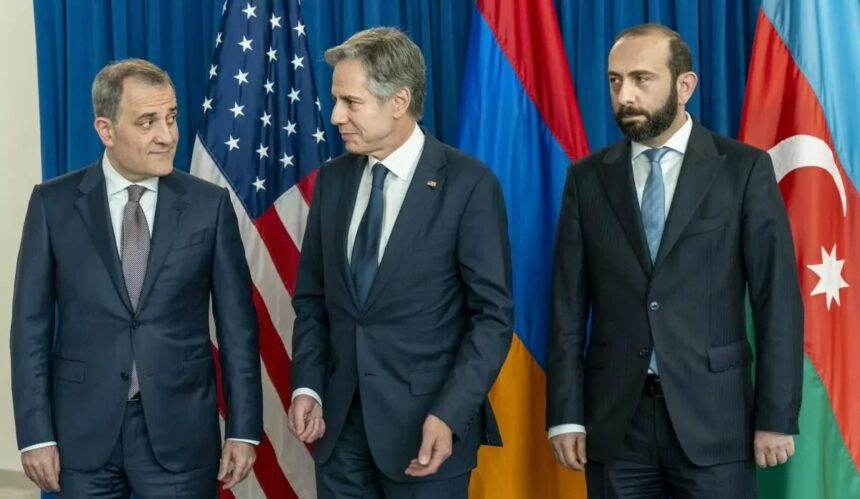
From June 27 to 29, the second round of the United States–mediated negotiations between the foreign ministers of Armenia and Azerbaijan was held in Washington (State.gov, June 29; see EDM, May 8). The statements from both sides following the talks and that of US Secretary of State Antony Blinken noted that the ministers agreed on more articles for the peace treaty and reached a mutual understanding on the draft agreement (State.gov, June 29; Mfa.gov.az; News.am, June 30). However, all three statements emphasized that Yerevan and Baku have yet to agree on “some key issues.”
According to statements from Armenian officials before and after the Washington-mediated meeting, a number of issues are particularly difficult to agree on for both sides (Armenpress, June 26; Armenpress, June 30). First, the Armenian side wants to use 1975 Soviet maps to delimit the border between the two countries. This contradicts the position of the Azerbaijani side, which wants to use “analyses and examination of legally binding documents, rather than any specially chosen map” for this process (Apa.az, June 5).
The second issue is the Armenian demand for an international mechanism to address the security and rights of the Armenian minority in the Karabakh region of Azerbaijan. For its part, Baku has made clear on a number of occasions that the issues related to the Armenian community in Karabakh are the internal matters of Azerbaijan and that it will not agree to any international mechanism to address these concerns. For the Azerbaijani government, such a mechanism may threaten to become a “Minsk Group 2.0,” in reference to the Minsk Group of the Organization for Security and Co-operation in Europe that failed to resolve the conflict between Yerevan and Baku for 30 years (see EDM, November 25, 2020; January 28, 2021; April 21, 2022).
According to Vice President of the Armenian National Assembly Ruben Rubinyan, the third issue on which the parties have yet to concur is the framework for guarantors of the peace agreement (Armenpress, June 26). Both sides understand the need for some mechanism to ensure compliance with the peace treaty, but they have yet to agree on the instrument’s modalities. The Armenian Ministry of Foreign Affairs also notes the withdrawal of forces from the Armenian-Azerbaijani border as another matter of contention between Yerevan and Baku (Armenpress, June 30).
Thus, the US-mediated ministerial talks have failed to bring the two sides to a mutual agreement on these thorny issues. The talks have also been negatively affected by armed clashes between both countries along the Armenian-Azerbaijani state border as well as in the part of the Karabakh region that is under the temporary control of the Russian peacekeeping forces. Azerbaijani media reports that, on June 15, members of the Armenian Armed Forces opened fire on servicemen of the Azerbaijani State Border Service at the Lachin border checkpoint as they were raising the Azerbaijan flag at the entrance of the Hakari bridge (Aztv.az, June 15). An Azerbaijani serviceman was injured in the course of the attack. Yerevan claimed that the area where the flag was being raised was Armenian territory (Asbarez, June 15)—a claim that was disputed by the Russian side, which noted the importance of demarcating the borders to prevent these sorts of clashes (Armenpress, June 21).
Immediately after the incident, the Azerbaijani side closed the Lachin checkpoint as the country’s law enforcement agencies began to investigate (Trend.az, June 16). In its aftermath, Baku asked both the Russian peacekeepers and the International Committee of the Red Cross (ICRC) to use the Aghdam-Khankandi road rather than the Lachin road to carry supplies to the Karabakh region while excluding the transfer of patients to Armenia who can be still carried via Lachin (Turan.az, June 24; Minval.az, June 28). As of June 30, the passage of Armenians via the Lachin Corridor has been restored through the ICRC’s mediation (Caliber.az, June 30).
The peace efforts were also disrupted by the armed clashes between Armenian and Azerbaijani forces in the Karabakh region on June 28, while the foreign ministers were still in talks in Washington. The Azerbaijani Defense Ministry reported that it carried out a small-scale military operation against the Armenian-backed separatist forces who had earlier attacked and injured one Azerbaijani serviceman (Mod.gov.az, June 27). The clashes, which resulted in the death of four Armenian servicemen, were used by the Russian-backed separatist regime to try to convince the Armenian government to halt the negotiations in Washington (News.am, June 28). Although this call did not result in the cancellation of the talks, it did create an unfavorable environment for them.
Meanwhile, the former Russian-backed “state minister” of the separatist region, Ruben Vardanyan (see EDM, February 13), accused Armenian Prime Minister Nikol Pashinyan of supposedly being “the failed negotiator who has no experience in governing the country or in the field of international diplomacy” and the “only one person responsible for the current situation” in the Karabakh region (News.am, July 2). Vardanyan’s overt attack on Pashinyan came on the heels of earlier media reports about Moscow’s possible intentions to push for a change of government in Yerevan (JAM-news, June 30).
It is no secret that Russian discontent is growing with the expanded role of the US and the European Union in the Armenian-Azerbaijani peace process (see EDM, May 23). For Moscow, Baku’s increasingly more favorable moves (e.g., closing the Lachin checkpoint for the Russian peacekeepers in the aftermath of the June 15 incident) and Yerevan’s more concerning policies (e.g., the deployment of the EU monitoring mission to the Armenian-Azerbaijani border while delaying the deployment of forces from the Collective Security Treaty Organization) adds more fuel to Russian fears about the possibility of a peace treaty ultimately being signed in the near future due to Western mediation and influence (see EDM, May 23; June 8). Hence, the intensifying clashes along the Armenian-Azerbaijani state border, as well as in the Karabakh region of Azerbaijan, serve the interests of those who seek to reverse recent progress in the peace negotiations and prevent the conclusion of an effective treaty under the existing circumstances.
Vasif Huseynov