The documents signed in Islamabad, which have multiple dimensions, indicate that this visit will have long-term consequences in the coming years.
Firstly, from the perspective of investment opportunities, Azerbaijan is coming to Pakistan not only as a military ally but also as an investor, beneficial to Islamabad by linking Pakistani producers to the Caspian region.
What will trade with Pakistan bring?
Thus, we have an example of interconnected processes. On one hand, promising Azerbaijani projects in Pakistan’s capital-intensive oil and gas sector mark the expansion of Baku’s economic interests. On the other hand, Azerbaijan will serve as a platform for the efforts of Pakistani businesses in the Caspian region and the South Caucasus.
The second aspect is related to the development of industrial hubs along transport corridors. Logistics networks and external economic “gates” at the borders are linked with industrial zones, which in turn are connected to a network of international transport corridors and multimodal communications.
A key hub for the supply of Pakistani goods to Azerbaijan is the terminal in Astara, opened in May 2024, which will increase transit freight traffic on the western route of the North-South Transport Corridor by 10-15% by the end of this year. The main cargo here consists of Russian-Iranian export-import shipments, including key commodities like timber (about 40% of total turnover) and grain and grain products (approximately 35% of total supplies).
Regarding the nomenclature of Pakistani supplies to Azerbaijan via the Astara terminal, the main flow of Pakistani rice (duty-free in Azerbaijan), livestock products, textiles, and container shipments for small and medium-sized businesses can be directed to the South Caucasus market.
The expansion of Pakistani freight traffic towards Azerbaijan and beyond will help “boost” cargo transportation along both the North-South Transport Corridor and the Middle Corridor routes. It’s important to note that over the past two years, trade between Pakistan and Russia has expanded, partly through Azerbaijani territory. Pakistan already supplies vegetables and fruits to the Russian market (the main flow currently goes through Central Asia), and there is also a certain flow of rice.
There are also projects for the supply of frozen vegetable and fruit mixtures, as well as nuts and legumes.
Transit to Russia
Conversely, in addition to wheat, the volume of other grains (buckwheat, oats, barley) and their processed products (cereals, muesli, etc.), as well as meat and meat products, dairy products, fish, and seafood from Russia to Pakistan is increasing.
About 70% of all Pakistani grain imports come from Russia, but they are either shipped by sea from Novorossiysk or via the eastern segment of the North-South Transport Corridor. However, this year, deliveries of Pakistani mandarins to Dagestan through Azerbaijani territory have begun.
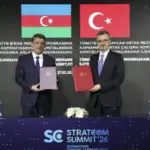
Addressing the expansion of the transport corridor, a high-level Azerbaijani delegation signed a “Transit Trade Agreement” in Islamabad, thus integrating the western segment of the North-South Transport Corridor into the Caspian supply network.
Another very important document signed in Islamabad is the “Preferential Trade Agreement.” The Pakistan Investment Council is currently forming a portfolio of investment proposals worth $2-3 billion for the Azerbaijani government to review. The conclusion of these negotiations is expected in November.
In the oil and gas sector, the Pakistani leadership offers our country a wide range of prospective projects, including underground gas storage, the White Oil Pipeline, liquefied petroleum gas infrastructure in the Karachi area, a stake in Pakistan Refinery Limited (PRL), projects in copper and gold mining, the creation of a joint venture between Pakistan State Oil (PSO) and SOCAR, and investments in exploration blocks both offshore and onshore.
The delegations also signed a memorandum of understanding on cooperation in information and communication technologies and an agreement on cooperation in science and technology in Islamabad.
In this context, the creation of IT campuses in Azerbaijan by leading Pakistani manufacturers of network equipment, smartphones, and IT services is not excluded.
BRICS as a Global Structure of the 21st Century
Another facet of Baku and Islamabad’s interaction is cooperation within the BRICS and SCO orbit. Concurrent with Ilham Aliyev’s visit to Pakistan, Milli Majlis Chairperson Sahiba Gafarova, speaking at the plenary session of the 10th BRICS Parliamentary Forum, reminded that Azerbaijan has strategic plans to become a full member of BRICS.
It turns out that Pakistan is moving in the same direction.
Local experts emphasize that Pakistani agriculture, textile industry, and information technology will gain further development momentum from BRICS membership. They also point to Pakistan’s strategic geographic location, as a link between South Asia, Central Asia, and the Middle East, which can strengthen regional ties and economic cooperation, aligning with BRICS’ goals to create a diversified and interconnected Global South.
Islamabad recognizes the economic and diplomatic advantages of BRICS membership, despite understanding the obstacles from India and the difficulty in meeting economic criteria.
In Pakistan, there is confidence that the China-Pakistan Economic Corridor (CPEC) is a bright example of Islamabad’s capability to participate in significant infrastructure projects and development plans reflecting BRICS’ spirit of cooperation.
Similarly, Azerbaijan, by developing communications both longitudinally and latitudinally, will form a key regional Caspian hub within BRICS and SCO, simultaneously creating a new financial, investment, and political architecture.
A Hero’s Welcome
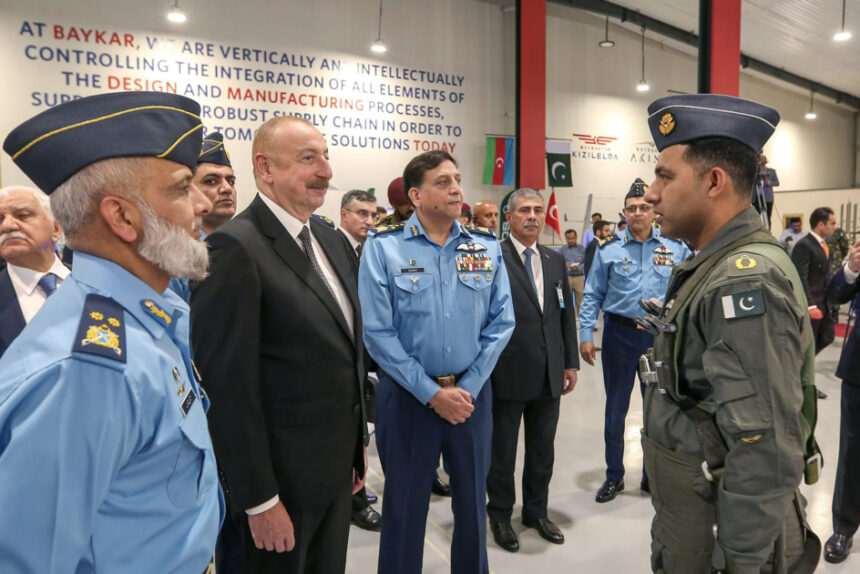
The honorary escort of Azerbaijan’s top aircraft by Pakistan Air Force fighters was not just a mark of respect and an attribute of a state visit by the leader of an allied country. The Pakistani military and political elite are undoubtedly aware that Azerbaijan is the sole favorite among the new post-Soviet armies, having proven its competence on the battlefield and fully liberating territories occupied by Armenia.
Historically, Pakistan, as a former British colony, is a country that, in constant confrontation with a powerful neighboring adversary, primarily relies on military success. Furthermore, it is within this framework that the Pakistani elite views all its partners.
It’s not just about the historical rivalry between New Delhi and Islamabad, including their influence on post-Soviet countries. Official Islamabad sees Ilham Aliyev not only as an influential political leader but primarily as the Supreme Commander of a victorious army. In the context of armed conflicts spanning Eurasia from the Middle East to the Far East, this is doubly valued.
Is it any wonder, then, that countries on this continent, as seen in the example of Pakistan and Azerbaijan, seek not only to expand their circle of military allies but also to strengthen relationships with them?
Ilgar Huseynov
Translated from haqqin.az