
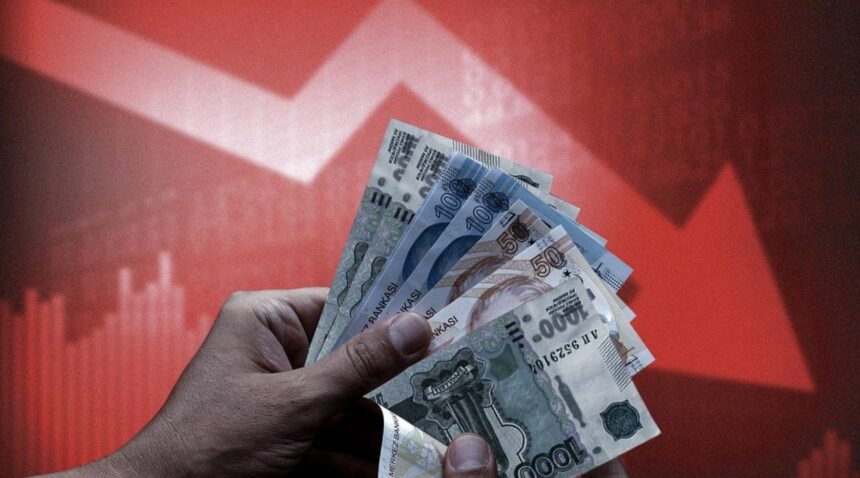
The fall of the Turkish lira, which has been continuing for more than two years, intensified again in June, despite recent attempts to raise the discount rate. In the first half of 2023, there was also high volatility with the Russian rouble depreciating by a quarter of its value against the US dollar and this negative trend continued in June.
The weakening of the currencies of the leading trading partners cannot but have an impact on the economic processes in our country and, alongside the depreciation of imports, narrows the scope for domestic exports and to a certain extent also limits the potential for inbound tourism.
Meanwhile, the volatility of the world’s main reserve currency, the US dollar, has reduced markedly in recent months, largely as a result of the US Federal Reserve (Fed) steadily tightening monetary policy since the second half of last year.
The data coming in June shows that the US economy is resilient and the threat of recession no longer appears to be an inevitable scenario as was expected at the end of last year. In this context, Fed Chairman Jerome Powell reiterated the other day that the US regulator has not completed the cycle of monetary policy tightening and it is very likely that the discount rate parameters will be raised even further by the end of July, indicating an unchanged high course of the dollar.
This version is also supported by a still rather high inflation rate in the USA – higher than expected in the annual forecasts. According to Powell, high consumer price indices are the most important argument for further interest rate hikes and the Fed sees the possibility of at least two more increases in the benchmark interest rate this year.
Of course, global processes are not good for the other currencies in the global reserve basket (euro, pound, and yen), and according to expert estimates, they may weaken further at the beginning of the second half of the year. The high volatility and weakness of the euro, in contrast to the strengthening US dollar, is quite an objective phenomenon: Europe’s economy has been hit hardest by the energy, food, transport and logistics, and other crises of the last 18 months, mainly related to the Russian-Ukrainian war and the sanctions standoff, as well as the loss of EU companies’ assets and markets in Russia.
This year, however, has put the Russian national currency to a particular test: in the first half of the year, the rouble has plummeted by 25% against the US dollar, losing around 8% in June alone. The depreciation of the rouble is recognised as one of the worst results on the global foreign exchange market, by comparison: of the major G20 economies only the Turkish lira is ahead with an almost 40% decline against the dollar since the start of the year.
In the last days of June, the Russian rouble continued to fall, having jumped over the annual lows: by the evening of June 30, the exchange rate against the US dollar exceeded 89 roubles; the Russian national currency also depreciated against the euro, and the yuan. It should be recalled that despite unprecedented Western sanctions against Russia, the Russian currency showed surprisingly low volatility for most of last year, trading within the range of 60 roubles per dollar, and a slight depreciation was observed only by mid-December.
This year, however, especially in April-June, the exchange rate stability of the rouble collapsed: the excessive import dependency due to the insufficient trade surplus had an impact. Demand for the US currency increased as foreign investors left and local companies withdrew their capital, compounded by the intensified de-dollarisation of the economy and increased stock market speculation on the foreign exchange market.
The new EU sanctions played a major role in the rouble’s depreciation, leading to lower export revenues amid falling exchange prices for Russian oil and gas raw materials and contracts for oil products and fuel, as well as the loss of a large part of the market for Russian energy products. The budget deficit on the back of weak exports and, conversely, the increased need for foreign currency due to war costs and other current external challenges are also significant pressure on the rouble.
The situation in the Turkish foreign exchange market remains very difficult. Since 2021 the discount rate of the Turkish central bank has been consistently falling. Despite a weaker lira and high inflation in the country, the rate fell from 19% in 2021 to 8.5% by February 2023 and the regulator has not moved to raise the interest rate since then, leaving it unchanged.
However, Turkish President Recep Tayyip Erdogan appointed Hafize Gaye Erkan, who worked at Goldman Sachs for nearly a decade, as head of the central bank in June, a move that signalled a shift to a traditional policy of containing inflation and strengthening the national currency by raising the refinancing rate to attract foreign investors who had left the country.
At the same time, Türkiye’s central bank relaxed regulatory requirements previously introduced to encourage individuals and businesses to reduce dollar investments and increase deposits in Turkish lira. The mechanism that required banks to reserve assets in lira at 10% of foreign currency deposits has been revised – according to the new version, this parameter has been lowered to 5%.
However, there is no immediate positive reaction of the financial market to attempts to adjust the monetary mechanisms. On June 22 the regulator raised the refinancing rate to 15% for the first time in 27 months, but it failed to achieve the expected stability for the national currency – the dollar exchange rate exceeded 24 Turkish liras for the first time ever. By June 30, the Turkish national currency had actually fallen to 26 liras to the dollar.
According to the forecasts of experts from the world’s leading banking structures – Goldman Sachs Group, JPMorgan, Morgan Stanley – new steps will be taken in Türkiye in the coming months to raise the discount rate to keep the lira exchange rate from falling further. In turn, analysts at the Financial Times and Bloomberg Economics do not rule out a further weakening of the Russian national currency, the rouble.
How could the dramatic events of the past six months affect the economy of Azerbaijan, for which Türkiye and Russia are listed as leading trading partners, especially in the segment of the non-oil economy? Last year, our country’s trade turnover with Türkiye in the past year approached $6 billion, continuing a proportional increase in the current year, supported by the preferential trade regime in force since 2021.
The depreciation of the lira will certainly affect the growth of Turkish imports into our country, including due to the growing year-on-year e-commerce. At the same time, strengthening the manat against the lira will not have a serious adverse effect on domestic exporters: a significant part of Azerbaijan’s supplies to the Turkish market comes from oil and gas raw materials, fuel, petrochemicals, and electricity.
Pricing in this segment is often based on special long-term agreements and correlated with world dollar prices. As for Azerbaijan’s non-oil exports, despite a 19% increase in shipments in January-May 2023, they amounted to $464.6 million, which is noticeably less than total energy and commodity exports.
The situation is somewhat different when considering trade turnover with Russia – the third largest trade partner of our country: in January-May 2023 Azerbaijani-Russian trade exceeded $1.789 billion, which is 44.4% more than the same period last year. The depreciation of the rouble observed in recent days will certainly affect the cheaper supplies from our northern neighbour, from where we import a considerable amount of food, particularly oilseeds, dairy and meat, cereals, flour, and confectionery products.
However, the Russian market is still the main for Azerbaijan’s export volumes of non-oil products: in the first five months of this year, Azerbaijani non-oil products delivered to Russia worth $ 404 million, with a growth of 53.4%. Of course, a further devaluation of the rouble and strengthening of the manat will not best affect the supply of fruits and vegetables and other agricultural products from Azerbaijan to the Russian Federation, as well as will affect the transport logistics.
On the other hand, the strengthening of the manat is not a good option for the development of tourism relations, which have strengthened markedly in the past year and a half. Thus, according to research recently published by IT company ATOL and travel service Tutu.ru, Azerbaijan is recognized as the country most visited by Russian tourists this year: in the regional ranking of Top 5 our country, having scored 15% in the most popular destinations for Russian citizens.
Nevertheless, despite the sinking of the lira and the rouble, we should not expect any negative impact on the sustainability of the manat. “Our financial system is in a fairly balanced state, the banking system is reliable, and the country has quite large reserves and very low debt. Therefore, we do not expect any particular negative effects,” Finance Minister Samir Sharifov said recently, ruling out any unwanted impact of inflation in Türkiye on the financial system of Azerbaijan.
Here it should be noted that about 90% of Azerbaijan’s exports account for energy resources, which are traditionally sold in the world market for dollars, creating an acceptable level of foreign trade and a balance of payments surplus.
Actually, so unlike the global energy crisis of 2014-2017, in 2021-2022 and the first half of 2023 the exchange rate of the Azerbaijani manat remained unshaken, and despite the raging inflation in the world, the situation in the currency market of our country remains generally stable. And most importantly, in contrast to many foreign trade partners, Azerbaijan has so far managed to avoid the worst scourge – monetary inflation. It was promoted by the measures taken last year by the Central Bank to maintain macroeconomic stability: various monetary and credit mechanisms were used which ensured stability of the manat – the most important anti-inflationary factor.
Equilibrium in the foreign exchange market strengthens the main anchor of price stability and neutralises imported inflation to a certain extent. All this makes the financial system of our country rather strong and creates a certain barrier against the influence of negative processes currently taking place in the economic space of post-soviet countries and Türkiye.
Khazar Akhundov
Caliber.Az