Georgians of all political stripes need to resolve their current crisis or risk losing Western support for their country’s aspirations to join the Euro-Atlantic community. The United States, as the country with the greatest positive influence in Georgia, needs to help facilitate a compromise.
For a country of only 4 million people, Georgia plays an outsized role in American strategy. This is partly due to its geography: Georgia serves as a Western gateway for trade from Central Asia and is a key part of the only economically viable east-west route that does not transit Russia or Iran for pipelines, railways, and highways for goods and resources en route to the Black Sea and beyond.
But Georgia has also made itself a key partner of the U.S. and its allies. Georgian troops have partnered with the U.S. military in Iraq, Afghanistan, and elsewhere, demonstrating Georgia’s commitment to being net contributors to international security. Georgia consistently has been the most pro-American country in the Eurasia region. After the 2008 Russo-Georgian War, in which Russia occupied 20 percent of the country, Georgia committed to integrating fully with the Euro-Atlantic world. The United States has provided more than $4 billion in military and non-military aid to Georgia over the past several decades to support the country’s democratic transition and Euro-Atlantic aspirations, and to defend against further Russian aggression.
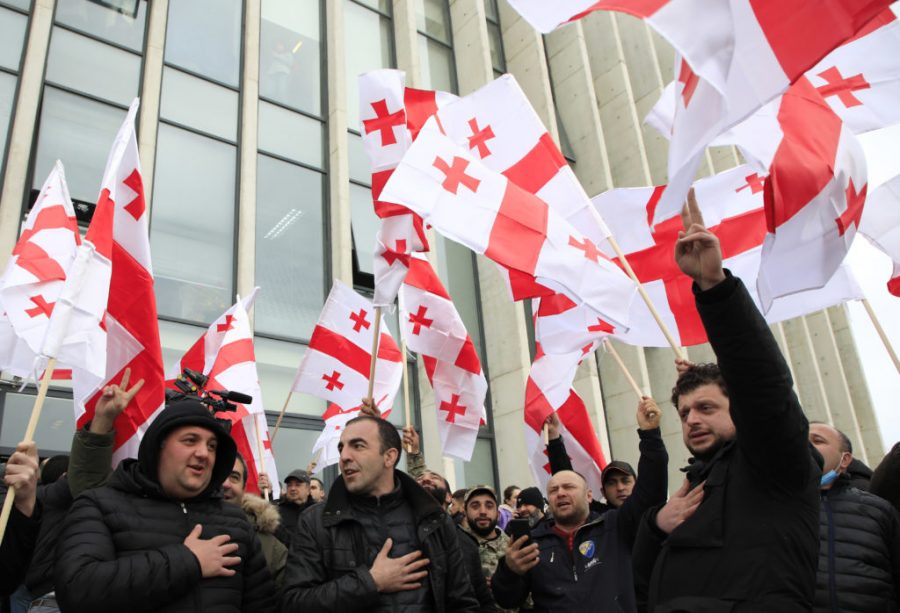
But the Georgian government’s decision in late February to storm the headquarters of the leading opposition party and arrest its leader, Nika Melia, put that support and goodwill in jeopardy. Melia remains in jail, unable to represent the interests of his party, United National Movement (UNM), in attempts to find a compromise with the party in power, Georgian Dream.
After claims of electoral fraud in last fall’s parliamentary election, which the Organization for Security and Cooperation in Europe essentially described as free but not entirely fair, UNM and other political parties boycotted the parliament, forcing a stalemate. The result is a one-party parliament, a feature Georgia shares unflatteringly with the likes of North Korea, China, Vietnam and Cuba. For Georgia to return to the path of democracy, Georgian Dream and the UNM-led opposition need to find a compromise, which is impossible when one side has imprisoned the leader of the other.
The European Union over the past few weeks has attempted to facilitate a resolution to the crisis with the recent visit to Tbilisi of European Council President Charles Michel. His designated special envoy, Christian Daniellson, followed up, but has so far failed to bring the parties together. The United States, meanwhile, aside from on-the-ground efforts by the U.S. ambassador, has been absent.
Melia was arrested in February on charges dating back to June 2019, when he called on protestors to storm the parliament after a Russian deputy, who had been invited by Georgian Dream leaders to participate in a conference in the parliament, took the speaker’s chair and spoke in Russian. Many Georgians took offense at the Russian lawmaker, Sergei Gavrilov , who supported Russia’s invasion of Georgia in 2008, being honored in their capitol.
The protests forced then-parliament speaker Irakli Kobakhidze, to resign, but he has since reemerged as leader of Georgian Dream. He ostensibly replaced billionaire Bidzina Ivanishvili, who made his fortune in Russia and is viewed by some as insufficiently tough toward the Kremlin, served for a year as prime minister in 2012-13, and remains the power behind the throne. Ivanishvili installed Irakli Gharibashvili as prime minister to carry the arrest of Melia after the previous prime minister, Giorgi Gakharia, resigned rather than authorize the arrest.
The crisis is the culmination of years of zero-sum politics, including attempts by Georgia’s ruling parties to marginalize the opposition and consolidate the reins of power to themselves. The problem of state capture is growing, evidenced in particular by court decisions favoring the government and Ivanishvili’s cronies, and threatens to stunt foreign investment if not halted quickly. Already reeling from the public health and economic impact of the pandemic, Georgia cannot afford to let the political crisis to drag on.
The crisis in Georgia comes at a critical time for the South Caucasus region. Recent months have seen war between Georgia’s neighbors, Armenia and Azerbaijan, and a shaky cease-fire enforced by 2,000 Russian troops. The U.S. and its allies need a resilient and secure Georgia to help stop the slide toward conflict and predations by larger powers. Georgia’s success matters because the region, beset on all sides by Russian occupation, conflict, and autocracy, needs a virtuous counter-model. Georgia’s location in a conflict zone is not just a challenge, but also an opportunity to show there can be a different outcome to the region’s troubles, which only benefit Russia.
The EU’s noble, but so far unsuccessful efforts to mediate the situation need reinforcement from the United States. The U.S. has a strong stake in seeing Georgia fulfil its sovereign choice to join the West and serve as a stable democracy on a critical east-west trade and energy corridor. While the Biden administration faces a vast array of domestic and foreign policy challenges, the United States needs to encourage a resolution to the crisis and exercise its outsized influence—including by signaling the possibility of sanctions for those responsible for setting the country on the brink.
That requires getting a full team in place at the State Department, where only three officials have been confirmed, and the president has yet to nominate a single assistant secretary. Filling those positions will take time, however, so in the interim, several key members of Congress, on a bipartisan basis, should organize a trip to Tbilisi and serve as temporary special envoys. In 2004, Senator Richard Lugar traveled to Kiev to help Ukraine out of a dangerous stalemate in that country. Georgia needs a similar effort. The recent hearing in the Senate Foreign Relations Committee was a start to a more active congressional role.
The only ones profiting from instability and chaos in Georgia are sitting in the Kremlin. That realization alone should be a wake-up call to all in Georgia, and to Georgia’s friends in the West, that Melia should be released immediately, after which all parties should work in good faith toward compromise on multi-party representation in the parliament. The United States can play a key role in facilitating that, but it needs to move quickly.
Ian Kelly and David J. Kramer
The Bulwark