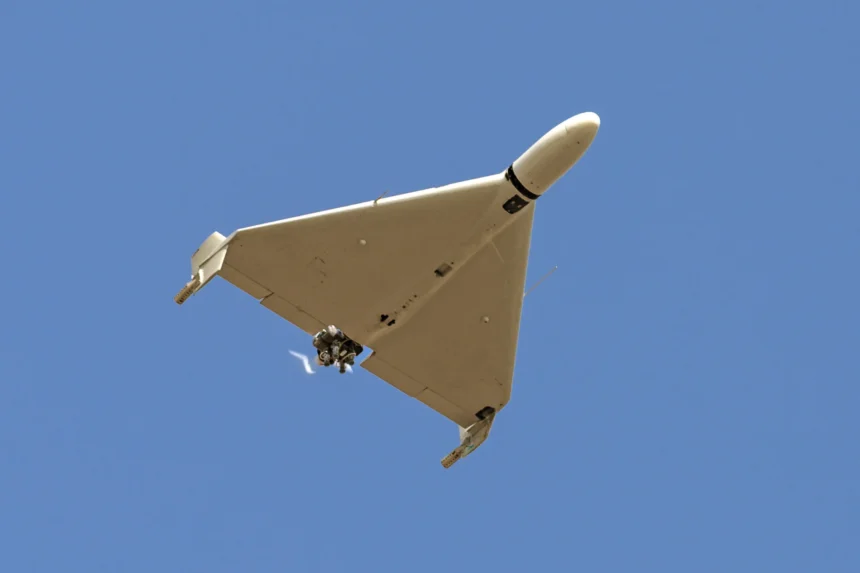
The drone strike on Azerbaijan’s Nakhchivan Autonomous Republic on March 5 has become one of the most serious incidents in relations between Baku and Tehran in recent years. Azerbaijani authorities described the incident as a terrorist act and demanded explanations and an apology from Iran. Tehran, in turn, rejected the accusations, suggesting the possibility of a provocation by “third forces.”
What began as a local security incident has raised concerns about regional stability in the South Caucasus.
Terrorist Act Against the State
Azerbaijani President Ilham Aliyev issued a statement strongly condemning “this despicable terrorist act. Those who committed it must be brought to justice immediately,” Aliyev said.
According to Azerbaijan’s Ministry of Foreign Affairs, one drone hit the terminal building of Nakhchivan International Airport, while another crashed near a school in the village of Shekerabad. Two civilians were reportedly injured.
Baku stressed that the attack, allegedly launched from Iranian territory, violated international law and could lead to a dangerous escalation of tensions in the region.
Diplomatic Escalation
Despite the harsh rhetoric in the first hours after the incident, Baku opted to rely primarily on diplomatic tools. The Iranian ambassador was summoned to the Azerbaijani Foreign Ministry and handed a formal note of protest requesting official explanations. Azerbaijan said on Friday that it was evacuating staff from its embassy in Tehran as well as its consulate in the city of Tabriz.
At the same time, Azerbaijani security forces were placed on high alert. According to Aliyev, the country’s armed forces were instructed to prepare possible countermeasures.
Turkish President Recep Tayyip Erdogan spoke by phone with Aliyev, condemning the attack and expressing support for Azerbaijan, according to official statements. Reports of alleged Iranian-linked sabotage plots also surfaced, with the Azerbaijani authorities stating that several terrorist attacks had been prevented on the country’s territory. According to the State Security Service, the Iranian Islamic Revolutionary Guard Corps was behind the plots. Among the alleged targets was the Baku-Tbilisi-Ceyhan oil pipeline, a strategic energy corridor linking the Caspian region with Turkey and one of the main routes for exporting Azerbaijani oil.
According to Azerbaijani sources, other potential targets included the Israeli embassy, a synagogue in the capital, and a leader of the local Mountain Jewish community. The security service reported that three explosive devices had been brought into the country but were discovered and defused before they could be delivered.
The development of the crisis has prompted increased diplomatic contact between world leaders. Russian President Vladimir Putin held a telephone conversation with Iranian President Masoud Pezeshkian amid the growing regional tensions. Shortly thereafter, Russia’s Foreign Ministry called on both sides to exercise restraint and emphasized the need for a thorough investigation into the drone strike.
On March 7, the foreign ministers of all the Central Asian states, together with Azerbaijan, were guests of Recep Tayyip Erdoğan in Istanbul to discuss regional cooperation and emerging security challenges within the Organization of Turkic States (OTS) framework.
On March 8, French President Emmanuel Macron also held a telephone conversation with Aliyev and expressed support for Azerbaijan.
Aliyev also held consultations with several leaders from Central Asia and the Middle East as the crisis unfolded. The office of Uzbek President Shavkat Mirziyoyev reported a phone call with Aliyev to discuss regional security, while regional media reported consultations and expressions of concern from officials in Kazakhstan. Aliyev later also thanked Kazakh President Kassym-Jomart Tokayev for his support following the incident. Analysts note that such intense diplomatic activity reflects attempts by international actors to prevent further escalation in the region.
Tehran’s Response: Denial and Accusations of Provocation
Following the strike, Iran categorically rejected accusations of its involvement. The general staff of the country’s armed forces stated that Iran “respects the sovereignty of all states, especially neighboring and Muslim ones.” Iranian President Masoud Pezeshkian appealed to neighboring countries, emphasizing that Tehran is seeking to resolve the conflict through diplomatic means.
“We respect your sovereignty and believe that the security and stability of the region should be achieved through the collective efforts of the countries in the region,” he wrote on X.
By March 8, there were already signs of de-escalation. Pezeshkian contacted Aliyev directly, stating that the incident involving the attacks was not related to Iran and assuring his counterpart that the circumstances would be investigated. He also expressed gratitude for Azerbaijan’s intention to provide humanitarian aid to Iran.
How Analysts Are Interpreting the Incident
The incident has sparked intense debate among regional analysts, who have proposed several possible explanations.
Some regional analysts have suggested that the strike could have been intended to put pressure on Azerbaijan amid broader regional tensions. In recent years, Azerbaijan has strengthened relations with the U.S. and Israel, developments that have caused concern in Tehran. In this context, analysts have discussed the possibility of threats against the Baku-Tbilisi-Ceyhan oil pipeline, which supplies a significant share of Israel’s imported oil. Around 30–45% of Israel’s oil imports originate from Azerbaijan via BTC and related supply chains, with some reports suggesting the share reached 46% earlier this year.
A shutdown of the pipeline would affect Israel’s energy security, but it would also have serious economic consequences for Azerbaijan, as up to 80% of the country’s oil exports pass through this route. Disruptions would also affect Turkey, Kazakhstan, Turkmenistan, and European consumers.
The second explanation focuses on the internal structure of Iran’s military system. Some analysts have also raised the possibility that the decision could have originated from elements within the Islamic Revolutionary Guard Corps rather than Iran’s political leadership. Given the complexity of command structures during military operations, analysts note that technical failures or errors in the command system also cannot be ruled out.
A third explanation, promoted by Iranian officials through state media, involves the possible role of third parties seeking to draw the region into a wider conflict. Representatives of Iran’s Khatam al-Anbia Central Headquarters issued a warning to Azerbaijan, calling on the country to remove the Israeli presence from its territory.
A Fragile Security Environment
Even if this incident proves to be an isolated episode, it highlights the fragility of security in the South Caucasus. Azerbaijan plays a central role in the energy architecture of Eurasia, with major oil and gas routes from the Caspian region to Western markets passing through its territory. Any escalation between Baku and Tehran could therefore affect not only regional security but also the stability of energy flows and transport corridors linking Central Asia, the Caucasus, and Europe.
For now, despite strong rhetoric, both sides appear willing to keep the dispute within the diplomatic arena. The key question is whether the incident will remain a short-term crisis or become the first episode in a broader confrontation in one of Eurasia’s most strategically sensitive regions.
Vagit Ismailov is a Kazakhstani journalist. He has worked in leading regional and national publications.