

This is where you find one of the breaking points between homosexuality-themed films and the cinematic art: exploring homosexuality in the body and making physiological feelings the center of the story.
Pasolini’s film, based on Euripides’ Medea, certainly does not tell a story of homosexuals. But Pasolini, one of the most brilliant creators in the world cinema, was one.
Although Pasolini does not focus much on homosexuality in his films, in some of his works, the homosexual motif is a part of the main storyline and carries a philosophical-theological-social content.
The energetic information communicated from that scene in Medea—the director’s homosexual vision—emerges spontaneously, subconsciously.
***
According to some assertions, the first film hinting at homosexuality was shot by the inventor William Dixon. Born in France to a Scottish immigrant family, Dixon’s 25-second The Dickson Experimental Sound Film (1895) shows two men embracing and dancing. But there is no saying for certain what the director wants to say about this kind of relationship.
The first film on the subject in the history of cinema was The Wings (1916) by Swedish director Moritz Stayler, based on Danish writer Herman Bang’s 1902 novel Mikaël. I cannot say anything about the artistic value of the film because there is no quality copy available on the Internet. The novel was adapted for the screen again in 1924 by the famous Danish director Carl Dreyer—I will come back to it later.
However, the purpose of this article is not to talk about educational films aimed at neutralizing homophobia. I will compare films featuring homosexuality by directors who have made a significant impact on the art of cinema with homosexuality-themed films of modern cinema, especially of the New Queer Cinema wave, that have gained popularity as works of art at indie film festivals. My first article covers the forms and approach influential authors take depicting homosexuality in their films and the meaning of their emphasis on homosexuality.
***
In Pasolini’s parable Teorema (1968), which enriches the cinematic art with social, Marxist analysis, mythical foundations and poetic constructions, a man having sexual intercourse with a man has no homoerotic meaning. An unnamed visitor arrives at the house of a rich family. He makes love to all the members of the family— the son, the father, the mother, the daughter and the maid—and disappears. Taking away the comfort of the family, which embodies a small model of capitalist society, the visitor causes their ruination. The secrets and vices of the family coming out when the stranger comes into their lives is a dramatic device that reveals the essence of the bourgeoisie. The director allows the maid to escape that only because of her social status.
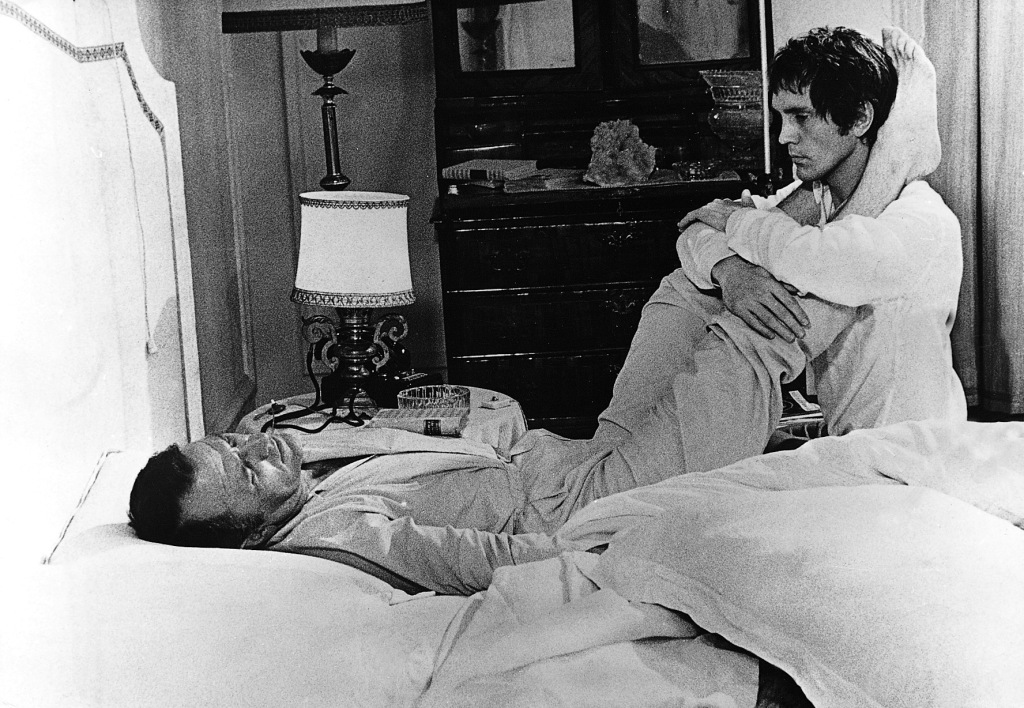
By the way, the film Three (2010) written and directed by Tom Tykwer, one of the most interesting examples of auteur cinema, draws from Teorema: a third person come into the life of an intellectual German couple and falls in love with both. Of course, this is not about a same-sex relationship either. The film is about irrational beliefs. The director offers a stable family formula by bringing a third person into the life of a couple living in monotony, indifference, moral and psychological fatigue and going through a relationship crisis. Only then does the couple’s life return to normal. This is why Tykwer said, “I see Three more as renewal and salvation.”
Luchino Visconti, one of the fathers of Italian neo-realism, was also a homosexual and was sexually abused while imprisoned for his anti-fascist activities. The director’s historical drama The Damned (1969) is a multifaceted story that depicts the establishment of Nazism in Germany in one family: some are killed, some flee, and the strong come to power.
Scenes of pedophilia, incest, homosexual orgy are used to dissect the idea of Nazism. In the episode dramatizing the Night of the Long Knives (in 1934, at Hitler’s behest, the Nazis’ paramilitary organization, Sturmabteilung (SA), which had played a key role in bringing the National Socialists to power, was eradicated because the organization’s leader Ernst Röhm’s was suspected of infidelity and insurrection. The purge went down in history as the “Night of the Long Knives”.), Röhm’s soldiers enjoy a homosexual orgy. The homosexual orgy here can be easily replaced with a heterosexual one. The scene of the homosexual orgy, it seems, is a symbol of Röhm’s sexual orientation. Röhm was gay, he used his status for personal purposes, and his appointment to this post was called a national-socialist disgrace. On the other hand, in some religious traditions, an orgy was a ritual performed to honor the gods. It is possible that the director also hinted at the blind worship of an individual through an orgy full of violence and chaos.
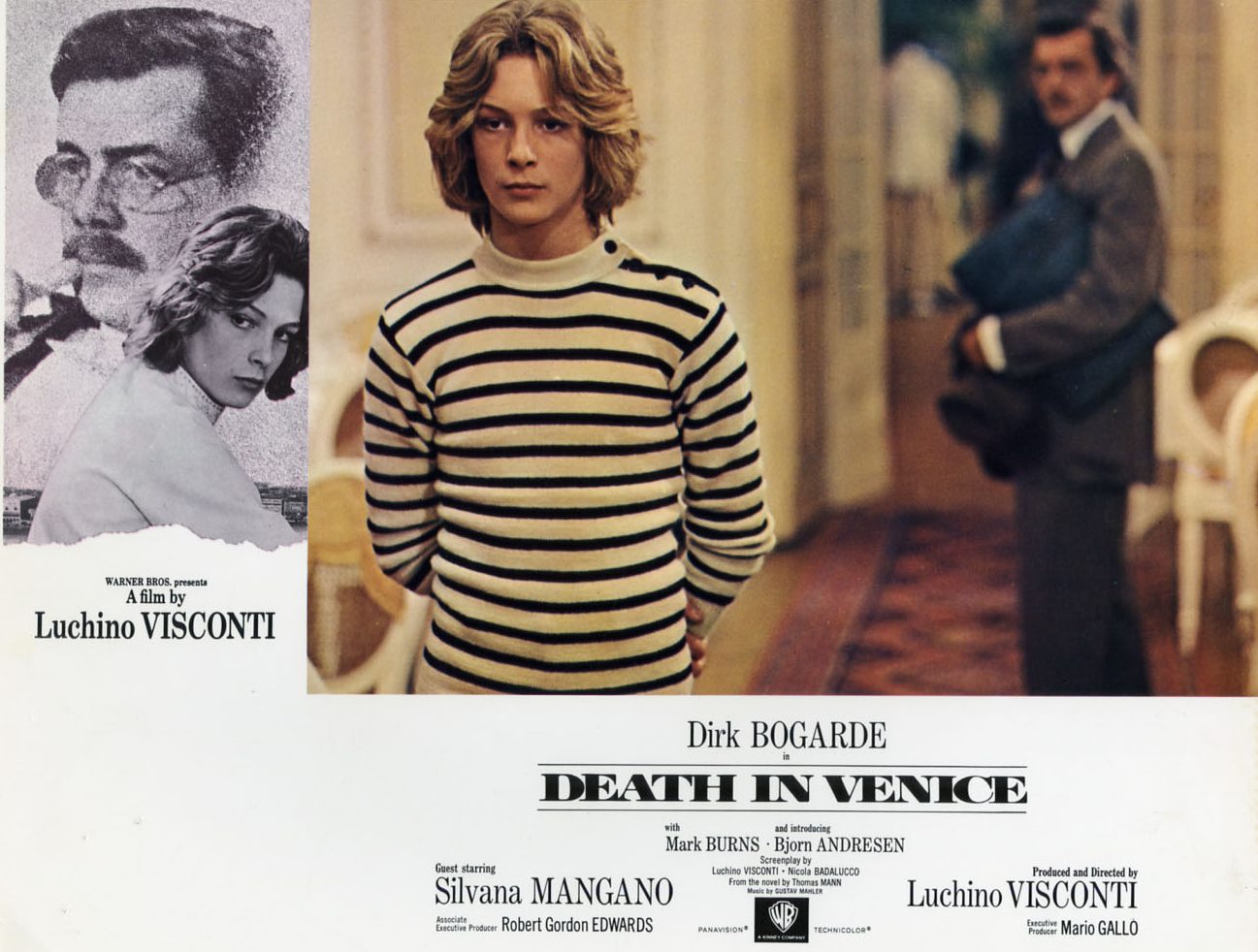
In Death in Venice (1971), traces of latent homosexuality can be found in the admiration for Tadzio’s adolescent freshness and beauty on the part of Aschenbach, who is going through personal and creative crisis. However, it would not be right to limit the range of issues contained in the idea of the story. Aschenbach is not a participant in real life, but a voyeur, he treats art as an absolute truth, and his escapist position takes him away from the realities of life. We get to know some details of the composer’s family tragedy in flashbacks. Perhaps his phobia of reality is rooted in the loss of a loved one. When he encounters Tadzio, who resembles a Greek god, the boy’s divine, yet tangible beauty subdues him, and, compared to this reality, art loses its power. The relentless time, the disharmony of old age kills his courage to approach the teenager, and he is afraid of losing his balance in the face of beauty (i.e., life). In short, the film is about art and reality, life and death.
The historical drama Ludwig (1972) is a film about the life and death of King Ludwig II of Bavaria. Visconti does not emphasize Ludwig’s homosexual desire, but hints at it in subtext. The main purpose is to show the protagonist’s isolation, loneliness and inability to be himself in the socio-political environment in which he lives. Decadence that soothes his loneliness (he loves Wagner’s music, he builds magnificent, fairytale-like castles) stems from his suppression of homosexual desires contradicting the Christian faith, and from the problem of sexual identity. Visconti said, “Ludwig’s life is a colossal defeat. I like telling stories of defeat. This is a tale of lonely hearts, souls and destinies destroyed by reality.”
***
Before I forget, a brief note on Carl Dreyer’s Michael. The plot of the film is the famous artist Claude’s love for his model Michael. The film does not have an enlightening, social character. The ultimate goal is to show the effect of love on an individual’s destiny: love can both destroy and save us. Michael takes advantage of the artist’s financial resources, then falls for a woman and leaves Claude. The artist dies of a broken heart. Homoeroticism is toned down in the film, love is mainly expressed in looks and text.
Dreyer went down in the history of world cinema as an innovative director, famous for his avant-garde techniques, and filmed one of the masterpieces of silent cinema, The Passion of Joan of Arc. In comparison with his body of work, Michael is a banal melodrama. The performances are not convincing, the visual depth is lacking, and the static mise-en-scènes are tiring.
Rainer Werner Fassbinder, one of the prominent figures in the New German Cinema movement, an absolute nonconformist, made no secret of his homosexuality, and this motif was present in some of his films.
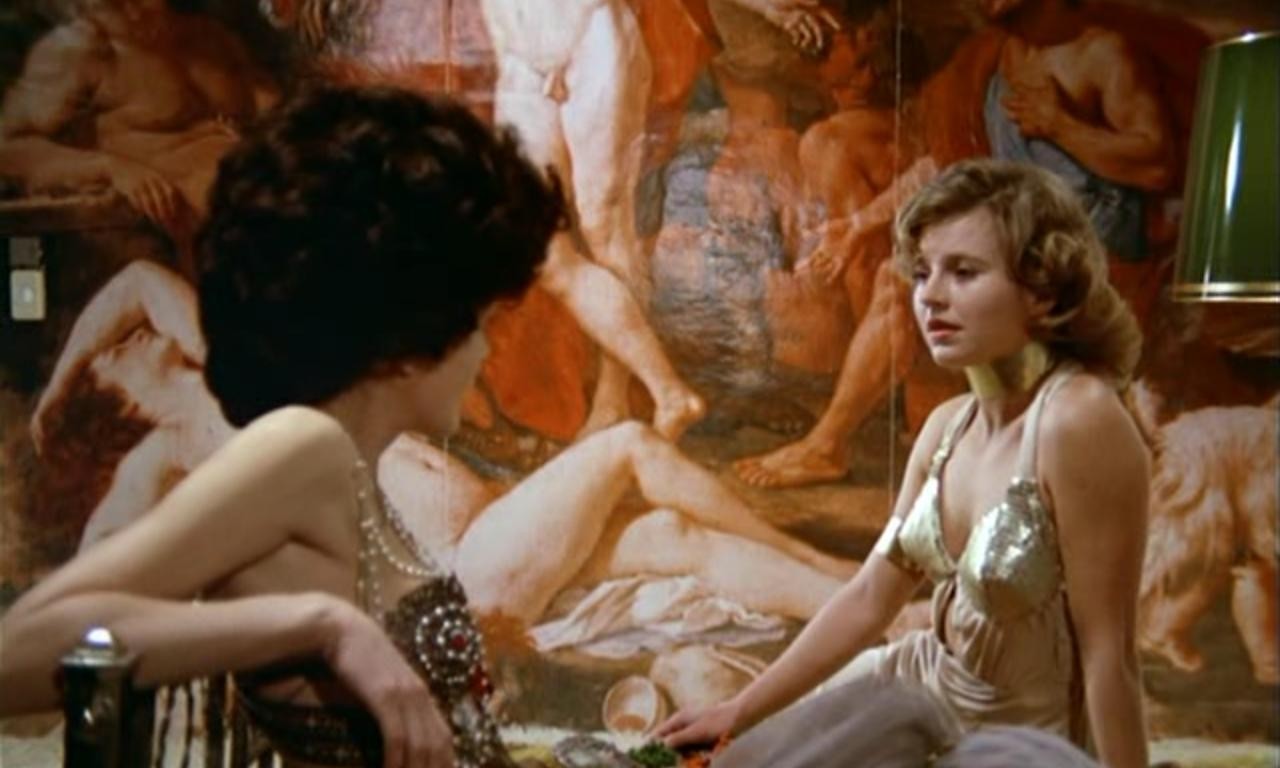
The protagonist of his chamber drama The Bitter Tears of Petra von Kant (1972), a famous fashion designer Petra is unlucky in personal life: she is divorced and indifferent to her daughter. Meeting a young model Karin gives new meaning to her life. Karin uses Petra’s access to the world of high fashion and then returns to her almost ex-husband. The story of Petra’s love for Karin, her alienation from society and family, her portrayal in the context of existential loneliness while surrounded by wealth, over-the-top, ambiguous aesthetic expression of glamorous life in the minimalistic settings and interiors saves the story from melodramatic banality. It also pays tribute to Douglas Sirk, who showed human tragedies and the futility of the “American dream” with luxurious settings and with whose work Fassbinder was fascinated.
Querelle (1982), an adaptation of Jean Genet’s novel of the same name, was Fassbinder’s last film. Combining homoerotic and criminal motives, the film is shot in the style of French poetic realism, and is influenced by the stylistics of Julien Duvivier’s film Pépé le Moko (1937). Querelle is overshadowed by Fassbinder’s major works in terms of dramatic composition and story. The plot is the criminal and sex life of a young sailor named Querelle, who is involved in drug trafficking. Intimate scenes are pornographic; characters suffering from lack of love try to fill that void inside with bestial, aggressive physical contact. In a way, the film may be regarded as Fassbinder’s self-portrait. After all, Kurt Raab, the actor who worked with Fassbinder on most of his films, said, “He was always in love and therefore angry.”
French director Marcel Carné, the president of the jury at the Cannes Film Festival that year, tried to convince his colleagues that Querelle should win the best film award, but it was impossible because of the homosexual nature of the story.
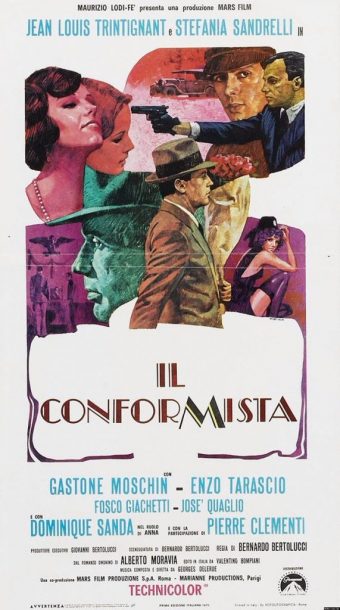
Bernardo Bertolucci, who usually touches upon taboo topics and explores subconscious motives in his films, explores fascism in stifled homosexual impulses in his drama The Conformist (1970). The story begins in 1938. Marcello collaborates with the fascists to build a “normal” life. One of his childhood traumas is having been sexually assaulted by a chauffeur. In the final scene that takes place after Mussolini’s fall, Marcello is shown with a naked teenager in a cave-like dark room. According to the director, at the end of the film, the protagonist understands why he is a fascist: because he wanted to hide and forget the roots of the homosexual desire that lurks in the deepest recesses of his consciousness. Thus, the director analyzes fascism, the reasons why Italians joined Mussolini’s party from a Freudian perspective. Some accused Bertolucci of homophobia. Indeed, from today’s point of view, the director’s exploration of the roots of fascism from the angle of sexual orientation seems a little simplistic to me.
However, the polyphonic, intricate structure and visual innovation of the narrative make The Conformist one of the best examples of the cinematic art.
***
“You may not talk about your homosexuality, but it’s important to understand it,” says Almodovar, who in most of his films explores women’s nature and emphasizes the importance of his mother and the women whose life stories he listens to. In his films, the homosexual lifestyle is shown as more than normal, and the director never opposes it to heteronormativity. Moreover, homosexuality is loaded with deep meanings and interpretations and acts as the background for other issues. It is also a pleasure to watch the homosexual storyline in Almodovar’s films because he offers an original interpretation of real-life stories, with the visual narrative often built on the mise en abyme technique and a unique way of working with flashbacks.
Bad Education (2004) is a moving story of Ignacio and his lover Enrique, who were sexually abused by the principal of a Catholic boarding school. Freedom of homosexual love is opposed to the dictatorship and hypocrisy of the institution of religion.
Almodovar’s latest film, Pain and Glory (2019), is about a film director’s physical and mental pain, loneliness, and re-evaluation of his past. The homosexual side plot dissolves in the main story.
In most of his works we come across stories of transvestites and transgender characters. The drama of the transvestite father in All About My Mother (1999) came from real life: “Lola was a transvestite from Barcelona. He didn’t allow his wife to wear a bikini, but he walked with his chest thrust out forward and offered his body to every stranger he would meet. This is an excellent example of machismo: something irrational, like all great manifestations of racism, paranoia and stupidity.” (Almodovar). 17-year-old Esteban, who wanted to become a writer, dies in an accident in front of his mother. The mother learns from her son’s diary that he wanted to know his father. The film emphasizes the possibility of a new life starting suddenly on the ruins of hope, the immensity of mother’s, woman’s compassion…
Aze.Media
If you want to contribute and have specific expertise, please contact us at editor@aze.media