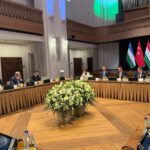
Azerbaijani President Ilham Aliyev’s April 2025 state visit to China, culminating in the signing of a Comprehensive Strategic Partnership, marks a significant elevation in bilateral relations. The agreement is more than a symbolic gesture: it reflects a strategic convergence across infrastructure, energy, and digital development. It also signals a re-balancing of power in the South Caucasus in response to Western inertia. As China consolidates its position, the question is no longer whether the West leads but whether it has already surrendered the initiative.
BACKGROUND: The Second Karabakh War of 2020 abruptly exposed the obsolescence of entrenched diplomatic frameworks in the South Caucasus, most notably the OSCE Minsk Group. The November 2020 Trilateral Statement that ended the fighting, brokered under Russia’s aegis, signified an incipient restructuring of regional dynamics. Russia positioned itself as the nominal guarantor of stability, installing a contingent of so-called peacekeepers on Azerbaijani territory. Yet this maneuver, driven by residual influence and opportunistic calculus, underscored Moscow’s determination to preserve a semblance of relevance amid shifting fault lines.
While Russia acted following long-established and well-defined interests, the U.S. and the EU hesitated. The initiatives introduced by Western actors, preoccupied with internal crises and other entanglements, lacked coherence, confidence, and strategic vision. The mediation efforts were fragmented and the summits were ad hoc. As a result, the promising diplomatic overtures failed to generate substantive traction. The reactive nature of Western engagement post-2020 contrasts starkly with the proactive moves of regional and other stakeholders having more immediate stakes in the evolving South Caucasus order.
Turkey’s deepening military partnership with Azerbaijan, formalized through the Shusha Declaration of 2021, epitomized pragmatic alignment. Kazakhstan, seizing the moment, accelerated its integration into the emergent Middle Corridor, bolstering East-West logistics networks through the Caspian basin. Concurrently, Gulf states capitalized on Azerbaijan’s post-war stabilization by channeling substantial investments into renewable energy infrastructure, particularly solar and wind projects in the liberated territories. These tangible gestures did not just reflect geoeconomic calculations but represented a recognition of the region’s latent economic potential.
In this context, China modified its traditionally cautious posture in the South Caucasus. Historically deferential to Russia’s informal sphere of influence, Beijing began to reassess the region’s strategic significance following the full-scale Russian invasion of Ukraine in February 2022. The resulting destabilization of Eurasian corridors, compounded by Western sanctions and the geopolitical weaponization of supply chains, propelled the South Caucasus from peripheral concern to a central axis in China’s connectivity strategy. This shift was not reflexive or opportunistic. Rather, it reflected China’s measured strategic assessment of the structural transformations in the architecture of Eurasian trade.
By 2022, the foundations for a deepening Sino-Azerbaijani partnership had been firmly established. The signing of a joint declaration on strategic partnership at the Shanghai Cooperation Organization summit in July 2024 signaled a decisive commitment to broaden bilateral economic ties. The two countries’ trade in 2024 was over 20 percent above its 2023 level, reaching nearly US$ 3.74 billion. Chinese enterprises expanded into sectors previously peripheral to their Eurasian ambitions: telecommunications, green energy, and transport logistics. President Ilham Aliyev’s state visit to Beijing in April 2025 did not initiate this trend but rather consolidated it. The Comprehensive Strategic Partnership (CSP) agreement was the logical culmination of sustained and deliberate moves that anchored Azerbaijan’s strategic realignment toward the East.
IMPLICATIONS: The realignment is not mere economic opportunism. Rather, it signals a deeper geopolitical evolution driven by the inadequacy of Western engagement and the region’s preparedness to respond to actors willing to match rhetoric with decisive action. The failure of Western policy is not just about inattentiveness, but also about an inability to grasp the interplay between regional agency, emerging connectivity frameworks, and the geopolitical vacuum created by Russia’s shifting posture. In this unfolding dynamic, Azerbaijan has moved beyond waiting for Western recognition or support. It has instead begun to assert its own role within a rapidly realigning Eurasian order.
For China, Azerbaijan serves as a gateway not only to Europe through the Middle Corridor but also toward the Middle East, reinforcing China’s broader trade architecture and strategic depth in the region. The CSP is not a symbolic gesture. Its scope is broad and consequential, encompassing coordinated industrial development, infrastructure harmonization, technology transfer, and streamlined customs protocols. These measures are underpinned by capital investments and long-term industrial partnerships.
For Azerbaijan, the CSP consolidates a deliberate move to attenuate traditional dependencies on Western and Russian interlocutors. It embodies Azerbaijan’s long-articulated aspirations for economic diversification, substantiated now by tangible capital flows and operational partnerships. The CSP’s provisions span petrochemicals, metallurgy, mechanical engineering, and renewables. Agreements on aerospace and intellectual property signal a strategic depth, eschewing transactional engagement in favor of embedded, systemic collaboration.
The transport dimension alone is reshaping regional dynamics. The Middle Corridor, stretching from China through Kazakhstan, the Caspian basin, and into the South Caucasus and Europe, has demonstrated rapid growth. While still smaller in scale than northern routes traversing Russia, its year-on-year expansion has been notable. A trilateral joint venture among Kazakhstan, Azerbaijan, and Georgia’s rail operators is actively synchronizing digital customs tracking and reducing delivery times to enhance competitiveness.
The Port of Alat, central to Azerbaijan’s maritime logistics, has already undergone substantial upgrades. Cross-border road transport agreements and operational protocols with China, concluded in 2024 and 2025, are streamlining east–west trade flows. China’s formal recognition of Azerbaijan as a “central transit node” underscores the strategic weight of this integration.
The significance of the CSP extends beyond ports and pipelines. Digital infrastructure has emerged as a foundational pillar. Huawei and ZTE, longstanding presences in the region, have solidified their positions through new agreements establishing joint research centers, expanding data infrastructure, and modernizing e-government frameworks. These initiatives are embedding Chinese technological standards into the South Caucasus and positioning Baku as a nascent digital hub.
Energy collaboration has similarly accelerated. China’s Universal Energy is backing the Gobustan solar project, with further discussions ongoing over potential wind energy developments along the Caspian coast. These initiatives are paralleled by an expansion of Chinese soft power, from Confucius Institutes to cultural exchanges and educational programs.
Azerbaijan has not “abandoned” the West. The reality is starker: the West has failed to keep pace with Azerbaijan’s evolving strategic calculus. President Aliyev’s visit to Beijing and the CSP with China are less an embrace of Beijing than a commentary on the chronic insufficiencies of Western engagement. For years, Baku signaled openness to deeper commercial ties, infrastructure investments, and a balanced diplomatic posture. What it often received were half-measures, symbolic gestures, and ideological critiques.
The waning of Western diplomatic leverage in the South Caucasus is not a sudden anomaly. It is the cumulative outcome of incremental miscalculations, fragmentary approaches, and the persistent failure to integrate regional realities into a coherent strategic vision. The 2020 Second Karabakh War marked a decisive inflection point. Azerbaijan’s reintegration of its formerly occupied territories exposed the impotence of frameworks long regarded as the bedrock of resolution efforts. The abrupt reassertion of Azerbaijani territorial sovereignty in 2020, and its completion in 2023, underscored the extent to which Western actors had become disconnected from the region’s evolving dynamics.
Europe’s Global Gateway initiative, though nominally prioritizing the Middle Corridor, remains hesitant and underfunded. The U.S., preoccupied with broader geopolitical contests, has failed to sustain a coherent South Caucasus policy. When attention does surface, it is often filtered through domestic advocacy agendas misaligned with both regional stability and U.S. strategic interests. Thus, under the influence of domestic lobbies, two of the Biden administration’s last acts were to decline to waive Section 907 of the Freedom Support Act, which bans direct assistance to the Azerbaijani government, and to sign a bilateral strategic partnership charter with the Armenian government.
CONCLUSIONS: The South Caucasus has shifted from constituting a peripheral zone to a strategic nexus. Capital and influence from East Asia, Central Asia, and the Middle East are converging upon the region. Turkey, Kazakhstan, and the Gulf states have become active participants in this evolving matrix. Azerbaijan, far from merely serving as a bridge, has assumed the role of architect and builder of new routes. Aliyev’s visit to Beijing is emblematic of this shift. Baku no longer waits for external recognition; it engineers its own relevance.
The West must recognize this not as a defection, but as an adaptation to opportunity over nostalgia. The coming months will be decisive. If the West wishes to remain a meaningful player, it must replace rhetorical overtures with substantive commitments: joint infrastructure ventures, credible support for energy transition, and diplomatic engagement rooted in regional realities rather than encumbered by historical preoccupations.
Azerbaijan’s choice is not between China and the West, but between agency and irrelevance. It has already chosen. The question now is whether the West retains both the capacity—and the will—to respond.
Robert M. Cutler is Director and Senior Fellow, Energy Security Program, NATO Association of Canada. He was for many years a Senior Research Fellow with the Institute of European, Russian and Eurasian Studies, Carleton University.