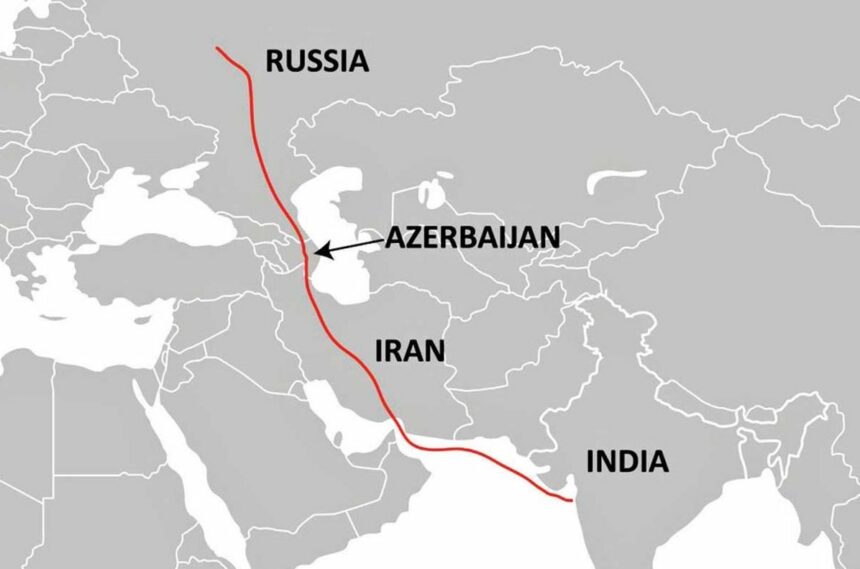
In a recent development, on May 17, Russia and Iran officially signed an agreement for the construction of the Rasht-Astara railway (Kremlin.ru, May 17). This railway project holds immense significance as it addresses a key missing link in the International North-South Transport Corridor (INSTC), or Middle Corridor. The INSTC is a multi-modal network of shipping, rail and road routes for moving freight between India, Iran, Azerbaijan, Russia, Central Asia and Europe. As two of the most sanctioned countries in the world, both Russia and Iran are interested in finding alternative routes to diversify their export and import routes as well as circumvent Western sanctions. In this context, since the beginning of Russia’s war against Ukraine, the INSTC’s strategic importance has significantly increased for Moscow and Tehran.
For both countries, the INSTC is central to replacing European trade with Asian markets, facilitating a pivot to the East and providing an alternative to the traditional sea route through the Suez Canal. For Moscow, the route provides opportunities to improve its economic relations with India, which has increased its oil imports from Russia by about 2,200 percent since the beginning of the war (The Moscow Times, March 28). For Iran, the development of the corridor offers a lucrative opportunity to earn transit fees, estimated at about $100 per ton of goods passing through its territory, which is comparable to the cost of one barrel of oil. (Mehr News Agency, August 1, 2022).
The corridor has three primary routes. The trans-Caspian direction crosses through the Caspian Sea as well as the territories of its littoral states. To the west, the route runs along the Caspian’s western coast, passing through Russia and Azerbaijan. In the east, the route passes through Iran, enters Turkmenistan and then crosses through Uzbekistan and Kazakhstan (Silk Road Briefing, April 4). For Moscow and Tehran, the western route holds greater significance as compared to the trans-Caspian and eastern routes. This is primarily due to the fact that the western parts of both countries encompass the most densely populated regions. As a result, this route presents favorable prospects for fostering trade relations and stimulating the emergence of new business sectors.
Furthermore, the western route is crucial to the Middle Corridor in terms of capacity and investment. The share of its potential freight traffic is around 60 percent, and it is expected to receive approximately 69 percent of future investments (Eurasian Development Bank, November 30, 2021, October 26, 2022). In fact, this passage has recently seen an increase in freight traffic. Rail transport along the INSTC increased by more than 40 percent to 4 million tons from January to May 2023. Most of the volume was carried along the western route, which accounted for 3.6 million tons during this period, representing a growth of 37.9 percent as compared to the same period in 2022 (Kommersant, June 5).
In this regard, growing cooperation between Tehran and Moscow reflects their interests in developing both the hard and soft infrastructure of the western route. In terms of hard infrastructure, the agreement on the construction of the Rasht-Astara railway will play a key role in improving the efficiency and effectiveness of the INSTC. According to the agreement, Russia has allocated 1.6 billion euros ($1.71 billion) for the development of its segment of the railway, which is planned to be completed within 48 months. Iran will pay for its portion of this from transit fees once the route becomes operational. After completion, Iran will be able to connect its railway network with the South Caucasus countries, Russia and Northern European countries, which will reduce the travel time for cargo transportation from Asia to the European Union by four weeks (Silk Road Briefing, April 20, 2022, May 18, 2023).
Russia and Iran also reached an agreement on improving soft infrastructure. They agreed to facilitate and expedite customs procedures and provide assistance to businesses to increase the volume of trade being transported along the route. In addition, Iran offered services for authorized Russian businesses to sign contracts with their Iranian counterparts within the framework of the “Green Customs Corridor” (Mehr News Agency, May 17).
Although the new agreements to develop the INSTC’s western route have the potential to help reduce delivery times and the costs of cargo, both political and technical challenges remain in the long-term development of the corridor. Regarding technical difficulties with hard infrastructure, differences between Russia and Iran on track gauges and rolling stock dimensions complicate smooth transportation via the railway route. Moreover, the lack of transit wagons and poorly developed infrastructure on Iran’s part due to geographical constraints and lack of investment create further problems for the INSTC’s efficiency (Silk Road Briefing, April 4).
Moreover, Iran’s current transit capacity is less than 10 million tons. In this context, the Russian and Iranian target of increasing shipments through the western route to as much as 15 million tons of cargo per year by 2030 does not seem feasible. In fact, according to the Eurasian Development Bank, INSTC container traffic could be as high as 5.9 to 11.9 million tons by 2030, when considering all three primary routes and all modes of transport (Eurasian Development Bank, October 26, 2022; Financial Tribune, March 12; TASS, May 17).
Finally, the disparity in freight rates, lack of a single window system for customs control and absence of a harmonization of procedures lead to increased delivery times and costs, as well as reduce the predictability of arrival times, leading to further delays (Eurasian Development Bank, October 26, 2022).
Politically, Western sanctions against Iran and Russia and increasing uncertainty in domestic policies have deterred some countries and international companies from using Russia and Iran as transit countries. Furthermore, sanctions have also had a negative impact on attracting private companies to invest in Russian and Iranian infrastructure, which requires massive investment capital for developing the INSTC (35 and 34 percent, respectively). In this context, the national budgets of the two countries are the only sources of financing, which have also been limited due to the deteriorating economic situation in both countries (Eurasian Development Bank, October 26, 2022).
Simmering tensions between Iran and Azerbaijan represent another political challenge, which could limit the development of the INSTC’s western branch. At the moment, Azerbaijani infrastructure is the most used and developed part of the corridor. As a result, further deterioration of relations between Tehran and Baku could negatively affect further development, especially in improving soft infrastructure (see EDM, April 19; Trend.az, May 18).
In sum, both Russia and Iran are deeply interested in developing the INSTC, especially its western branch, as this section passes through the most populous provinces of both countries and has the highest potential freight-carrying capacity. Yet, despite the recent agreement on the construction of the Rasht-Astara railway and the easing of customs problems, political and technical difficulties may prevent the corridor from reaching its maximum potential in the long term. This reveals an interesting paradox: Russia and Iran are the main drivers of the INSTC’s development; however, at the same time, the increasing sanctions against both countries and problematic relations with their neighbors make them the main obstacles to future development of this corridor.
Yunis Sharifli is a research fellow at the Central Asia Barometer. His research areas cover Chinese foreign policy in the context of Beijing’s relations with Russia and Central Asia. He also works as a junior research fellow at the Caucasian Center for International Relations and Strategic Studies (QAFSAM) in Azerbaijan.