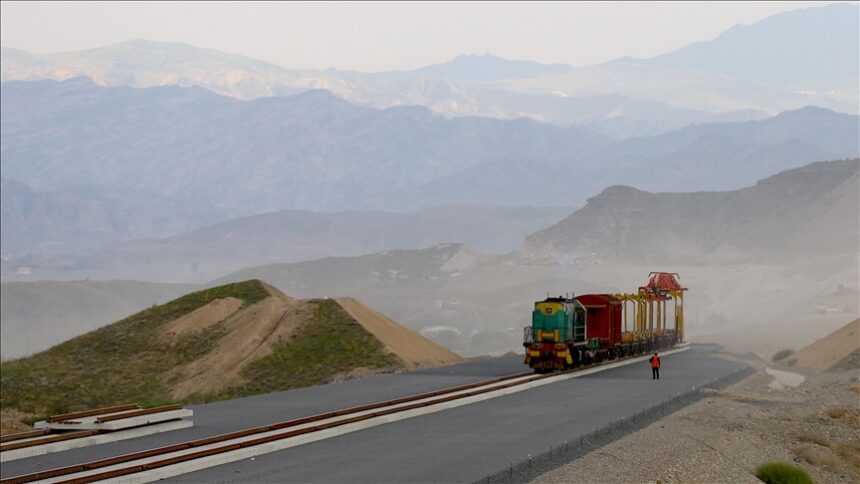
Geopolitical aspects
The realization of the Zangezur Corridor can contribute to long-term stability in the region. In the South Caucasus, plagued by conflicts for decades, revenues from this new transit road, the establishment of logistics hubs, and prospects for direct access to Europe provide a rare incentive for cooperation instead of confrontation. At the same time, the balance of external power undergoes a serious shift: with active U.S. involvement and patronage, the corridor’s opening reduces the traditional influence of Russia and Iran in the region, redirecting power dynamics. Thus, Azerbaijan, Armenia, and other neighbors are no longer confined to Moscow’s dictated security system but instead join a multilateral stability format with Western guarantees.
Strategically, the corridor diversifies communications and strengthens transport security. First and foremost, it creates a new, reliable link between East and West: bypassing both Russia and Iran, it acts as a resilient “lifeline” connecting Europe and Asia. As part of the Trans-Caspian route, this road links Central Asia with the South Caucasus and Turkey en route to Europe, minimizing risks stemming from issues such as Russia’s war in Ukraine or Tehran-West tensions.
Additionally, the corridor frees Azerbaijan and Turkey from sensitive transit dependencies. Azerbaijan will no longer rely on the sole road through Iran to access Nakhchivan, and Turkey will have an alternative route to connect with the South Caucasus beyond Georgia, thereby enhancing the resilience of the transport network. Plans include not only roads and railways, but also oil and gas pipelines as well as fiber-optic communication lines. This is vital not just economically but also strategically: new energy pipelines can broaden access to European markets, while fiber-optic lines strengthen digital connectivity in the region.
To ensure transport security, the TRİPP model applies international oversight to the corridor. A neutral logistics operator will manage cargo transport and share data transparently with all sides-this guarantees permanent access for Baku, while Yerevan maintains sovereign control over its territory. Thus, the Zangezur Corridor is being built as a secure and sustainable communication line, both physically and institutionally.
Possible changes in diplomatic relations
The new corridor and peace agreement significantly reshape the regional diplomatic landscape. Firstly, they mark real progress toward resolving the decades-long conflict between Azerbaijan and Armenia-the U.S.-mediated agreement represents a major breakthrough in normalizing relations. This deal also opens the door to thawing Armenia-Turkey relations. With the corridor operational, the long-closed Armenian-Turkish border could open for transport communications, boosting political dialogue and trade exchanges. Turkish business circles have already shown interest in investing in Armenia’s post-war reconstruction and infrastructure projects, a process tied to Ankara-Yerevan normalization.
For Armenia, the geopolitical vector changes dramatically. Having long depended on Russia as its main ally and economic partner, Yerevan is now moving closer to the West (the U.S. and Europe). Experts note that Armenia’s pragmatic decision to join this corridor-once deemed “unacceptable”-allows it to secure a place on the Eurasian trade map without sacrificing sovereignty, reducing dependency on Russia, expanding access to foreign investment, and becoming a contributor rather than an obstacle to regional integration.
Azerbaijan also strengthens its international standing. Within the TRİPP framework, at U.S. request, Baku has agreed to take steps toward full normalization with Israel (joining the Abraham Accords), binding it more closely to the U.S.-Israel strategic partnership. As a result, the diplomatic activity around the Zangezur Corridor may lay the groundwork for moving from a “cold peace” to genuine regional cooperation.
Geoeconomic aspects
The Zangezur Corridor paves the way for new energy and transport-logistics routes. Most importantly, once direct land connectivity is established between Azerbaijan and Turkey, Caspian energy resources will reach European markets more easily. For instance, through the Southern Gas Corridor, Azerbaijan exported 12 bcm of natural gas to Europe in 2023; this figure is expected to reach 20 bcm by 2027. With Europe seeking to reduce its dependence on Russian energy, Azerbaijan and Turkey’s direct land connection strengthens their role in Europe’s energy supply chain. Estimates suggest that with U.S.-supervised corridor operations, EU companies could reduce energy import costs by 10-15%.
The Kars-Igdir-Nakhchivan railway and new highways planned along the corridor will open up additional transit opportunities for both Azerbaijan and Turkey toward Central Asia. As a complementary line to the existing Baku-Tbilisi-Kars railway within the Middle Corridor, the Zangezur route can significantly cut delivery times and reduce transport costs, overcoming infrastructure and customs bottlenecks along the Georgian route. This shows that the corridor is not just a political project, but also a key element of a new “Silk Road” energy and logistics infrastructure.
Trade flows and investment opportunities
The corridor promises major economic benefits by accelerating trade flows across Eurasia. As the Middle Corridor becomes more efficient, cargo volumes from Central Asia and the South Caucasus will rise, boosting regional revenues from foreign trade. At the same time, the corridor’s realization attracts large-scale foreign investment. Building its infrastructure (roads, railways, bridges, border crossings) requires billions of dollars in capital, and major stakeholders like the U.S., Turkey, and China have already expressed readiness to provide financial support.
Estimates suggest that while $3-5 billion may be needed to complete the corridor, annual savings of $20-30 billion in logistics costs are possible. For Azerbaijan, the impact is especially positive: according to analyses by the Center for Economic Reforms Analysis and Communication, Azerbaijan’s total exports will grow by $700 million annually, and its non-oil GDP will rise by around 2% each year after the corridor opens.
As a regional project, the corridor also draws the attention of foreign investors such as European infrastructure companies and international financial institutions. If stability endures, logistics hubs, warehouses, and new industrial parks may emerge in Armenia and Azerbaijan with foreign capital. Turkish companies are already showing interest in road construction, tunnel building, and logistics projects in Armenia. A U.S.-led consortium of international logistics operators is also expected to join. Overall, the Zangezur Corridor can integrate the region into the global trade map, launching a new era of investment and growth.
Impact on regional economic integration
Another major geoeconomic benefit of the corridor is strengthening regional economic integration. New transport links will tightly connect regional markets. Economic ties within the Turkic world are expected to deepen. Turkish President Recep Tayyip Erdoğan has called the Zangezur Corridor a “part of the geoeconomic revolution,” emphasizing that it will allow Turkish goods to reach Central Asia and China faster via the Caspian, while Europe-to-China freight will move through Turkey-giving the Middle Corridor a strategic leap.
Indeed, by filling the weakest gap in the Middle Corridor, the Zangezur route transforms the previously fragmented Eurasian space into an integrated economic network. Turkey plays a central role in this process, acting as an “integrator” of Eurasian infrastructure after decades of spearheading regional projects like Baku–Tbilisi-Ceyhan and Baku-Tbilisi-Kars.
For Armenia, joining the corridor means becoming an active participant in regional integration for the first time. This allows Yerevan to enter international and regional projects (such as transport corridors and energy markets) from which it had long been excluded. Both Armenia and Azerbaijan can benefit from the stability and investments brought by this East-West artery.
For Central Asia, integration deepens further. Kazakhstan, Uzbekistan, and Turkmenistan will establish direct economic ties with both the South Caucasus and Europe via the corridor. It will carry Central Asia’s resources and goods to European consumers, while delivering European and Turkish products to Central Asian markets-acting as a new integration bridge. Experts predict this will boost Central Asia’s share in global trade and spur their economic development.
China also views the corridor as a vital development for its Belt and Road Initiative (BRI). Since 2013, BRI has sought to build multiple land and sea routes connecting China to Europe. Among them, the “Middle Corridor” (China-Central Asia-Caspian-Caucasus-Europe) had long lagged behind the Northern (via Russia) and Southern (via the Indian Ocean) routes. But the Zangezur Corridor fills the weak link in the Middle Corridor, making it a real and efficient alternative.
Ultimately, the corridor’s economic integration platform has both regional and global dimensions. Major powers like China, the U.S., and the EU also seek to be part of the trade flows along this route, generating a positive multiplier effect for the region.
Zangezur Corridor, characterized as a road of regional prosperity and development, brings all participant countries into closer economic cooperation and fosters a new integration environment based on shared interests. Its main geopolitical and geoeconomic benefit lies in opening new horizons of cooperation. If all stakeholders act with foresight and pragmatism, the corridor will go down in history not just as a transport route but as a highway uniting peoples and bringing stability and prosperity to the region.
Dr. Matin Mammadli, senior advisor at the Baku-based Center of Analysis of İnternational Relations.