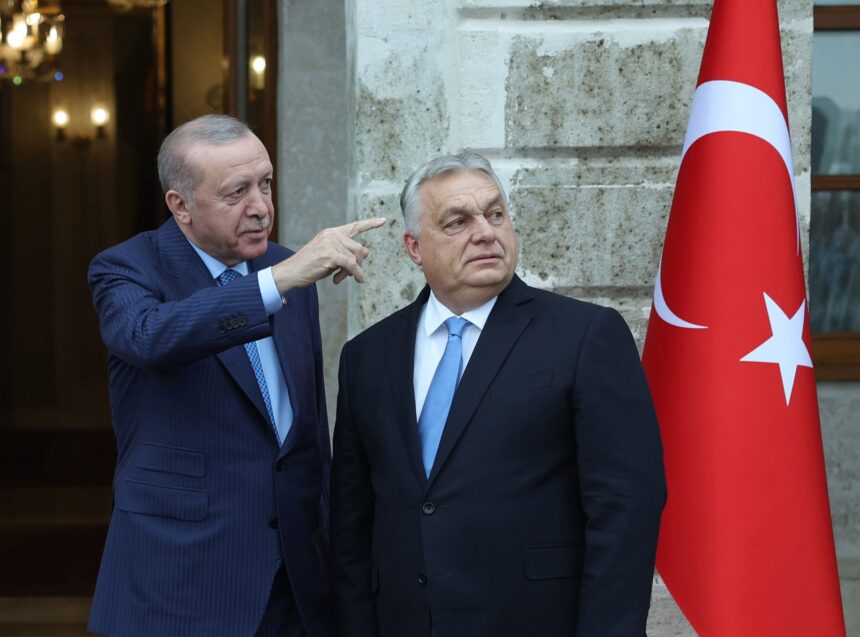
On December 8–9, Hungarian Prime Minister Viktor Orbán paid an official visit to Turkey that attracted attention far beyond the two countries, as the decisions taken went well beyond the bilateral agenda and have the potential to affect processes across Eastern and Central Europe. Amid tightening EU and US sanctions on Russian energy resources, Orbán reached an agreement with Turkish President Recep Tayyip Erdogan to guarantee the continued transit of Russian gas via the TurkStream and Balkan Stream routes. This is particularly significant given the European Commission’s intention to phase out Russian gas and oil by 2027, a move that threatens Hungary, Slovakia, and other countries with higher prices and a deterioration of economic conditions.
Acting in defiance of Brussels, the Hungarian prime minister effectively secured special conditions for his country by conducting advance talks in Washington and Moscow. The United States granted Hungary a one-year exemption from its sanctions regime, while Russia confirmed that it would fully honor its contractual obligations on gas and oil supplies. In Istanbul, Orbán consolidated these arrangements, under which Budapest is set to receive around 7.5 billion cubic meters of gas by the end of 2025. An additional step was Gazprom’s decision to relocate the headquarters of the TurkStream operator, South Stream Transport B.V., to Hungary.
Although the European Commission’s position remains tough, with Brussels dissatisfied by Budapest’s attempts to preserve long-term supplies of Russian gas, the EU’s institutional capacity to pressure Hungary is limited. Energy policy remains within the competence of national governments, and the consensus-based nature of sanctions decision-making makes a pan-European ban on Russian gas imports impossible due to the positions of Hungary and Slovakia. In practice, Brussels is left only with indirect levers of influence, which are insufficient to alter Hungary’s energy strategy. Under these conditions, Orbán maintains autonomy, strengthening the country’s energy security while simultaneously enhancing its regional influence, especially in an election year.
This course fits organically into Turkey’s broader strategy. Turkish Energy Minister Alparslan Bayraktar has confirmed that gas from Azerbaijan, Russia, and Iran will remain the backbone of Turkey’s energy mix. For Ankara, cooperation with Budapest supports the formation of a major regional gas hub, reinforcing Turkey’s resilience and its role in Eurasia.
The Turkic dimension of Hungarian–Turkish relations is also gaining importance. Orbán openly speaks of the strengthening of the Turkic world as a new center of political and economic power, while Erdogan has proclaimed the beginning of a “Turkic century.” For Hungary, this represents not only cultural affinity but also a strategic space in which it can compensate for constraints imposed by the EU and act as an intermediary between West and East. The growing influence of Turkey, Azerbaijan, and Central Asian states is turning the Turkic world into a highly sought-after platform amid global fragmentation, offering Budapest new opportunities to expand its presence in Eurasia.
Energy cooperation with Azerbaijan is becoming a key element of this strategy. Budapest supports the expansion of the Southern Gas Corridor and seeks to connect to new TANAP and TAP routes. At the same time, the ambitious “green energy corridor” project linking the Caspian Sea, the Black Sea, Romania, and Hungary is advancing, envisaging the transmission of Azerbaijani green energy via an undersea cable. This enables Hungary to reduce its dependence on the EU in the field of decarbonization and strengthens its role as a terminal distribution hub for Turkic green energy in Central Europe. Baku’s inclusion in this framework broadens cooperation and turns Hungary into an important component of the Eurasian energy architecture.
Thus, Orbán is not only addressing domestic economic challenges but also creating room for strategic maneuver, reinforcing Hungary’s role as an independent and pragmatic actor in a changing Eurasian landscape.
Notably, during these same days Azerbaijan’s Foreign Minister Jeyhun Bayramov paid a working visit to Hungary. It appears likely that prospects for expanding energy cooperation will be among the key topics of the talks, especially against the backdrop of the successful visit by Azerbaijani President Ilham Aliyev to Slovakia, which demonstrated Central Europe’s growing interest in Azerbaijani energy initiatives. All of this increases the importance of multilateral arrangements in shaping a new energy map of Europe, where the autonomy of participants and their focus on pragmatic parameters—economic feasibility, supply reliability, and diversification—are becoming the foundation for the successful development of the region’s energy architecture.
Ilgar Velizade