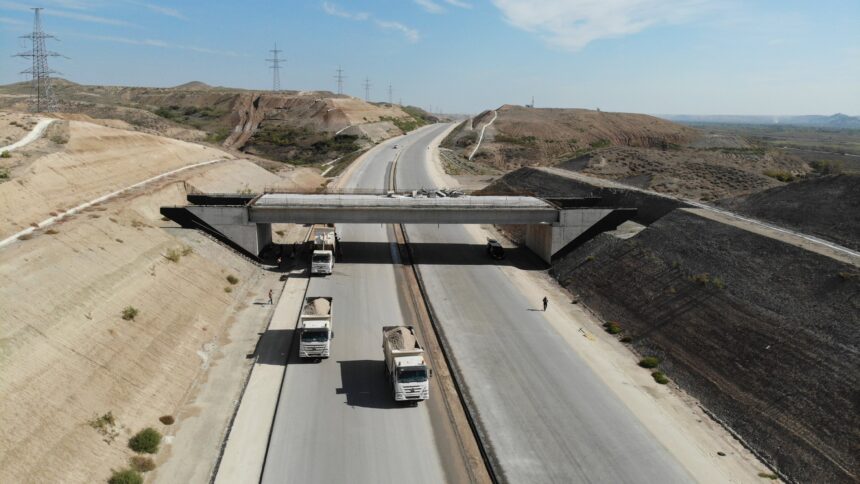
Following the 2020 cease-fire between Azerbaijan and Armenia, the idea of establishing a land corridor, known today as the Zangezur Corridor, linking Baku with Nakhchivan came to the forefront of regional debates. Since then, Türkiye and Azerbaijan have pursued intense diplomatic efforts to bring this route into existence. Türkiye initially framed the corridor as indispensable for a broader regional peace and, through initiatives such as the 3+3 platform, sought to promote coordination and dialogue among the relevant states.
At the most basic level, the significance of the Zangezur Corridor lies in its potential to physically reconnect two separated territories and populations of a single country. Beyond this, the creation of an uninterrupted link between Central Asia and Türkiye was expected to facilitate economic growth and enhance regional trade. Türkiye’s position was consistently anchored in the principle that such issues ought to be negotiated and resolved by the region’s own actors. The logic behind this approach is clear: the foundation of stability rests upon the capacity of regional players to establish their own order without external interference. The inverse is equally true: external interventions often constitute the root causes of regional instability. The tragic trajectory of the Middle East attests to this reality – not only as a historical lesson but as an ongoing experience.
Iran, however, has from the outset opposed the very notion of such a corridor. Tehran has argued that the proposed route runs counter to its national interests and violates international law.
Why does Iran oppose Zangezur?
Iran’s opposition to the proposed corridor rests on several interrelated concerns. Foremost among these is the fear of losing its land connection with Armenia and, by extension, its physical access to the Caucasus. Such a limitation would deprive Tehran of opportunities to extend its reach toward Georgia, the Black Sea and Russia. In parallel, the corridor would undermine Iran’s ability to control transit routes from Türkiye to Central Asia – a development that carries the prospect of significant economic losses.
Another layer of Iranian anxiety stems from the anticipated deepening of Turkic integration. Iran is home to a large Turkic population and the prospect of these communities intensifying contact with their kin beyond Iran’s borders is viewed in Tehran as a political liability. The concern is that such interactions could not only embolden ethnic identities but also provide Türkiye with a political advantage inside Iran. Finally, there is the broader strategic dimension: Ankara’s potential to strengthen its political and economic standing in the South Caucasus, thereby tilting the balance of regional competition at Iran’s expense.
Against this backdrop, Iran adopted an openly confrontational posture toward the Zangezur project. Its opposition was not limited to harsh rhetoric; Tehran also engaged in military posturing, reinforcing its border regions, staging exercises and issuing veiled threats.
This aggressive stance prompted reciprocal reactions from Baku. Azerbaijan issued its own stern statements and undertook security operations against individuals accused of operating within Iranian espionage networks. A series of diplomatic escalations followed: the closure of a mosque alleged to have ties with Tehran, the suspension of the office of Iran’s Supreme Leader in Baku, and, most dramatically, the attack on Azerbaijan’s Embassy in Tehran in January 2023, after which diplomatic relations hit a nadir. The embassy remained closed for nearly a year and a half before reopening.
For a time, however, Iran’s attention was diverted to other pressing developments, leaving little bandwidth to devote to the corridor dispute. Yet, with the Aug. 8 announcement of the Azerbaijan-Armenia peace agreement, which was brokered under former U.S. President Donald Trump’s mediation, Iran has once again found itself under the spotlight.
Addressing Iran’s concerns
In the aftermath of this development, Iran’s reactions revealed a striking duality – ranging from vehement rejection to cautious accommodation. On one hand, Ali Akbar Velayati, senior adviser to Supreme Leader Ayatollah Ali Khamenei, declared that Tehran would resist the creation of what he termed an “American corridor” in the Caucasus, regardless of whether Moscow aligned itself with Iran’s stance. Velayati warned that such a project would turn into a “graveyard for Trump’s mercenaries,” accusing Washington of treating the Caucasus as though it were a mere piece of real estate to be leased. Echoing this rhetoric, several commanders of the Islamic Revolutionary Guard Corps (IRGC) accused both Azerbaijan and Armenia of paving the way for NATO and Israel’s presence in the South Caucasus.
Such hostile responses from conservative commentators and politicians in Iran’s media sphere were hardly unexpected. What proved more surprising, however, was the notably different tone adopted by Iran’s executive leadership. President Masoud Pezeshkian and his government opted for a cautiously optimistic stance. Government spokesperson Fatemeh Mohajerani appeared before the press with a map in hand, pointing out that the Iran-Armenia border would not be severed, noting that the corridor merely traversed a small section of Armenia’s territory. Pezeshkian himself emphasized that all of Iran’s core concerns had been taken into account in the plan and assured that Tehran would not incur losses. While highlighting the risks associated with the U.S. presence in the region, the Iranian government nonetheless welcomed the peace agreement as a positive step.
Within days of the announcement, Pezeshkian traveled to Yerevan for talks with Armenian Prime Minister Nikol Pashinyan. During their meeting, the Armenian side reassured Tehran that Iran’s concerns were unfounded, stressing that the corridor would remain under Armenia’s full control and that no third-party military presence would be permitted. Crucially, Pashinyan underscored that neither the Iran-Armenia border nor Armenia’s sovereignty would be compromised. Diplomatic contacts between Yerevan and Tehran have since continued both through official visits and frequent phone calls, as Iran maneuvers to ensure it is not sidelined from the emerging regional equation.
Iran’s new cautious optimism
Several factors may explain the Iranian government’s cautiously optimistic response to the Zangezur Corridor. Perhaps the most immediate is Iran’s limited strategic bandwidth: engaged in an ongoing confrontation with Israel and anticipating the possibility of a second assault by the Zionist regime, Tehran simply lacks the capacity to divert substantial political and military capital toward a fresh crisis in the South Caucasus. The agreement has already been signed; the process has moved forward. Any attempt at reversal through military or political intervention would carry immense risks for Iran. For this reason, Tehran has opted against escalating tensions further in a way that could deepen instability.
Another consideration is that the government may not view the Zangezur Corridor as an unambiguously negative development. Instead, its potential positive or negative consequences will likely become clearer with time. By adopting a wait-and-see approach, Iran leaves itself room to prepare for different scenarios. Moreover, Tehran may even find comfort in the possibility that the involvement of an external power, even the U.S., could counterbalance Türkiye’s prospective geopolitical gains, which would arguably be greater if the corridor were solely under Turkish and Azerbaijani management.
A third reason, closely connected to the previous point, is that this development does not necessarily fall into the category of issues to which Iran must react with categorical rejection. Government spokesperson Fatemeh Mohajerani explicitly underscored this nuance. The divergence in positions reflects the contrast between Iran’s conservative, security-oriented faction and its reformist, moderate camp. President Masoud Pezeshkian has framed the matter as an internal arrangement between Armenia and Azerbaijan – territorial developments within their own sovereign boundaries – rather than the “border change” narrative propagated by security hardliners. From Tehran’s official perspective, the Zangezur Corridor does not cross the critical red line of altering Iran’s borders.
Pezeshkian’s personal background as an Iranian Turk further shapes this pragmatism. He is acutely aware of the discontent generated among Iran’s sizable Turkic population during the 44-day war, when Tehran appeared to lean toward Armenia. The shared kinship and emotional solidarity between Azerbaijanis and Iranian Turks cannot be easily dismissed in any sustainable political calculus. Recognizing this, Pezeshkian appears intent on crafting a political space where Iran’s geopolitical imperatives intersect with ethnic sensitivities, rather than clash with them.
In sum, unlike conservative and hardline circles, the Iranian government has refrained from treating the Trump Corridor as an inherently hostile development. Its measured steps suggest a strategy of managing the situation in a way that may ultimately yield advantages – or at the very least, minimize nonessential losses. Unlike in previous years, Tehran has not resorted to massing troops at the border or conducting provocative military exercises. Nor does it appear inclined to do so in the near future.
Mustafa Caner