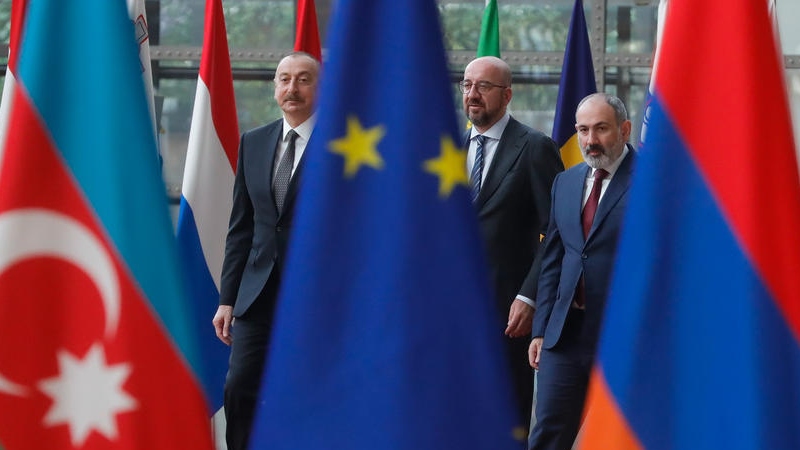
Following the war, the EU took some initiatives, and began to perform an active mediatory role between the two countries in 2021. On December 14 of that year, the European Council President, Charles Michel, succeeded to bring the leaders of the two countries to the negotiating table on the sidelines of the Eastern Partnership summit. The EU’s growing role in this process, in parallel to Russia’s distraction due to its war against Ukraine, raised some hopes in the South Caucasus that Brussels could replace Moscow as an honest broker between Baku and Yerevan which would lead to a major breakthrough, since it is widely believed that Russia manipulates this conflict and is not genuinely interested in a complete settlement.
However, the EU platform of negotiations was primarily focused on the normalization of the Armenia-Azerbaijan relations from the outset and avoided dealing with the present situation in and future of Karabakh region of Azerbaijan – the root of this conflict between the two countries. This was so because of objective reasons on the ground. Unlike Russia, which has since 2020 had military and other presence on the Karabakh soil, the EU does not have access to the region, and has hardly any influence over the separatist regime. These limitations in the European track of negotiations were likely the reason why the Kremlin did not take any tough stand against the EU mediation efforts.
This situation lasted until October 2022, when Russia noticed that Armenia and Azerbaijan could soon sign a peace treaty through which Yerevan would recognize Azerbaijan’s sovereignty over the Karabakh region. The reports about the launch of direct communications between Baku and the Armenian community of the Karabakh region, and the statements from both Baku and Yerevan about the possibility of signing of a peace treaty by the end of 2022, reaffirmed these positive signals. This would have dealt a huge blow to Russia’s influence in the region, as the persistence of this conflict and thereby the presence of Russian peacekeeping forces in Karabakh are seen in Moscow as a matter of critical geopolitical importance. Alarmed by these developments, Russia deployed its instruments and succeeded to undermine the peace process.
Towards this end, the most destructive move by Russia was the dispatch of Ruben Vardanyan, a business tycoon of Armenian origin, to Karabakh. Vardanyan, with apparently more ambitious political plans not only in Karabakh but also in Armenia, renounced his Russian citizenship, received a “political” position in the separatist regime in Karabakh, and virtually stopped all the existing communication channels between the locals and Baku.
In parallel, Prime Minister Nikol Pashinyan of Armenia, indirectly warned by the Kremlin against recognizing Karabakh as part of Azerbaijan, had to distance himself from the EU-supported peace treaty model where this clause about Karabakh was reportedly to be enshrined. He also sabotaged the EU-track of negotiations insisting on a change in this format by including French President Emmanuel Macron – which was unequivocally rejected by Azerbaijan due to France’s increasingly biased position against Azerbaijan. In the wake of this intervention, at least two attempts of the EU to convene the next summit of the Armenian and Azerbaijani leaders in December failed.
This was accompanied by the launch of protests by Azerbaijani non-governmental organizations and ecology activists in early December against the plundering of the natural resources and polluting of the environment in the Karabakh region by the separatist regime. The activists, supported by the government of Azerbaijan, protested also against the abuse of the Lachin road, that is the only land passage between Karabakh and Armenia, by the separatist regime to carry military supplies and bring in fighters from Iran and elsewhere to the region. The protestors vow to continue their campaigns unless these illegal activities of the separatist regime are prevented. In parallel to these protests, Baku reiterated its objection to Vardanyan’s involvement, and demanded that he leaves the Karabakh region.
This resulted in a stalemate situation in the region: While the Azerbaijani side continues its protests with a list of demands concerning the natural resources of the region and the legal regime at the Lachin road, the Russian peacekeeping mission limits the passage of Armenians through this road. In response to the accusations related to the humanitarian crisis in Karabakh due to these limitations at the Lachin road, Baku has repeatedly declared that the passage along this road is controlled by the Russian peacekeeping mission, and the limitations have nothing to do with the Azerbaijani side. Russia also uses this crisis to pressure Armenia to enter the Russia-Belarus Union State. This was seemingly the reason for Yerevan’s refusal to attend the trilateral foreign ministers meeting with Russia and Azerbaijan in Moscow in late December.
These factors have created one of the most consequential crises in the region since the end of the Second Karabakh War, where the need for EU mediation is even higher than before. However, no major mediatory role on the side of the EU to resolve the crisis and help the sides find a common ground to agree upon has so far been observed. This is so despite the fact that the EU decided in mid-December to deploy a new technical mission to the Armenian territory along the border with Azerbaijan following the termination of the term of the previous mission which was deployed to the region after the Prague summit of October 6. Some Azerbaijani observers saw the deployment of the new mission as an initiative of the French government rather than the European Union. For them, the new mission seeks to prepare ground for the deployment of a permanent French mission to the region to protect Armenia rather than to help the peace efforts.
Against this backdrop, expectations for a peace treaty between Baku and Yerevan in the near future and the complete settlement of the conflict have markedly lowered. There is widespread concern in the region that the sides might end up in a violent military escalation this year if they fail to sign a peace treaty and agree on a roadmap for the resolution of the remaining disputes concerning the Karabakh region of Azerbaijan and the re-opening of regional transportation links. Under these circumstances, there is a great need for the constructive intervention and active mediation of the EU, without which Baku and Yerevan are unlikely to be able to overcome the difficulties created by the Russian side, such as the presence and actions of Reuben Vardanyan.
Dr Vasif Huseynov, Head of Department at the Centre of Analysis of International Relations (AIR Centre) and Adjunct Lecturer at Khazar University in Baku, Azerbaijan.