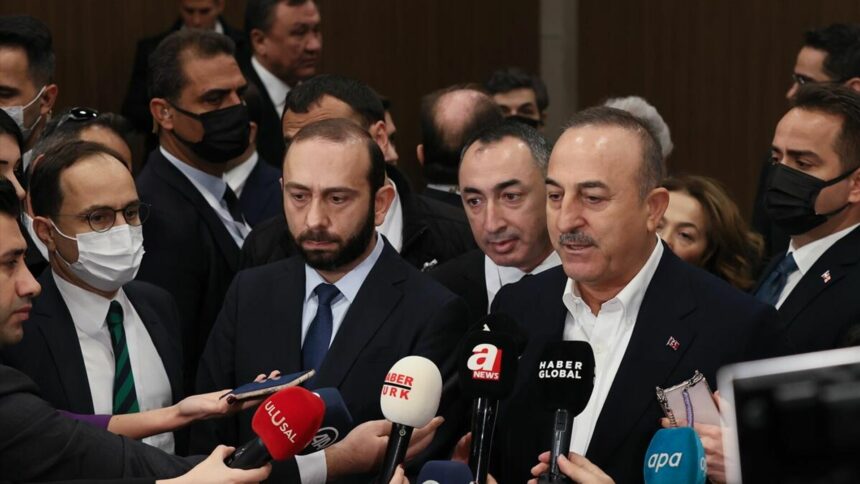
On February 15, Armenian Foreign Minister Ararat Mirzoyan arrived in Ankara to meet his Turkish counterpart Mevlut Cavushoglu in the wake of the deadliest earthquake that hit Türkiye’s 11 provinces on February 6. Mirzoyan’s official visit came shortly after Armenia dispatched humanitarian aid and a rescue team to Türkiye to help alleviate the tragedy’s consequences. Hence, the earthquake diplomacy appeared to be a turning point for Yerevan to shift the goodwill diplomacy with Ankara. This became the second visit of Armenia’s foreign minister to Ankara, even though the diplomatic relations between the two ceased in 1993.
Although not a new phenomenon, earthquake diplomacy has long been a valuable tool for revitalising relations between conflicting parties. In the case of Ankara-Athens, amid the earthquake casualties, Greece became the first country offering full assistance to neighbouring Türkiye despite the recent diplomatic standoff over the Aegean Sea islands.
Similarly, Armenia seeking diplomatic normalisation with Türkiye, took this opportunity to mend ties and possibly open the borders partly for trade operations. Last July, Ankara and Yerevan agreed to a sort of pilot project of opening the border, allowing third-party nationals to cross, as well as start allowing air cargo flights between the two countries. The move engendered hope that it could lead to a more permanent border opening.
Also, in the post-war period, senior officials, including Turkish President Recep Tayyip Erdogan and Armenian Prime Minister Nikol Pashinyan, began talking publicly about the prospect of normalisation of relations in 2021. As such, the two sides appointed their special envoys for normalisation in December 2021. Since then, several meetings have been held between the two delegations chaired by special envoys to coordinate normalisation efforts. Despite some tasks being fulfilled, the attempts at major breakthroughs have largely failed.
As minister Mirzoyan stated, “I consider it symbolic that on Saturday, the Armenian-Turkish border, which has been closed for thirty years, was opened for Armenian lorries loaded with humanitarian aid heading to Adiyaman.” The crossing was the first time in three decades the border had been used; Turkey closed it in 1993 during the first Karabakh war between Armenia and Azerbaijan, Türkiye’s closest ally. Following the second Karabakh war in 2020, efforts to normalise relations – including reopening the border – have been revived, though they have not borne significant fruit so far.
Even though the earthquake diplomacy could yield some positive results in the normalisation process, the full Ankara-Yerevan diplomatic thaw highly depends on the results of peace negotiations between Baku and Yerevan. In the post-Karabakh war, the Baku-Ankara axis strengthened significantly, reaching the level of strategic military and economic partnership further cemented by the Shusha Declaration signed in 2021. Therefore, any possible diplomatic normalisation with Yerevan would require Ankara to consult with Baku.
Unlike this time, in 2008, Ankara and Yerevan were in talks for possible normalisation of relations under the guise of the Zurich protocols. However, the process was overturned due to rising diplomatic rifts between Baku and Ankara over the protocols. Moreover, Türkiye’s moderation of the Baku-Yerevan peace process would likely be more fruitful for regional cooperation than external actors’ moderation.
Nevertheless, the recent earthquake dialogue and initial agreements, such as the joint restoration of the Ani bridge on the Turkish-Armenian border and other outdated infrastructure, as a part of preparedness for the full reopening of borders. Although the humanitarian aid will boost Armenia’s positive image in Türkiye, it will not facilitate the diplomatic normalisation process with Ankara soon. Hence, such prospects may force Yerevan to intensify peace efforts with Azerbaijan by the end of 2023, though the war of words with Baku leaves no optimism for a quick rapprochement.
Türkiye and Armenia earthquake dialogue is indeed a helpful tool to rekindle relations with the neighbouring country but would be insufficient in this case. Not all political actors in Armenia are happy with the diplomatic thaw with Ankara, as they also protested the dispatching of humanitarian aid to that country. Therefore, the government of PM Nikol Pashinyan still has to persuade its opponents of the necessity of diplomatic normalisation with Türkiye.
Fuad Shahbazov
Caliber.Az