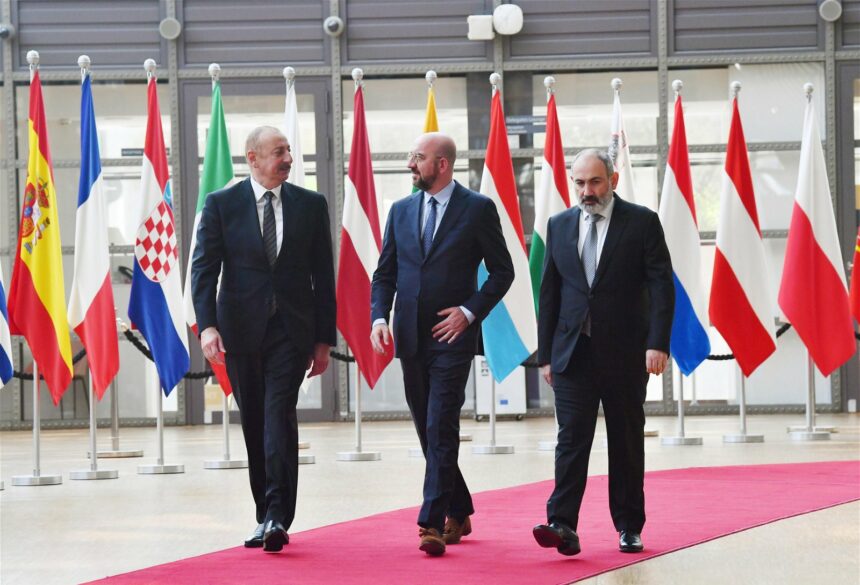
On May 14, Armenian Prime Minister Nikol Pashinyan and Azerbaijani President Ilham Aliyev met in Brussels for the fifth meeting on peace negotiations as mediated by European Council President Charles Michel (Consilium.europa.eu, May 14). This summit came on the heels of the United States–mediated meeting of both countries’ foreign ministers in early May (see EDM, May 8), was followed by another such ministerial meeting in Moscow on May 19 and is expected to be followed by at least one other summit between Pashinyan and Aliyev along with a meeting of the deputy prime ministers over the next two weeks (Armenpress.com, May 18; Turan.az, May 19). The recent dynamics in these talks, which have been accompanied with clear progress on some issues of conflict, testify to a growing potential for a peace treaty. However, a multitude of revanchist, geopolitical and various other challenges could derail the negotiations and entangle the parties in prolonged disputes.
The current promising situation with the peace talks has been confirmed by all three mediators (the US, the European Union and Russia). In a similar way to US Secretary of State Antony Blinken’s statement that “the sides are within reach of an agreement” (see EDM, May 8), Russian Foreign Minister Sergei Lavrov reaffirmed this potential, declaring that it was possible to bring Baku and Yerevan “closer to a common vision” on a peace treaty. Lavrov made this announcement following the trilateral ministerial meeting in Moscow on May 19 (News.am, May 19). The summit in Brussels on May 14 was likewise a historic moment as Armenia and Azerbaijan recognized one another’s territorial integrity by officially establishing their respective territorial sizes (29,800 square kilometers for Armenia and 86,600 square kilometers for Azerbaijan) (Consilium.europa.eu, May 14). This was largely interpreted as Yerevan’s verbal recognition of the Karabakh region as part of Azerbaijan.
Progress has also been reported on the re-opening of transportation routes between the two sides. Both Michel and Lavrov confirmed that the parties are close to a final agreement in this area, but apparently, so far, only the railway networks have been agreed upon (Consilium.europa.eu, May 14). The major news from the Moscow meeting was related to the reactivation of the trilateral format of deputy prime ministers of the three countries that deal with connectivity proposals—that is Russia, Armenia and Azerbaijan. This format, launched at a summit of the three countries’ leaders on January 11, 2021, met most recently on December 6, 2022, for the 11th meeting in this format (Hetq.am, December 7, 2022).
The reactivation of this format and that of Russia’s mediation role in the peace talks more generally allows the Kremlin to make sure that the re-opening of transportation routes and any comprehensive peace deal will be proceeded with the consideration of Russian interests. In particular, Moscow is interested in the deployment of its forces along the Zangezur Corridor in line with the tripartite statement of November 10, 2020, thus hoping to ensure some presence in the Karabakh region in the aftermath of a peace deal (Hetq.am, February 9). Therefore, the repeated statements by Russian leaders about the importance of building any peace deal on the basis of the trilateral statements (Kremlin.ru, November 10, 2020; Mfa.gov.az, January 11, 2021; Primeminister.am, November 26, 2021) agreed to by Russia, Armenia and Azerbaijan are aimed at serving Moscow’s goal to guarantee Russian influence in the region. The fact that the EU and US have yet to bring the Armenian and Azerbaijani leaders together to sign a similar document in the Western track of negotiations only strengthens the Kremlin’s position. “There is no alternative to the trilateral statements by the leaders of Armenia, Russia and Azerbaijan regarding the settlement of the situation,” said Lavrov at the tripartite meeting in Moscow on May 19 (News.am, May 19).
In a separate meeting with Armenian Foreign Minister Ararat Mirzoyan, Lavrov clearly expressed these views, stressing that “Russia plays a historical role in this region and has major interests at stake. I am convinced that our allies are aware of that” (Mid.ru, May 19). Two days before this meeting, on May 17, the Russian foreign minister, in an interview with a local television channel, complained that the West is trying to push Armenia to kick the Russian military base and border guards out of the country and rely instead on the US for defense. He characterized the move as “a blatant provocation” (Azatutyun.am, May 17). Such a confrontation between the mediators represents a serious challenge to the peace process. Increasingly, more observers believe that negotiations are less likely to deliver a peace treaty with durable practical impact without accommodations between the West and Russia.
Another challenge is related to the presence of revanchist societal and political groups in Armenia who oppose any peace deal that would recognize Azerbaijan’s sovereignty over the Karabakh region. For example, Hakop Aslanyan, a parliamentarian from the ruling Republican Party, following the May 14 summit in Brussels, said that recognition of Azerbaijan’s territorial integrity does not imply recognition of the Karabakh region as part of Azerbaijan. “We recognize the territorial integrity of Azerbaijan to follow the example of Kosovo. Serbia’s territorial integrity was also recognized, but ultimately, Kosovo was recognized as independent,” Aslanyan asserted in a recent interview with local media (Hraparak.am, May 18).
The fact that the territorial claims made by the Armenian side against Azerbaijan are inscribed in its legislative documents presents yet another challenge to the process. The Declaration of State Sovereignty of Armenia, which is referred to in the Armenian Constitution as a foundational document of the modern Armenian state as well as in a resolution of the Supreme Council from 1992, among others, references Yerevan’s territorial claims to the Karabakh region of Azerbaijan. The 1992 document prohibits “any international or domestic document that mentions the Nagorno-Karabakh Republic as part of Azerbaijan” (Panorama.am, May 15). Hence, as stated by Nurlan Mustafayev, an Azerbaijani scholar of international law, “Armenia’s recognition of Azerbaijan’s territorial integrity must be accompanied by changes in its constitutional documents and the formal repeal of the ‘unification’ of Karabakh and Armenia” (Commonspace.eu, May 18).
In conclusion, the ongoing peace talks between Armenia and Azerbaijan have shown positive dynamics and progress, with notable developments on issues of conflict including the re-opening of transportation routes between both sides. However, challenges remain that could hinder these negotiations. Such difficulties include revanchist political groups in Armenia opposing recognition of Azerbaijan’s sovereignty over Karabakh and the presence of territorial claims in Armenian legislative documents. Additionally, tensions between Western and Russian interests in the region add complexity to the peace process. Thus, despite the progress already made, it is becoming increasingly clear that coming to some accommodation between the mediating parties will be crucial for the negotiations to come to fruition and deliver a treaty that will establish sustainable and impactful peace in the South Caucasus.
Vasif Huseynov