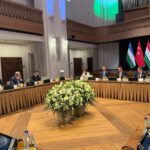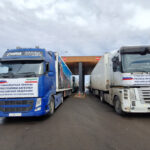
Eight days earlier, Russian Foreign Minister Sergey Lavrov had submitted an official appeal to the OSCE, the Council of Europe, the International Committee of the Red Cross (ICRC) and the United Nations, proposing to arrange an international humanitarian mission to the conflict zone. The Russian Foreign Minister noted that Russia had repeatedly tried to send a humanitarian convoy via its Ministry of Emergency Situations, but each time was rejected by the Ukrainian authorities.
On 6 August, the UN Security Council held an emergency meeting on the humanitarian situation in Ukraine at the initiative of Russia. The Russian Permanent Representative to the UN, the now late Vitaly Churkin, voiced the proposal to send Russian humanitarian convoys to Donetsk and Luhansk under the aegis of ICRC representatives. Ukraine and several Western countries – permanent members of the United Nations Security Council – did not support this proposal.
In particular, Samantha Power, US Permanent Representative to the United Nations, said, and this is very interesting: “The US will consider Russia’s unilateral operation to deliver humanitarian aid to Ukraine as a direct invasion.” Didier Burkhalter, then-OSCE chairman, reflected that: “humanitarian aid should be delivered with full respect for the territorial integrity of Ukraine”. Canada, on the other hand, commented that “Russia is once again demonstrating its willingness to ignore Ukraine’s sovereignty and territorial integrity.”
These statements, facts and details are undeniably very important. We will need them for the purposes of comparison with another case with similar characteristics, for nine years later, history would repeat itself, as is its wont, this time in Karabakh and in the form of a charade. And Western countries are now “singing” a completely different “song” to a markedly different “tune”. We will discuss this further.
From the outset, the world has understandably suspected that Russian security services could try to use any humanitarian pretext to supply weaponry. The European Commission, which warned Russia “against any unilateral military action against Ukraine, under any pretext, including humanitarian ones,” tried to prevent the dispatch of humanitarian supplies. On 5 August, another meeting of the UN Security Council was held, at which Sir Mark Lyall Grant, UK Permanent Representative to the UN, stated: “It is deeply ironic that Russia is calling an emergency meeting of the Council to discuss a humanitarian crisis of its own making.”
Official Kyiv specified a series of terms for Russia: Ukrainian politicians insisted that the delivery of humanitarian aid should be undertaken under the aegis of the International Committee of the Red Cross or other relevant international organisations, unaccompanied by any Russian security forces. Subsequently, Kyiv developed a more stringent approach, guided by exigencies predicated on the principle of sovereignty, demanding that all humanitarian supplies to its Eastern provinces should proceed from Ukrainian territory, under its proper control, instead of being delivered from Russia in unchecked fashion.
The Kremlin rejected these conditions and tried to break through by force, and the Ukrainian border-customs group, aiming to inspect the goods, was unexpectedly blocked at a “Donetsk” checkpoint, installed by Russia.
The dispatch of a convoy containing so-called “humanitarian supplies”, without Ukraine’s official consent, was rightly considered across the world as a violation of sovereignty and to constitute an act of aggression.
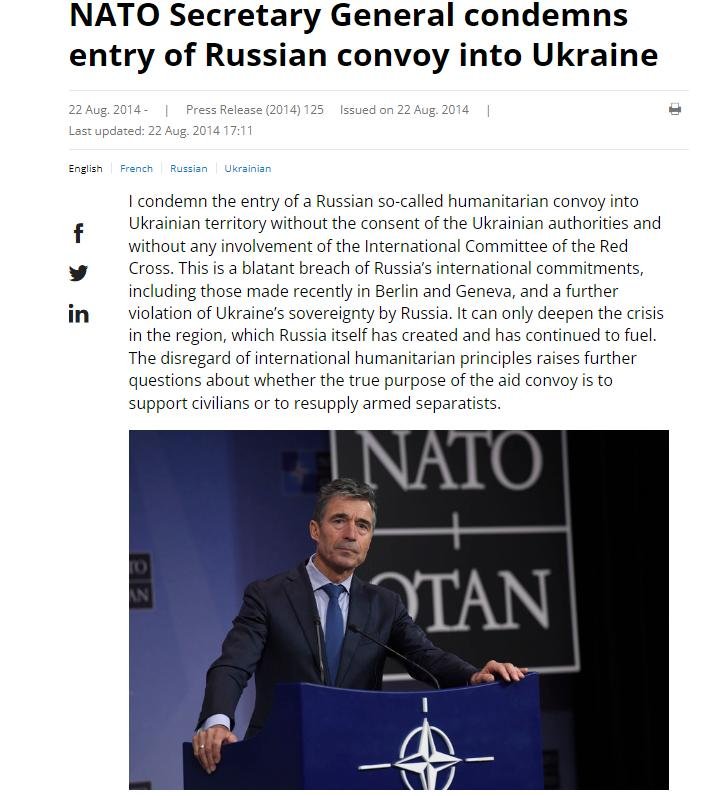
On 22 August 2014, NATO Secretary General Anders Fogh Rasmussen condemned “the entry of a Russian so-called humanitarian convoy Ukrainian territory” without Kyiv’s consent, accusing Russia of a blatant breach of its international commitments. France also joined the group, with then-President Francois Hollande expressing his concerns during telephonic contact with President Vladimir Putin regarding the unilateral Russian mission carried out under the auspices of an alleged humanitarian effort. Then former French Foreign Minister Laurent Fabius suggested that, under the guise of an innocuous convoy, Russia might be trying to establish a base near Donetsk and Luhansk.
This issue was also the subject of a special investigation at the UN Security Council. On 8 September 2014, in a statement to the OSCE Permanent Council Special Session on Ukraine, UN Assistant Secretary-General for Human Rights, Ivan Simonovic, declared that the local armed groups in charge of Ukraine’s eastern regions openly refused any aid from the Ukrainian Government, adding: “On the other hand, the well-publicised white truck convoy that was sent over the border by the Russian Federation, without the consent of the Ukrainian Government, was able to deliver its cargo. The well-being of the residents of Luhansk has obviously become part of a larger geopolitical struggle. This is both a violation of humanitarian principles, as well as humanitarian law.”
The West’s unshakably consolidated position on the subject has remained intact throughout the succeeding time period. For instance, in a note delivered to the OSCE Permanent Council, based in Vienna, US Ambassador Daniel B. Baer reiterated the same argument, lambasting the efforts of Russian-supported separatists in blocking international aid convoys from the rest of Ukraine and declaring their decision “to accept so-called ‘humanitarian shipments ‘ from the Russian Federation”, as being inconsistent with international law and in violation of Ukrainian sovereignty.
The important point of the whole story is not about WHAT was sent to Donetsk and Luhansk (although the military achievements of the separatists became more noticeable after the delivery of this so-called “humanitarian aid”), but the very fact of the disregard for Ukraine’s sovereignty under the guise of a “humanitarian disaster”. Another curious aspect is that, during the entire summer of 2014, Kyiv offered to dispatch the same humanitarian aid convoys to rebellious Donetsk and Luhansk, with international organisations, including the International Committee of the Red Cross, being actively involved in terms of offering assistance. Rather unsurprisingly, the pro-Kremlin separatists, who seized power in this region, rejected this assistance, saying that they would accept “humanitarian aid”, not from the West, but from the East, in other words, from Russia.
Doesn’t it sound familiar to you? Does it not ring a bell?
The focal point of this entire story is the unconditional support of Western countries for Ukraine’s fair position, its sovereignty and efforts to curb the secessionist tendencies in the rebellious eastern regions inspired by Russia. Ukraine despised, and rightly so, the idea of a land passage, uncontrolled by itself, connecting Russia with the separatist regions. Naturally, Kyiv retained the West’s firm and unwavering backing.
At the time, these self-same Western nations urged the regional authorities to accept assistance from the central government of Ukraine, instead of Russia. None pressurised Kyiv to open the road to allow uncontrolled crossings from the Russian border that were unhindered or unimpeded.
On the contrary, Moscow was criticised for its blatant support of the secessionist forces, being accused of infringing Ukraine’s territorial integrity and counteracting Kyiv’s integration policies.
It is always possible to suggest that one should not fall into the trap of generalisation, and every single case, however similar they may appear to be, could be different. There is always a room for manoeuvre. Nevertheless, that which took place nine long years ago in Eastern Ukraine is not seismically different to what is happening now regarding Karabakh. One can’t help but discern the factual similarities.
Armenia is now playing the proxy role of Russia, sending trucks containing dubious “humanitarian” cargoes to the Azerbaijani region, as if to its own homeland, without any coordination with Baku. And the role of Ukraine is being played by Azerbaijan.
So, where does the difference lie? In view of the similarities when it comes to the facts on the ground and the applicable legal norms, precedents and principles, one wonders why the Western evaluation of these two cases differs so violently.
Azerbaijan is ready – as Ukraine was nine years ago – to let foreign convoys into its territory, albeit solely via the route which, in Baku’s considered opinion, is most judicious. If the actual purpose is to ease the humanitarian predicament of the Armenians in the Karabakh region of Azerbaijan, then the question is as to why supplies should not be transported via the routes that Baku considers safe and right. Azerbaijan needs to control aid destined for its sovereign territory and ensure that all customs procedures are followed. So does Ukraine. The point here is that Kyiv is understood and espoused in the West, whereas Baku is not.
This comparison makes one wonder. There appears to be a great deal of hypocrisy, propped up with mental gymnastics, and Azerbaijan is acutely conscious of this. ‘Double standards’ may sound clichéd, trite and unseemly, but the terminology is probably apt. Azerbaijan does not like to be patronised. It understands only too well that “fairness” is an illusion and a relative concept. Azerbaijan’s Nakhchivan exclave has been under blockade for the past 30 years, and, contrary to Article 9 of the 10 November 2020 tripartite statement, obligating Armenia to provide an overland passage to the area, Yerevan has so far done nothing to honour the provision. No concerns have been raised about this.
In what is falsely presented to be a “humanitarian disaster” in Karabakh by the government of Armenia and some supportive Western powers and organisations, deluded or self-deluded by quasi-religious Armenian propaganda, Baku discerns the unmistakable signs of a tasteless and burlesque charade. Azerbaijan does not feel encumbered by the weight of the admonitions levied against it. It feels on the right side of history and justly righteous.
Caliber.Az