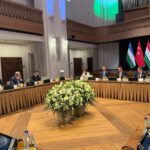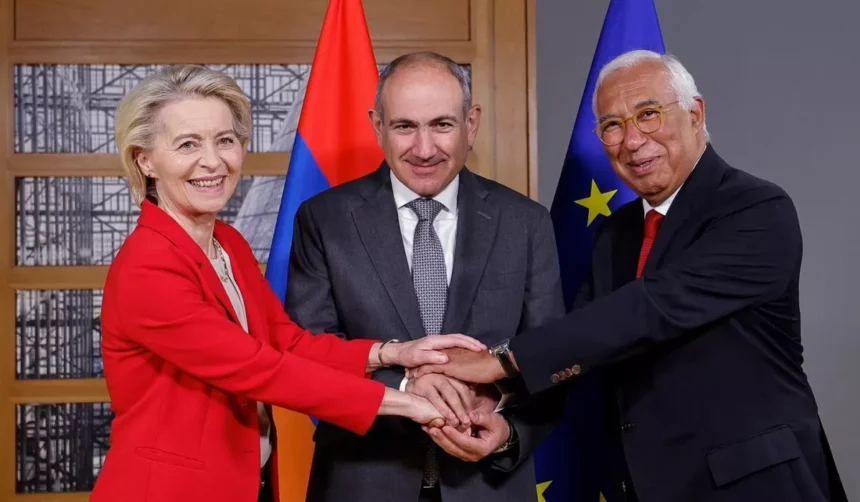
On July 14, Armenian Prime Minister Nikol Pashinyan paid a working visit to Brussels. According to Armenian media, a trilateral meeting took place yesterday between Pashinyan, President of the European Council António Costa, and President of the European Commission Ursula von der Leyen. The Prime Minister is also scheduled to meet with EU Commissioner for Enlargement Marta Kos and Belgian Prime Minister Bart De Wever.
The stated purpose of the visit, according to media reports, is to discuss the prospects for deepening cooperation between Armenia and the European Union. Given the intensifying contacts between Yerevan and Brussels, there is little doubt that Nikol Pashinyan once again sought to assure European partners of Armenia’s commitment to European integration and its intention to pursue a foreign policy course aligned with the EU.
However, considering the well-known dual-track policy of official Yerevan—its desire to sit on two chairs at once and its endless vacillation between Russia and the West—the likelihood of Armenia making a clear and definitive foreign policy choice in the near future remains slim. It is enough to recall that Yerevan has yet to take such a step even after the signing of a military cooperation pact in Brussels in April 2024. That closed-door agreement, reached in the EU–US–Armenia format, involved military assistance to Armenia from the US and EU, including the transfer of advanced military technologies and weapons systems.
While actively courting the EU, Armenia nonetheless continues to demonstrate an interest in cooperating within the framework of the Eurasian Economic Union (EAEU), which clearly indicates its unwillingness to leave Russia’s financial comfort zone. It is worth noting that Armenia’s fast-tracked accession to the EAEU in October 2014 took place at Moscow’s behest, prompted by Yerevan’s earlier intent to pursue European association. Back in September 2013, then-President Serzh Sargsyan announced Armenia’s decision to join the Customs Union, and later in November, Yerevan officially withdrew from signing an economic association agreement with the EU, which would have established a Deep and Comprehensive Free Trade Area. It was only in 2023 that Nikol Pashinyan, speaking before the European Parliament, expressed his readiness to move closer to the EU—as far as the Union itself would deem possible. The aforementioned meeting in Brussels later gave a strong impetus to Yerevan’s rapprochement with the West.
However, in light of recent events surrounding an attempted coup in Yerevan, Armenian-Russian relations have entered yet another crisis. Last month, the media outlet Civic published a document titled the “Coup Strategy,” which, according to its sources, had been prepared by the opposition. The document mentioned names such as former National Security Council Secretary Artur Vanetsyan, the leader of the “Tavush for the Homeland” movement Archbishop Bagrat Srbazan (Galstanyan), former Armenian presidents Robert Kocharyan and Serzh Sargsyan, the founder of the Prosperous Armenia Party Gagik Tsarukyan, as well as affiliates of Russian Railways and Gazprom Armenia. Pashinyan declared that a coup attempt had failed, stating: “Fraudsters attempted to carry out a coup in Armenia, but the attempt was unsuccessful,” he wrote on Facebook, accompanying the post with a link to Civic.
The current tension in Russian-Armenian relations plays into Brussels’ hands, and it is likely that Pashinyan may seek to reassure Western partners that Armenia is prepared to distance itself from Moscow—in exchange for certain financial injections from the EU. However, given Armenia’s contradictory foreign policy, it would be premature to claim that the country is truly capable of fully severing ties with Russia. On the other hand, Yerevan is certainly aware that EU membership is not a realistic prospect anytime soon.
Indeed, the recent two-day visit to Yerevan by EU High Representative for Foreign Affairs and Security Policy Kaja Kallas indirectly confirmed this reality. During a joint press conference with Armenian Foreign Minister Ararat Mirzoyan, Kallas announced that the EU would allocate €270 million to Armenia under a resilience and economic growth programme for 2024–2027, placing financial support at the centre of the visit’s agenda.
“The EU and Armenia have never been as close as we are now. Earlier this year, you adopted a law to launch the EU accession process. We very much welcome your readiness to deepen our partnership,” said the top EU foreign policy official. Notably, while expressing satisfaction with Armenian authorities’ statements about their desire to join the EU, Kallas did not utter a single word regarding the prospect of Armenia’s membership. She merely stated that the political bloc welcomes Yerevan’s intention to strengthen its partnership with the EU.
This fact further confirms that the EU views Armenia primarily as a tool to advance its interests in the South Caucasus, and that the accession of the “land of stones” is by no means part of the organisation’s plans. Based on this, the likelihood that the issue of Armenia’s EU membership was discussed during Nikol Pashinyan’s meeting with senior European officials in Brussels is extremely low.
It seems that one of the main topics of the Brussels negotiations was the swift resolution of Armenian-Azerbaijani relations and the signing of a peace agreement between Baku and Yerevan. It is worth recalling that during her visit to Yerevan, EU High Representative Kaja Kallas specifically emphasised that Brussels welcomes the positive progress achieved in bilateral Armenia–Azerbaijan talks, which could serve as a foundation for establishing stability and peace in the region.
Prior to the visit, Kallas and Pashinyan had discussed the peace agreement between Azerbaijan and Armenia on the sidelines of the European Political Community summit in Tirana. In this context, it is pertinent to mention that recently Anitta Hipper, the EU spokesperson for Foreign Affairs and Security Policy, commenting to Armenian media on the meeting between Pashinyan and Azerbaijani President Ilham Aliyev in Abu Dhabi on July 10, stated that the European Union urges Armenia and Azerbaijan to sign and ratify the peace agreement as soon as possible.
“The EU welcomes the meeting between the leaders of Armenia and Azerbaijan in Abu Dhabi on 10 July. We encourage both sides to proceed with the signing and ratification of the draft peace agreement as soon as possible. The EU stands ready to provide additional support and expertise, should the sides request it,” she said.
A similar position was expressed last month by the Council of Europe. Its Secretary General, Alain Berset, stated that he sees no obstacles to the prompt signing of a peace agreement between Armenia and Azerbaijan.
In any case, it is assumed that the document will be signed only after Armenia meets two important conditions set by Azerbaijan. If Brussels is truly interested in the peace treaty being signed, European diplomats should exert pressure on Armenia regarding this matter. So far, however, the EU has limited itself to the pledged millions of euros that Armenia will receive over the next two and a half years.
Matanat Nasibova
Caliber.Az