Russia’s war of aggression against Ukraine naturally has a direct impact on the situation in the South Caucasus. In the 44-day war of 2020, Azerbaijan was able to liberate important parts of its territory, which had been under foreign occupation for about thirty years, but not all of its sovereign territory. Apart from territorial restitutions, the ceasefire agreement signed between Armenia and Azerbaijan on November 10, 2020, also stipulated that the part of Karabakh remaining under occupation would be supplied by land from Armenia via the so-called Lachin corridor. It was also stipulated that supplies to the separatist area would be supervised by approximately 2,000 Russian so-called “peacekeepers”. Under the agreement, these Russian peacekeepers were given a five-year mandate with the option of renewal.
Despite efforts to reach a final formal settlement of the conflict, for example in the form of a peace treaty (for which the Azerbaijani side has proposed five key points), and despite spectacular diplomatic progress, such as the face-to-face talks between Armenian Prime Minister Nikol Pashinyan and Azerbaijani President Ilham Aliyev in Prague on October 6, 2022, tensions continued to flare up even after the end of the 44-day war. Their sad climax so far was an intense armed clash between Armenia and Azerbaijan between September 12 and 14 last year, which resulted in the deaths of approximately 300 people.
Since December 12, 2022 Azerbaijani environmental activists have been protesting in and around the Lachin corridor against, among other things, the continuing occupation of part of their land.
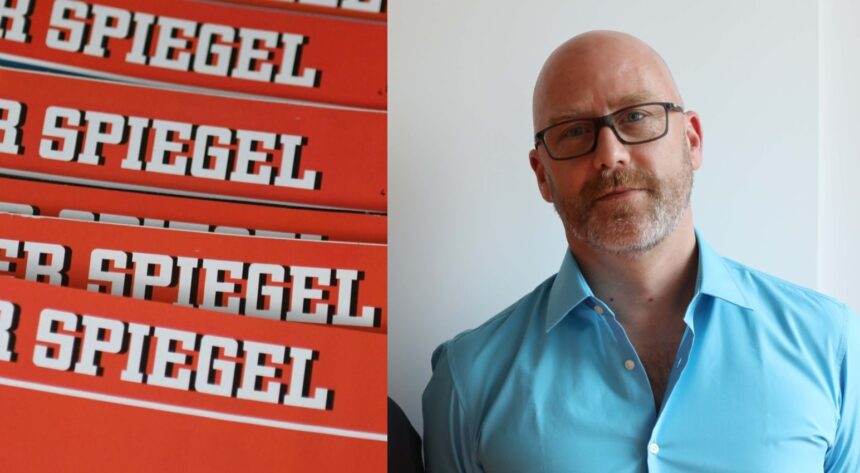
In a long episode of its foreign podcast Acht Milliarden (Eight Billion), Der Spiegel addresses the situation on the ground. The host, Olaf Heuser, chose to highlight the situation from the Armenian point of view, and so the complete assessment offered in the 33-minute audio file is based, in addition to his own statements, on the opinion of Gayane Beglaryan, an Armenian in Yerevan, and Anna Arijanyan, an Armenian-born journalist working for T-online. The only statements from the Azerbaijani side that feature in the podcast are some statements by the President of Azerbaijan that are framed with strongly negative remarks. In terms of arguments, however, the Azerbaijani side is not represented in any significant way, be it quantitatively or qualitatively.
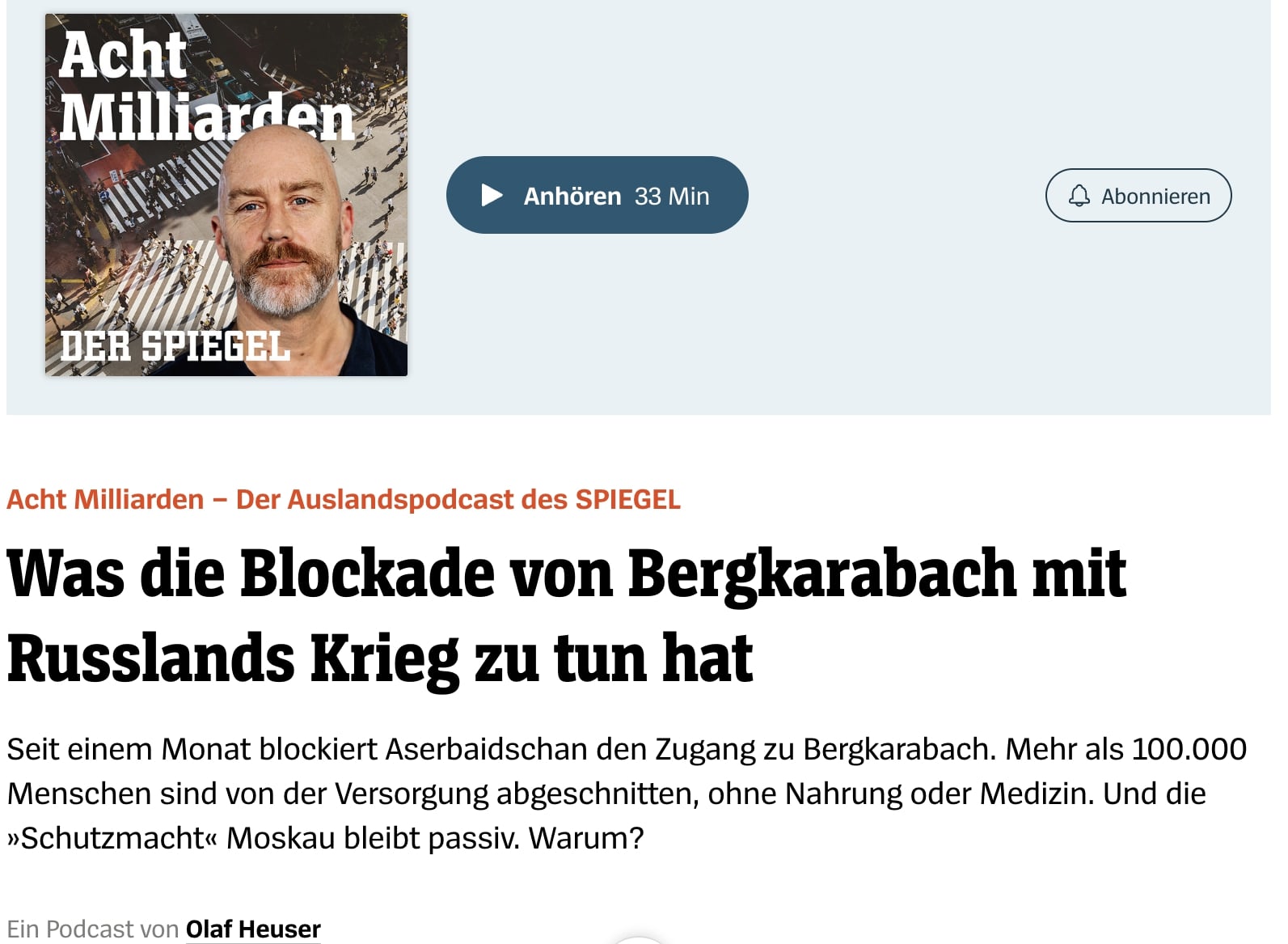
Admittedly, it is technically possible to get a somewhat objective assessment of a situation even by critically evaluating the statements of only one party. However, the prerequisites for this are the will towards neutrality and objectivity, stringency in argumentation and, of course, verification of statements made on the basis of independent information. You will look in vain for all of this in Heuser’s podcast.
To begin with, Der Spiegel in the person of Olaf Heuser continues to use the incorrect designation of that part of Karabakh as an “exclave” (1:06). At this point I take the liberty of pointing out that since the outbreak of the 44-day war I personally have repeatedly written to the editorial staff of Der Spiegel informing them of the nonsensical nature of this designation, most recently a few weeks ago. Despite the promise made by the magazine’s editors that they would henceforth deal more sensitively with important terminology, the podcast of January 13, 2023 shows the opposite. This is certainly a factor that must contribute to the (rightly) spreading disenchantment with journalism in the German-speaking world, including and especially among media with a claim to “quality”. As Albert Camus said, “To misname an object is to add to the misfortune of this world.”
The intellectual core of the podcast is a compassion narrative in favor of Armenians. Through this, “Armenian people” are portrayed exclusively as victims and “Azerbaijani people” (this is apparently the new politically correct speak for “Armenians” and “Azerbaijanis”) only as autocrats and criminals. Here alone it becomes clear how extremely problematic Heuser’s decision to allow only Armenian victims such as Beglaryan to have their say is. Because in the whole podcast “Nagorno-Karabakh” is systematically equated with the Armenians living there, as if there has never been any other population there or as if the fact that before the Armenian conquest and occupation of the area at the beginning of the 1990s about 40,000 Azerbaijanis still lived in the then “Nagorno-Karabakh Autonomous Oblast” (NKAO) is of no importance at all. Thus, for Heuser, the Azerbaijani victims of the Armenian policy of aggression and occupation in Karabakh are quantités négligeables and, in fact, even less than second-class victims, or rather zero-class victims, because they do not even feature in the presentation. One might say that the podcast projects a vision of a one hundred percent “Azerbaijani-free” Karabakh, in line with the Armenian ethnic cleansing policy.
The consequences of this deliberate and systematic exclusion of the Azerbaijani perspective are also clearly evident in Heuser’s assertion that the separatist area in Karabakh “is called ‘Artsakh’ by the people there” (0:41). On the surface, there is at least some logic to this thesis. After all, the Azerbaijanis are not indeed the “people there”, since they were driven out of their homeland or murdered by the Armenians.
All in all, based on what has been said, Heuser can be accused of indirectly legitimizing the war and human-rights crimes committed by Armenians in and around Karabakh since the early 1990s with his one-sided concept of victimhood. This is not a problem of detail. Rather, Heuser retroactively makes himself an accomplice to the policy of ethnic cleansing pursued by Armenians. Heuser does not seem to mind that the very selection of his sources legitimizes exactly this inhumane policy. Gayane Beglaryan’s claim that the territory in question does not belong to Azerbaijan, namely because she herself is Armenian and lives there, should have been countered with the remark that without the Armenian nationalist policy of aggression and expulsion, which started in the late 1980s, thousands of Azerbaijanis of the former NKAO would be able to stand in front of the microphones today and say that the region is Azerbaijani because they are Azerbaijanis and live there. Heuser has fallen for a classic case of double-standard thinking here, focusing only on the victims of one side.
By the way, the following statement of Beglaryan (8:44) is revealing both with regard to the way of her own thinking and with regard to Heuser’s reluctance to look closely at and interpret sources: “Nobody here wants to live under the control of Azerbaijani forces. THIS IS NOT EVEN UP FOR DISCUSSION.” [Emphasis added by M. R. H.] Here, too, an observer well-versed in democratic processes of representation may notice the exclusivity of “no one here”, as this all-encompassing pronoun effectively excludes non-Armenians and arose as a result of the ethnic cleansing carried out by the Armenians in Karabakh in the first place. But above all, one must be alert to a sentence like “This is not even up for discussion”, because it means nothing other than that dissenting opinions or sentiments will not be tolerated. Incidentally, for an observer thinking in historical dimensions, such statements reveal the continuity between the intolerant and violence-obsessed belief in authority and behavior of the early “Nagorno-Karabakh” separatists (from mid-1918) and their present-day avatars.
Needless to say, Heuser’s aforementioned adoption of the term “Artsakh” leads to a chain of further argumentative incoherencies and dead ends. Even according to Armenian data, the last year in which a province of this name (Armenian: Արցախ) was at least nominally under the rule of an Armenian prince was 1045 (Kalpakian 1993: 112). Until that year, the area was still part of the Bagratid kingdom, indicated in Armenian historiography as Armenian, which ended in 1045, having been annexed by Eastern Rome. Since then, what had once been Արցախ was never again under Armenian rule until its annexation by Armenia in the early 1990s, and the term “Artsakh” was never again used as an administrative-legal term until then, not even under Tsarist and Soviet rule. So, when Heuser says: “After the October Revolution, the Transcaucasian Soviet Socialist Republic was established, consisting of Armenia, Georgia and Azerbaijan. With the establishment of individual Soviet republics from this conglomerate, the territory of Nagorno-Karabakh was assigned to the Azerbaijan Soviet Republic. By that time, Artsakh’s population was more than 90% Armenian.” (18:11), he propagates the myth of a historical entity “Artsakh”, which by that time had been non-existent for more than nine centuries, and confuses Armenian historical myths with historical reality.
So while Heuser, in the wake of his Armenian prompters, has no problem describing political reality with the vocabulary that fell out of political-administrative use about a millennium ago, and thus can discover an “Artsakh” where none exists, he and his Armenian source Arijanyan ignore very well-documented historical facts from far less distant historical periods when these reveal the opposite of their pro-Armenian views. For example, Heuser gives his Armenian-born journalist colleague Arijanyan the opportunity to mock at length and in no uncertain terms the idea promoted by the Azerbaijani side to refer to the present-day state of Armenia as “West Azerbaijan” (from 16:00). “Every serious historian says that this is complete nonsense,” Arijanyan says, which Heuser, as is almost always the case with the statements of his Armenian contacts, lets slide.
But is it really true? Since the “serious historians” who allegedly prove the designation “West Azerbaijan” to be “complete nonsense” are not named, it remains only to make one’s own logical guesses about the plausibility of this claim. As is known, Yerevan (Azerbaijani: İrәvan) was the capital of a bәylәrbәylik (“grand province”) during the Safavid period (1501-1736). The Safavids were a Muslim dynasty of Turkic origin whose language can be considered a precursor of modern Azerbaijani, and the territory of the province was populated by a majority of Azerbaijani and Iranian-speaking Muslims. Armenians were only a relatively small minority there. In the second half of the 18th century, the İrәvan area with its Azerbaijani Muslim leadership and upper class became an independent khanate and continued as such until it was annexed and dissolved by Russia in 1828. It was not until the establishment of the Armenian so-called Ararat Republic on May 28, 1918, that the city of İrәvan/Yerevan came under Armenian rule for the first time in its history—incidentally, under circumstances whose historical and legal legitimacy is in part questioned by the Azerbaijani side today.
So, if one looks back at the historical continuity of rule as a criterion for determining whether Yerevan and its environs, or the territory of the former İrәvan khanate, could legitimately be called “West Azerbaijan”, does the designation really seem as absurd as the Heuser-Arijanyan duo insinuate? Is it really so inconceivable, as Arijanyan argues with strong understatement (16:54), to assume that the (present-day) Armenian capital of Yerevan was originally Azerbaijani? Since the last independent state with some claim to be called “Armenian” before the establishment of the Ararat Republic was the kingdom of Cilicia with its capital Սիս (Sis) in present-day southern Turkey, which had perished in 1375, one can definitely rule out the possibility that there had been anything like an Armenian rule in later İrәvan/Yerevan even before the establishment of Safavid rule in 1501. Even for earlier periods this is rather improbable and may belong to ephemeral historical phenomena, given that the original settlement area of the Armenians was essentially west of İrәvan/Yerevan, including the territory of Anatolia. Thus, while one can at least draw on a few centuries of political and administrative continuity to legitimize İrәvan/Yerevan’s historical affiliation with “West Azerbaijan” (if one does not want to argue with much more complicated categories such as culture and demography), there was nothing Armenian of a comparable nature in the same area at least between 1375 and 1918, and very likely a few centuries earlier. In my opinion, the question that should be asked in view of all these historical circumstances is rather why İrәvan/Yerevan should not then be called (western) parts of Azerbaijan at least in reference to these historical periods.
All these complex historical backgrounds obviously do not matter to Spiegel at all, because to Olaf Heuser everything is already clear with regard to Yerevan’s historical affiliation to Armenia, West Azerbaijan or whatever. He believes that he can wipe away the idea of thinking of Yerevan as part of West Azerbaijan, at least in theory, with the omniscient and condescending interjection directed at Ilham Aliyev: “That’s what you do when you want something and when you are hold all the power” (16:37).
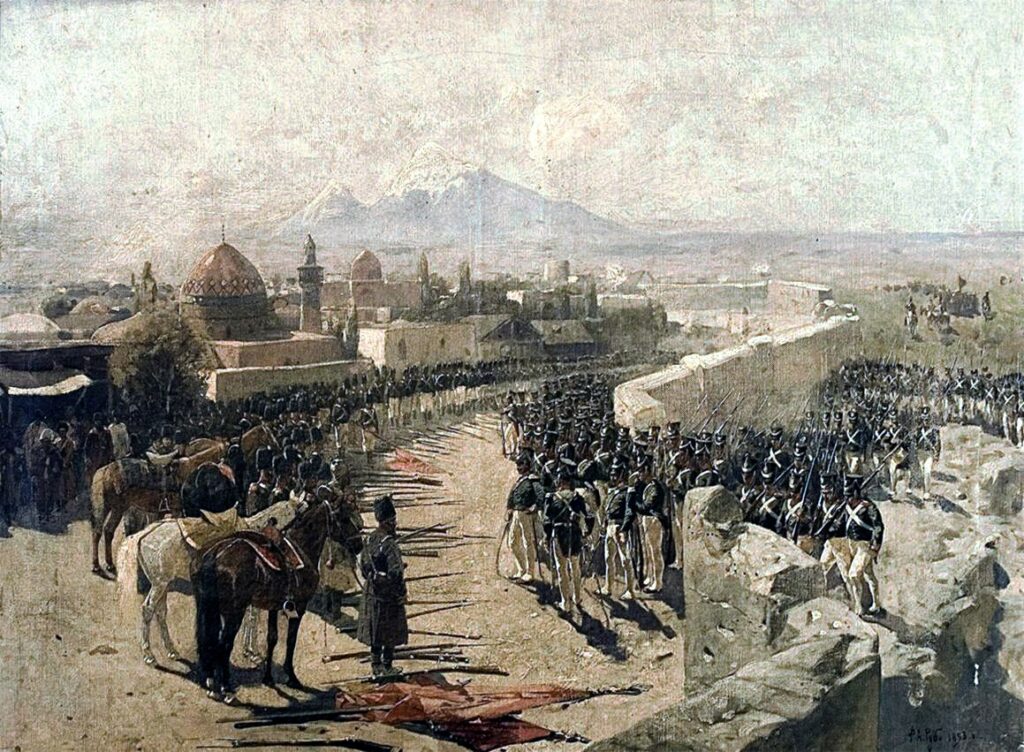
Franz Roubaud’s painting of the Yerevan Fortress siege in 1827 by the Russian forces under leadership of Ivan Paskevich.
Without background knowledge, the world looks very simple: it is either black or white, good or evil. The role that Heuser assumes in this part of the dialogue (until about 17:00) with Arijanyan is no longer that of a moderator or even a neutral journalist, but rather that of a passive cue-giver and claqueur. Both cheer each other on, as Arijanyan draws a parallel between Aliyev and Putin or Russia and Azerbaijan, in other words, assigns the Azerbaijani side the role of the sole aggressor. In this context, Arijanyan speaks of “falsification of history”, “propaganda”, and “misinformation.”
However, what is understood by “falsification of history”, “propaganda” and “misinformation” in the podcast are almost without exception only Azerbaijani and never Armenian positions. When Heuser says at another point (18:48), “when the Nagorno-Karabakh conflict broke out at the collapse of the Soviet Union”, he again reveals his fundamental incompetence to separate the wheat from the chaff when it comes to the presentation of history or propaganda. Because with this statement he sweeps under the carpet the critical build-up of tensions around Karabakh, which was deliberately brought about and calculated out of nationalist sentiments, and which was already being pursued by the Armenian side before the fall of the Soviet Union, at the latest from 1987 onwards. This is “falsification of history”, “propaganda”, this is “misinformation”.
Heuser’s carelessness in handling historical information is also clear at 17:38, when he claims that “the problems between the two states arguably began with the attempted genocide of the Armenians during World War I. The Young Turk government of the Ottoman Empire murdered hundreds of thousands of Armenians between 1915 and 1916.” At this point one should be reminded that there was neither an Armenian nor an Azerbaijani state in 1915 or in 1916. Also, reducing or rather pinpointing the beginning of the Armenian-Azerbaijani discord to the Armenian Genocide might not be entirely uncontroversial in view of the events of 1905 and the complexity of historical events involving Armenians, Azerbaijanis, Ottomans and others between 1914 and then. Heuser’s wholesale adoption of a superficial reference to the genocide, and thereby of the central building block of contemporary Armenian argumentation strategies regarding Karabakh that often serves as a killer argument, is ultimately just further evidence of his clearly pro-Armenian position.
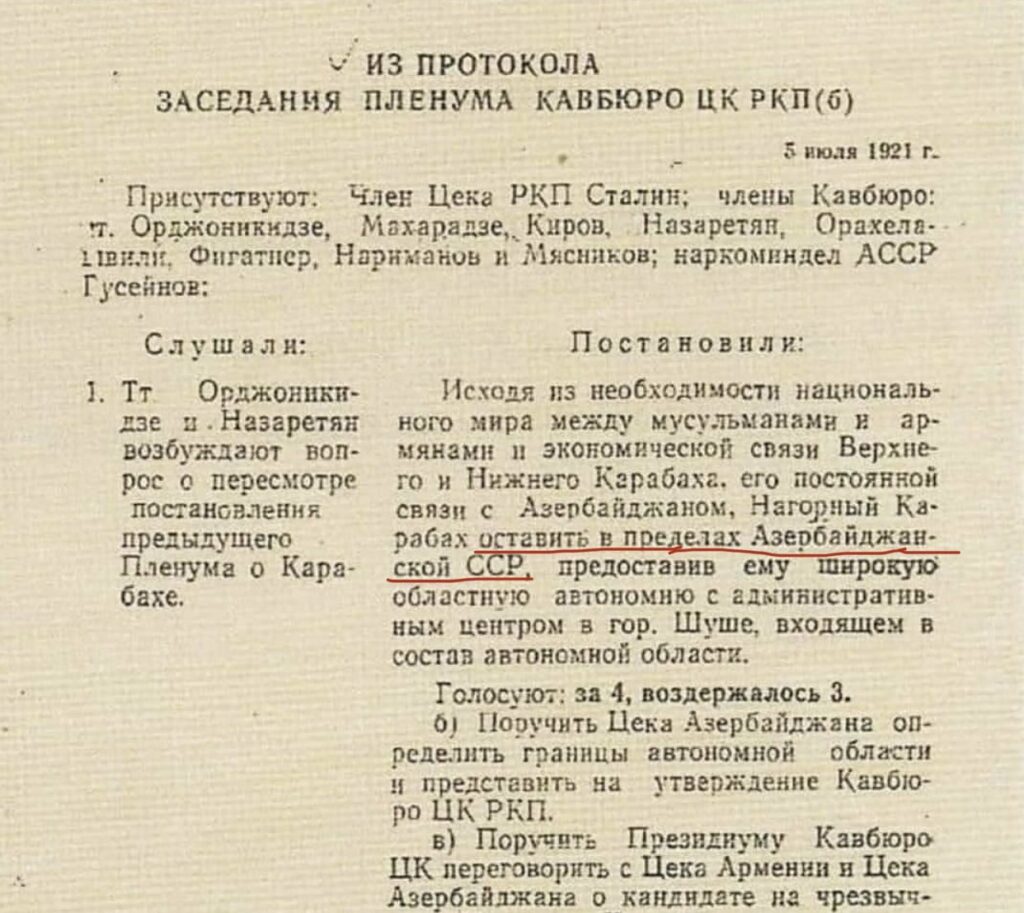
One might ask, what do historical facts mean to Der Spiegel? The publication follows well-known Armenian historical theories and strategies down to every little detail in order to increase their plausibility. This includes deliberate omissions and false assertions. This becomes obvious when one reads the already mentioned quote “After the October Revolution, the Transcaucasian Soviet Socialist Republic was established, consisting of Armenia, Georgia and Azerbaijan. With the establishment of individual Soviet republics from this conglomerate, the territory of Nagorno-Karabakh was assigned to the Azerbaijan Soviet Republic”, viewed once again from a different perspective. If we go from the October Revolution in 1917 directly to December 13, 1922 (the date of foundation of the mentioned “Transcaucasian Soviet Socialist Federative Republic, Zakavkazskaya Socialisticheskaya Federativnaya Sovetskaya Respublika in Russian), or to March 1922, when the federation already came into being under a slightly different name, springing to describe the history of “Nagorno-Karabakh”, this naturally cannot go well, because the term “Nagorno-Karabakh” came into being only after the October Revolution and the key stages of the conflict over it were covered precisely in these five years. Accordingly, the sentence “With the establishment of individual Soviet republics from this conglomerate, the territory of Nagorno-Karabakh was assigned to the Azerbaijan Soviet Republic” is not correct at all, neither the described process nor the year. As is known, the crucial passage in the document “From the Minutes of the Meeting of the Plenum of the Caucasus Bureau of the Central Committee of the Russian Communist Party (Bolsheviks)” (Russian: “Iz protokola zasedaniya plenuma Kavbjuro CK RKP (b)) of July 5, 1921 reads: “Nagorno-Karabakh shall remain within the borders of the Azerbaijan Soviet Socialist Republic” (Russian: “Nagorny Karabakh ostavit’ v predelah Azerbajdzanskoy SSR”), with no mention of “assignment” or “allocation”.
However, it is not only a lack of knowledge and a lack of willingness to familiarize oneself with the subject matter in an unbiased manner that lead to serious misjudgments. The claims gushing out of the podcast into the ether are not even always consistent per se. For example, the claim that “after the last conflict Armenia ceded the territories around Artsakh to the victorious Azerbaijanis” (1:01) is accepted without comment. At least a follow-up question by the journalist would have been appropriate here. If one assumes that “Armenia” “ceded” the territories around the separatist stronghold to the Azerbaijanis, it suggests that Armenia had the power, supremacy or at least a significant influence there, which would imply that the separatist entity was not exactly an independent state, but an Armenian satellite or something of the sort. Similarly, it is stated (19:11) that the war of 2020 was fought by “Armenia”. But how does all this fit in with the statement made at another point (8:55), which is also left unchallenged, that the people in the region call themselves an independent state?
Besides the one-sidedness, the distortion of the victim’s perspective, the distortion of historical facts and the inconsistency, another problem of the presentation in the podcast is its blatant partiality. This includes the rhetorical technique of personalization and tailored emotionalization used in it in an unbalanced way, combined with personal attacks against the Azerbaijani president. “To all appearances, the Azerbaijani autocrat wants to use the opportunity to settle the 30+ year old conflict over the territory in his favor once and for all.” (3:51) This wording gives the impression that the conflict is about some kind of personal vendetta of Aliyev, and Aliyev alone. This demonization of the Azerbaijani president also serves to delegitimize Azerbaijan’s claim to regain control over its own territory. This makes it appear not as a justified and logical plan stemming from the principles of international law, but as a kind of personal campaign of the Azerbaijani leader. The actual basis of Azerbaijani claims—international law, as articulated, for example, by the well-known UN Security Council resolutions of 1993, the right to self-defense, and so on—are not mentioned in a single syllable of the podcast. Instead, a number of Aliyev’s statements are inserted, laced with the undertone of indignation (7:48), in an attempt to discredit him. However, one only hears the president clarify that Azerbaijan seeks not to expel Armenians from Karabakh, but to fight separatists and occupiers. Are these not perfectly legitimate aspirations? Does the civilized international community not applaud the Ukrainian leadership under Zelenskyy for similar actions? Even if one does not want to adopt Azerbaijan’s position, it should be noted that there is no personalization, emotionalization and demonization of Armenia or Armenian leaders in the podcast. The name of Pashinyan is not even mentioned.
The strategy of personalization becomes particularly implausible and somewhat embarrassing, especially from a German perspective, at the point (9:17-12:00) where Arijanyan is allowed to describe in great detail how Ilham Aliyev met with Vladimir Putin two days before the start of the Russian war of aggression against Ukraine. The Spiegel podcast pokes fun at this, condemning the fact that the two heads of state exchanged jokes during this meeting and that the atmosphere was friendly. So what? This is just the way it is in diplomacy, even among heads of state. There is a certain etiquette when it comes to achieving rapprochement at the political and diplomatic level. It is obvious that this rapprochement was the goal of the talks, otherwise they would probably not have taken place. As a German, I would only like to remind you in this context that Olaf Scholz also met with Putin in Moscow on February 22, 2022, and Scholz probably made no great attempt, at least in his rhetoric, to annoy Putin or to be unfriendly. So what the podcast builds up for minutes as an apparent backdrop for arguments against the Azerbaijani president is, in the end, little more than windy polemics.
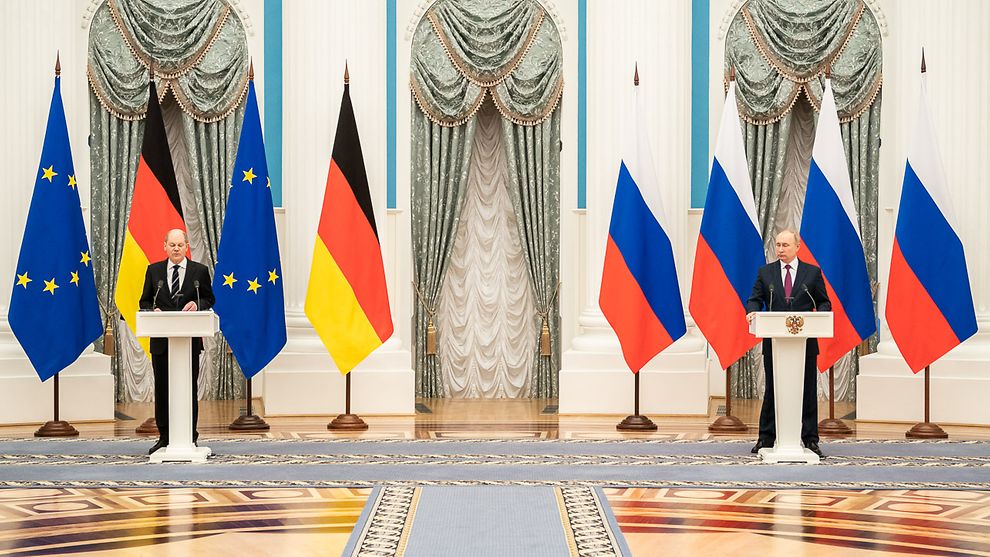
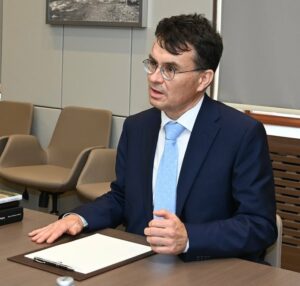
Foto: Bundesregierung/Kugler
This demonization of Azerbaijan is all the more incomprehensible, at least from Spiegel’s perspective, that the podcast itself does not assign the blame for the alleged “blockade of Nagorno-Karabakh” mentioned in the title to the Azerbaijanis at all, but rather to the Russian representatives on the ground (5:16). The podcast points out that it is the Russians who have set up the roadblocks that lead to the described precarious humanitarian situation in the area. One cannot help but wonder what the problem with Azerbaijan actually is, when the main target of criticism is Russia. In my opinion, Arijanyan’s assessment of Russia’s role is very realistic and cannot be dismissed out of hand (6:18). She points out that Russia has an interest in the conflict or in maintaining it, because without this conflict it would no longer be able to assert its influence in the South Caucasus region. One cannot really argue with that.
In conclusion, after listening to the podcast, I ask myself why German mainstream journalists devote themselves to topics that they themselves know to go beyond their chosen format and available capabilities, without any professional depth or desire for balance, and without any discernible effort. Perhaps in the future, a little less would be more here, too.
Michael Reinhard Heß, is a German Turkologist and researcher of the Azerbaijani poet Imadeddin Nesimi.
References
Kalpakian 1993. Kalpakian, Bischof Vosskan: Der armenisch-aserbaidschanische Konflikt und das »Karabach«-Problem. In: Hakobian, Hravard et al.: Armenisches Berg-Karabach/ Arzach im Überlebenskampf. Christliche Kunst – Kultur – Geschichte. Richter, Manfred (Hg.). Berlin: Edition Hentrich. 111-113.