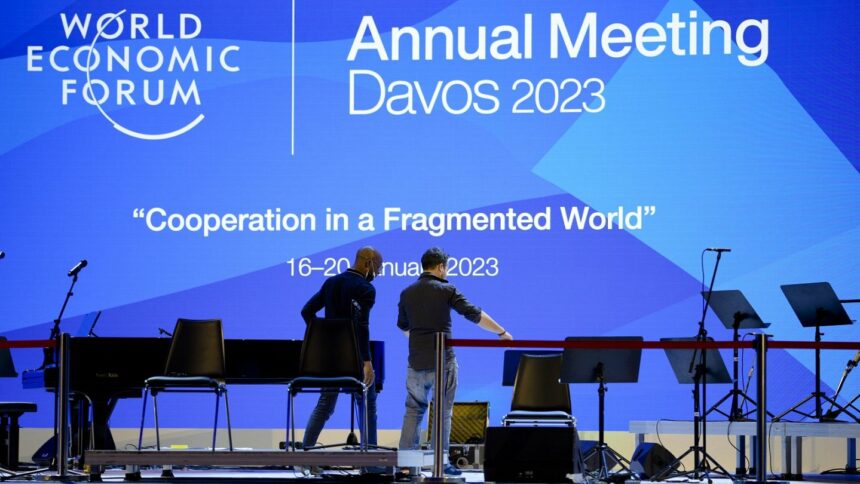
The discussions, scheduled in the WEF program for January 16-20, will consider prospects of overcoming the energy crisis and other consequences of the Russian-Ukrainian war, as well as assess the risks of a recession and possible trade conflicts. According to the WEF’s website, the President of Azerbaijan Ilham Aliyev has been announced as a panelist to talk on the role of the “Middle Corridor” in Eurasia.
Held for the 52nd time at the Swiss Davos resort, the World Economic Forum gathered about 2,700 guests, including heads of state and governments, top managers of the world’s largest companies (only among billionaires 116 are declared to come) as well as public figures and representatives of the world’s leading media from more than fifty countries. As was already the case last May, sanctioned Russia is not participating in the forum.
Panel sessions discuss ways to direct the global economy out of a series of complex crises. This year’s WEF program calls for public-private partnerships to address the world’s most pressing problems, and the forum’s organizers call on world leaders to work together on energy, climate and trade. There are planned speeches and presentations of heads of such authoritative international organizations as the United Nations, the World Trade Organization (WTO), the European Commission, the International Monetary Fund (IMF), NATO and a number of other structures, as well as heads of governments and presidents of leading countries of the world. According to the agenda of the forum organizers, a number of activists in the cultural sphere have been awarded the “Crystal” prize.
“I believe, that it is essential to have an international platform that includes all stakeholders in global society: Governments, business, civil society and the young generation. I hope that the participants of the forum, which brings together all interested parties, will be able to find ways of solving the existing crises”, said the founder of the forum and the permanent organizer of the annual meetings in the format of WEF, Klaus Schwab.
And it seems that the possibilities of the Davos platform for discussion and search for compromises to overcome the expected crises are very much in demand today. We are, in particular, talking about the growing risks of a global recession against the background of tightening monetary policy by financial regulators of the world’s leading economic centers. Energy is still a challenge, with a number of experts predicting a new wave of de-industrialization in Europe in the face of volatile gas and oil prices and persistent supply chain problems. It is equally important to coordinate the efforts of the world’s leading countries to overcome the inflationary backlash that prevailed in 2022, while excluding trade protectionism.
The latter carries huge risks in the new year of 2023: as early as the end of November last year, Bloomberg warned of possible negative consequences due to the adoption of a new US law to reduce inflation, including the reduction of the tax burden by providing incentives in the field of energy supply to American enterprises in order to encourage the American population to buy local products (the so-called “Buy American” plan). A key provision of the US law is a tax deduction of up to $7,500, encouraging consumers to buy domestically assembled electric vehicles that have US-made batteries. In general, Washington, who promoted the new law, was motivated primarily by the idea of economic isolation of China, but the document caused strong opposition from France and Germany, other leading EU countries and serious concern in Japan. America’s partners believe that unilateral protectionist moves by the US could split the transatlantic unity. And in Paris, they talked about the need to introduce countermeasures, for example, the adoption of a similar “Buy European” law, as well as the possibility of litigation with Washington within the WTO.
“The international community is faced with a high probability of the emergence of new trade wars, as countries are increasingly paying attention to themselves against the background of global instability. Some States have opted for the path of isolation or confrontation, in particular, the People’s Republic of China has pursued a very aggressive policy in recent years. If other countries of Europe or North and South America move along a similar path, we will not be able to solve the world problems”, said German Economy Minister Robert Habeck, speaking at the WEF forum as Bloomberg reported. A similar message was delivered by Spanish Prime Minister Pedro Sánchez, who called for a compromise between the EU and the US at Davos to avoid a trade war because of America’s anti-inflationary Inflation Reduction Act.
Amid the above-mentioned challenges and potential risks, the participants of this forum in Davos show genuine interest this year in expanding cooperation with the post-Soviet countries in the field of energy security, using the opportunities of transport and logistics corridors connecting the “Old World” countries with the regions of the South Caucasus, Central Asia, etc.
This topic is very close to Azerbaijan, which is a permanent member of the WEF forums and tries to make maximum use of the opportunities of the Davos platform to coordinate its business interests in a rapidly changing world. In recent years, the Azerbaijani delegation in Davos has focused on “green” energy, increasing energy supplies to Europe and digitalization of the domestic economy. This year, the Azerbaijani delegation (including experts from the Ministry of Economy) also takes part in the forum. According to the WEF’s website, President of Azerbaijan Ilham Aliyev was announced as a panelist on the role of the “Middle Corridor” for Eurasia to be held on January 19. The European Commissioner for Administration and Budget, Johannes Hahn, and the Prime Minister of Georgia, Irakli Garibashvili, will also participate in these discussions. According to the Latvian media, a bilateral meeting between the presidents of Azerbaijan and Latvia is also scheduled in Davos.
It is worth recalling, that the disintegration of global transport and industrial links, which began during the Coronavirus pandemic, advanced even more against the background of the Russian- Ukrainian War, and in fact the transport potential of the Russian Federation today is left out of global trade and logistics. Against this very negative background in Europe, Türkiye, China, Japan and other Asian countries are increasingly looking at the possibilities of an alternative “Middle Corridor”, which runs through the territory of the states of Central Asia and South Caucasus. And almost all these transit routes pass through the territory of Azerbaijan, so it is not surprising that the seaports, roads and railway fleets of the republic became a key beneficiary of the increased international traffic in 2022.
Today, Baku is undertaking large-scale initiatives to expand the capabilities of “Middle Corridor”: the capacity of terminals of Baku’s International Sea Trade Port in Alata will be increased from 15 to 25 million tons per year. Work on the modernization of the Baku-Tbilisi-Kars railway (BTK) has started – its capacity will be increased from the current 1 million to 5 million tons per year, and for this purpose will receive over $100 million from the state budget, with part of the funds already allocated. In the future, Azerbaijan’s transit capacity will be further expanded within the framework of the already implemented plans for the construction of railway roads and road infrastructure of the Zangazur corridor. Given the urgent need of the European market for geographical diversification of energy sources, mineral, petrochemical and other raw materials, as well as alternative ways of their delivery, it is safe to say that the planned presentation of the potential of Azerbaijan on the “Middle corridor” will attract genuine interest in Davos.
Khazar Akhundov
Caliber.Az