This includes fantasies like “total victory” and daydreams about Israel assassinating Turkish President Recep Tayyip Erdo?an and Iran’s Supreme Leader Ayatollah Ali Khamenei. We recently featured one such vision here at Naked Capitalism from neocon-connected Simon Watkins at OilPrice. In it, he raises an option for Israel in attacking Iran out of Azerbaijan, which would lead to another front in war, destruction of Middle East and Caspian energy infrastructure, the tanking of the global economy, and potentially the deaths of hundreds of thousands of people, if not more — just the usual neocon reverie.
While Watkins version is unlikely (see comments on his piece here), there are pathways for the Caucasus to get sucked into the US/Israel slaughter in the Middle East. Neocon fever dreams unfortunately do play a role, but there’s also a lot else going on, and I’d like to take a more sober look at that here.
The Caucasus is at the crossroads of Europe, Asia, and the Middle East, and is therefore one of the most contested centers for the vital issues of energy transfer and trade logistics. All the major players from the Middle East conflicts, as well as others, are heavily involved in geopolitical maneuvering here.
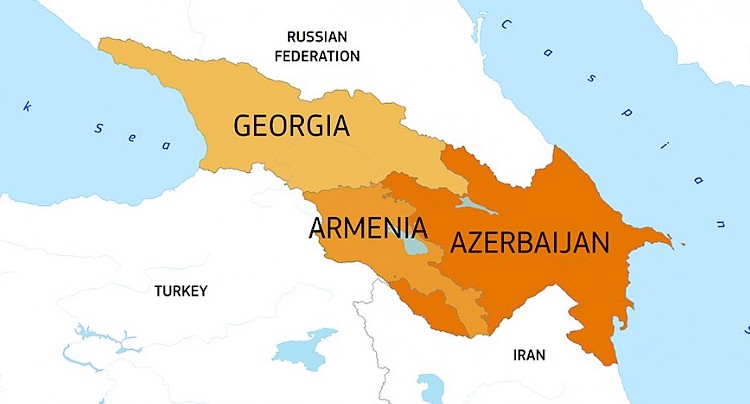
Much of the intrigue in the Caucasus centers around the so-called Zangezur Corridor, a 42-kilometer strip of land in southern Armenia wedged between Azerbaijan and its exclave, Nakhchivan, and bordered by Iran to the south.
This small piece of coveted territory plays an outsized role in larger trade and energy projects due to the fact that whoever controls it will increase their influence in the region. It is of major interest to all the large players in the wider Middle East conflict, including Iran, Russia, Türkiye, Israel, and the US.
The latter happens to be in large control of its fate due its recent infiltration of the Armenian government, which has become an outpost of the US, and the Zangezur Corridor is a big bargaining chip for Washington.
The nine-point ceasefire agreement signed under Russian mediation that ended the 2020 war between Azerbaijan and Armenia included a stipulation that the latter is responsible for ensuring the security of transport links between the western regions of Azerbaijan and Nakhichevan, facilitating the unhindered movement of citizens, vehicles and cargo in both directions. Azerbaijan and Turkiye have latched onto that point, insisting they have the right to set up transportation links through southern Armenia.
Baku wants travel of people and cargo between Azerbaijan and Nakhchivan to be free of inspection and customs and expects Yerevan to agree to the deployment of Russian border guards along the corridor. Moscow agrees with the deployment of its border guards, even if it doesn’t see eye to eye on the customs issue (it wants the Russians to conduct the security checks).
While Türkiye, Iran, Azerbaijan, and Russia might not see eye to eye on Zangezur, there had been a concerted effort to find some agreement that works for all sides. Baku wanted a broader “3+3” framework, involving Russia, Iran, Türkiye, Azerbaijan, Armenia, and Georgia. Russia was steering the process until Armenia last year turned to the US and EU to replace Moscow, a decision that quickly resulted in Armenia’s loss of the contested Nagorno-Karabakh territory and more than 100,000 ethnic Armenians fleeing.
The insertion of the US into the equation makes a peaceful agreement more unlikely while increasing the odds that destabilization spills over from the Middle East.
The starting point for any conflict in the southern Caucasus that draws in outside actors would be another round of fighting between Armenia and Azerbaijan. The latter receives heavy military support from Israel and Türkiye while Armenia is now a western proxy with support primarily from France and the US, as well as India.
While Washington unleashes the crazies — both in the State Department and in its proxy states where its fevered support of neo-Nazis, jihadis, and genocidaires increasingly looks like a go-for-broke strategy — it would be surprising if it and Israel didn’t try to push forward with more recklessness in the Caucasus.
Will the other actors — Türkiye, Azerbaijan, Iran, and Russia — be able to find mutually acceptable paths forward rather than conflict?
The prospects aren’t looking so great at the moment. Peace talks between Azerbaijan and Armenia (with heavy input from the Americans) intended to settle long-festering border issues, as well as the Zangezur question, are currently circling the drain. The chief hold up is the Zangezur issue.
On October 14, Azerbaijan’s defense minister instructed the country’s military to stay on high alert and “to be ready to take preventive measures against all possible provocations of revanchist forces on the conditional border.”
Both Azerbaijani President Ilham Aliyev and Erdo?an have made frequent statements about taking the Zangezur Corridor by force if necessary, and in any new conflict between Azerbaijan and Armenia it’s entirely possible — if not likely — that they make an effort to do so.
The problem there is that Iran is increasingly worried about the prospect of the corridor as its influence is under attack across the Middle East and is drawing red lines as it becomes isolated on the issue.
It’s easy enough to imagine plenty of scenarios under which conflict spreads from the Middle East to the Caucasus, especially when factoring in the machinations of the current all-or-nothing US/Israel approach. Rather than speculate on those hypotheticals, I will here provide a brief summary of the positions of all the players as they relate to the Zangezur Corridor and how their positioning is likely attached to the current US/Israel rampage in the Middle East.
Iran
Tehran is reportedly making it clear to the US that if Israel/US attacks its energy infrastructure, it will respond in kind in the region, and that includes not just the Middle East but the South Caucasus as well — specifically Azerbaijan.
That makes sense as Azerbaijan supplies 40 per cent of Israel’s energy needs. The strong weapons-for-energy relations between Israel and Azerbaijan continues to be a major concern for Iran where the media report on secret Israeli military bases in Azerbaijan and the belief that sabotage against Iran is frequently directed by Israel from Azerbaijan.
On the issue of the Zangezur Corridor, Tehran says that it crosses its red line.
The implementation of the Zangezur Corridor would be a negative for Tehran in about every conceivable way. Iran would be eliminated as a bypass route around Armenia. Details from Al Monitor:
Iran earns a 15% commission from Azerbaijan’s gas supplies to Nakhchivan. It serves also as a route for Turkish exports to Central Asia. An average of about 12,000 Turkish trucks use the route monthly, with Iran charging passage fees of up to $800 for their 1,800-kilometer (1,120-mile) journey to the Turkmenistan border.
More than the money, however, Iran doesn’t want to lose influence over Azerbaijan, which relies on transit through Iran to connect to its exclave. And Tehran is especially worried about a NATO Turan Corridor which sees the West link up hypothetical client states throughout central Asia. From Dr. Vali Kaleji, a Tehran-based expert on Central Asia and Caucasian Studies:
Iran sees the creation of the Zangezur corridor as a matter beyond the access of the Republic of Azerbaijan to Nakhchivan exclave and believes that this corridor will provide direct military access for Türkiye as a NATO member in the Caucasus and west of the Caspian Sea. Indeed, a significant number of Iranian elites and experts believe that the expansion of Türkiye’s presence in the South Caucasus, especially through the Zangezur corridor, will strengthen pan-Turkism in the region, which is a direct threat to the Azeri regions of north-western Iran.
In 2022 Iran opened a new consulate in southern Armenia and has conducted more frequent military drills on its border with Azerbaijan, as well as in the Caspian Sea. Should Azerbaijan and Türkiye attempt to take Armenian land by force, an Iranian intervention would make sense, but what is Tehran to do if Armenia agrees to the Zangezur Corridor? Taking action in that case would come at a moment when Iran’s plate is awfully full and put Tehran at odds with everyone else in the region, including Russia.
In September, Iran summoned the Russian ambassador over Moscow’s support for Zangezur. There are reports of other issues between Iran and Russia, although it’s unclear how much meat is on the bone there. Regardless, recent news from the South Caucasus is reason for more concern for Tehran.
On October 8, Armenian Prime Minister Nikol Pashinian and Russian President Vladimir Putin announced that Russian border guards will withdraw from the Armenian-Iranian checkpoint by January 1. Since 1992 Armenia’s borders with Türkiye and Iran have been the responsibility of Russian troops.
Due to Armenia’s cozying up to NATO and coupled with Azerbaijan being a Mossad outpost, Tehran understandably views this development as part of an increasing threat from its north.
Israel and Azerbaijan
Azerbaijan wants the Zangezur Corridor. The question is how do they want to get there?
The problem is if they go for it, the US/Israel could try to make sure it becomes a conflict. You can understand temptation for Türkiye and Azerbaijan but could play right into trap. No doubt this item was under discussion by Putin and Aliev during the former’s visit to Baku in August and so far Azerbaijan — which also has strong ties to China (more on that later) — is refusing to play its role in the West’s attempt to direct the play.
Relations between Iran and Azerbaijan have long been difficult due to a variety of issues, but it’s important to remember that doesn’t always mean endless escalation until conflict as it frequently does for nations in the orbit of the rules-based international order. Baku and Tehran also find ways to cooperate, such as on the International North-South Transport Corridor that will run through both countries and connect Russia to India.
That being said, Baku’s friendly relationship with Israel is increasingly problematic, and both sides are accusing the other of espionage and terrorism. From 2016 to 2020 Tel Aviv accounted for 69 percent of Azerbaijan’s major arms imports, including its loitering munitions, which gained notoriety in the 2020 Nagorno-Karabakh War.
This relationship with Israel serves as a counterweight to Iranian influence on Azerbaijan, which includes pressure against the development of trans-Caspian routes through Azerbaijan. There is also the issue of Iran’s West Azerbaijan and East Azerbaijan Provinces, which are mostly populated by Azeris and Kurds. Baku makes some noise about self-determination, but this is mostly an American neocons dream. They have long imagined using the ethnic Azerbaijani population in Iran to destabilize the country. Oddly enough, Iran’s current president Masoud Pezeshkian, who came to power after his predecessor died in a helicopter crash on a return flight from Azerbaijan, is part ethnic Azeri, as is Supreme Leader Ali Hosseini Khamenei.
According to non-neocon accounts, (and maybe some Iran expert readers can add more insight) Iranian Azeris are mostly well integrated into Iranian society and there’s not a whole lot of dissatisfaction for outside actors to exploit. That rarely stops the neocons, however, who often view conflict as the key to unlock repressed ethnic tensions that will be unleashed in their favor.
Conor Gallagher
nakedcapitalism.com