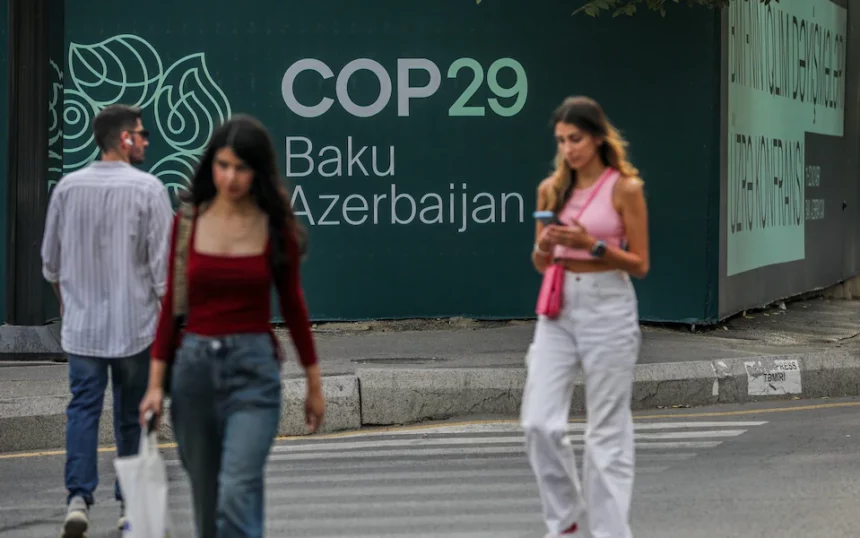
Azerbaijan will host the United Nations Framework Climate Change Conference (UNFCCC COP 29) from November 11 to 22, 2024. The global event is expected to attract up to 100,000 participants, including heads of state and government from over 180 countries, to Baku, the capital of the South Caucasus republic.
As the country presiding over the summit, Azerbaijan has called for a global truce during the conference, urging all nations involved in conflicts to cease hostilities during the event and one week before and after. “Azerbaijan continues and will exert additional efforts to make Cop yet another success story with regard to peace, and to make COP29 a Cop of peace alongside the climate action issue,” said Hikmet Hajiyev, foreign policy adviser to President Ilham Aliyev, in an interview with The Observer in Baku, adding that “We are actively working on the advancement the peace agenda.”
From the outset, Azerbaijan’s COP29 story was linked with the peace and security agenda, as Azerbaijan’s neighbor Armenia, the country with which Azerbaijan was in a violent conflict until recently, supported Baku’s bid to host COP29 in a historic agreement between the two South Caucasian countries on December 7, 2023. The agreement also included a clause on exchanging prisoners detained by the sides in different situations since the end of the 2020 Karabakh War. The breakthrough was internationally lauded by several countries, including the United States and the European Union (EU).
However, in the year since the December 7 agreement, Baku and Yerevan have failed to make tangible progress toward signing a peace treaty, with unresolved issues continuing to hinder prospects for a lasting agreement. Based on a broader seventeen-article peace agreement, Armenia has proposed a treaty of thirteen agreed-upon articles. Yerevan simply excluded the yet-to-be-agreed articles from the draft treaty it sent to Baku at the end of August, which has not been made public. Dismissing this approach as “primitive” and “inadequate,” Azerbaijani president Ilham Aliyev stated that the peace treaty would be incomplete without the remaining provisions.
In July, President Aliyev confirmed that 80 percent of the text of the peace treaty was ready but emphasized a precondition for Armenia to meet before signing the agreement. This condition pertains to Armenia’s constitution, which references the country’s Declaration of Independence—a document that calls for the unification of Armenia with the Karabakh region of Azerbaijan.
This region, internationally recognized as part of Azerbaijan, has been at the heart of the conflict between the two countries for the past thirty years, as Armenia sought its separation from Azerbaijan due to the presence of an Armenian community in the area. Yerevan occupied the region and surrounding districts of Azerbaijan during the First Karabakh War in the early 1990s, maintaining control until the Second Karabakh War in 2020, which ended the occupation and opened the door for peace and reconciliation between the two nations.
However, this path has proven more challenging than expected. The constitutional basis for resuming the conflict and judicial manipulation conducted by revanchist forces have fostered distrust in Baku regarding Armenia’s future intentions. Armenian experts and politicians fuel this distrust by publicly discussing the importance of a military build-up and using force to retake the lost territories.
Armenian Prime Minister Nikol Pashinyan has acknowledged the need to amend Armenia’s constitution for lasting peace and stability in the region. However, this process may take considerable time and is not expected to be completed before 2027. In the meantime, both countries have discussed the possibility of signing an interim document based on basic principles, which could be signed during COP29 in Baku.
Such a document could serve as “a temporary measure and form the basis of the bilateral ties and ensure neighbourly relations between the two countries,” said Hikmet Hajiyev, foreign policy adviser to the Azerbaijani president, in July. The two countries may continue negotiations toward a comprehensive peace treaty with more confidence if they succeed in signing an interim document in the upcoming months.
The path to peace and reconciliation between the two countries is likely to be more complex. The territorial claim in Armenia’s constitution is not the only issue complicating the situation. Baku and Yerevan remain at odds over several critical matters, including the reopening of regional transportation links, the return of refugees to their homes, and reparations for the destruction and ethnic cleansing carried out by Armenia in Azerbaijan’s formerly occupied territories. While the latter two issues are primarily bilateral concerns, the reopening of transportation routes carries broader geopolitical significance. The interests of Russia, Iran, and the West clash over the regional transportation corridors. Therefore, this issue extends beyond the relations between Baku and Yerevan.
At the bilateral level, the two countries have enough problems to resolve. Above all, Azerbaijan expects Armenia to pay reparations for the destruction it caused in the Karabakh region and surrounding territories. The end of the Armenian occupation in 2020 revealed the immense scale of devastation in areas that were once home to up to a million people. Everything—including residential buildings, schools, hospitals, public buildings, historical sites, graves, and mosques—had been reduced to rubble by Armenians during and after the First Karabakh War (1988–1994). For instance, Gevork Kostanyan, a former prosecutor general of Armenia and Yerevan’s former representative at the European Court of Human Rights, criticized the government’s failure in the 2020 Second Karabakh War, noting that Armenia could be forced to compensate Azerbaijan for the damage, estimated at over $50 billion.
Azerbaijan and Armenia also have to agree about the fate of refugees. Baku expects Yerevan to allow the return of up to 300,000 Azerbaijanis who were forced to leave Armenia in the late 1980s. Baku was called by the EU to facilitate the return of Armenians to Karabakh, the region they voluntarily left in September 2023 after Azerbaijan’s anti-terror measures against the separatist Armenian military forces.
The fact that Armenian civilians faced no maltreatment from the Azerbaijani side during and following the anti-terror measure was confirmed by both the Armenian government and international organizations. In September 2023, the fact-finding mission of the United Nations confirmed that Armenians left Karabakh voluntarily and “did not come across any reports—neither from the local population interviewed nor from the interlocutors—of incidences of violence against civilians following the latest ceasefire.” This fact was confirmed by the call of the Armenian Prime Minister Pashinyan to the Karabakh Armenians, who tried to convince them to stay in Karabakh. “Our assessment at the moment is that there is no direct threat to the civilian population of Karabakh,” he said on September 21, 2023—a day after the termination of Azerbaijan’s anti-terror measures.
In October 2023, the Azerbaijani government invited Armenians to apply for Azerbaijani citizenship and return to Karabakh. However, this offer has yet to be accepted by the Karabakh Armenians, who demand international security guarantees—a condition that conflicts with the sovereignty and constitutional framework of the Republic of Azerbaijan. Meanwhile, the Armenian government continues to refuse any discussion regarding the return of Azerbaijanis to Armenia, framing it as a territorial claim and a threat to the country’s national security.
On a positive note, in the past year, since the September 2023 events that resulted in the collapse of the separatist entity in Karabakh, the so-called “Artsakh Republic,” Baku and Yerevan have made significant progress in some areas. In April, the two countries resolved a territorial dispute in a peaceful manner for the first time in post-Soviet history, with Armenia returning four border villages of Azerbaijan as part of the delimitation of the interstate border. They are still on the constructive path in this context. In August, the two countries approved regulations for the joint work of the commissions on the delimitation of the Armenian-Azerbaijani border. These developments indicate enough potential to overcome the remaining challenges and build lasting peace and stability in the region.
Dr. Vasif Huseynov is a department director at the Center of Analysis of International Relations (AIR Center) and Adjunct lecturer at Khazar University and ADA University in Baku, Azerbaijan.