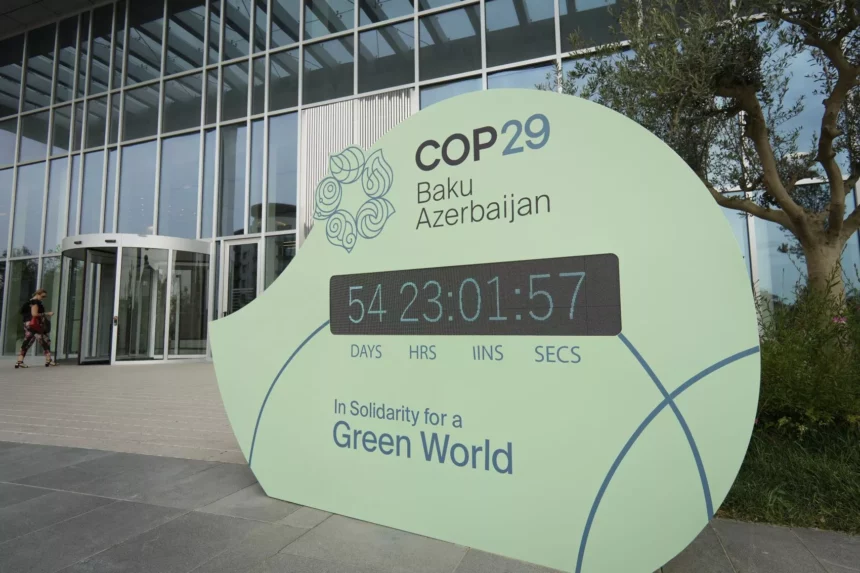
COP-29 in Azerbaijan: Why Location Matters
While selecting Azerbaijan as the host for COP-29 may have initially seemed unexpected, this year’s Conference of the Parties holds more potential than meets the eye. Geopolitically, Azerbaijan and the broader South Caucasus region sit at the crossroads of Europe, Asia, and the Middle East, enabling it to foster cooperation among both developing and developed countries. However, Azerbaijan’s strong reliance on domestic oil and gas reserves—resources that will continue to play a role in its economy for the foreseeable future—has raised concerns among climate advocates, once again putting the spotlight on the role of “petrostates” in COP events.
What is less widely acknowledged, however, is Azerbaijan’s ambition in renewable energy, a vision that it can readily finance through its oil and gas revenues—a model recently adopted by other fossil-fuel-rich states in the Middle East. Beyond the environmental benefits of a cleaner domestic energy sector, this shift would also free up oil and gas currently used domestically, making them available for export. While financing may not be the primary hurdle for Azerbaijan—or for other petrostates—it remains a critical issue for countries with fewer natural resources, whether they are developed or emerging economies. For this reason, COP-29 has been frequently referred to as the “finance COP,” a natural extension of the focus on mitigation and adaptation funding that had emerged at COP-28. Furthermore, under the “COP Presidencies Troika,” Azerbaijan’s COP will need to bridge the commitments made at COP-28, where parties agreed to “transition away from fossil fuels,” with COP-30 in Brazil, where biodiversity may take center stage.
A challenging path lies ahead, yet Azerbaijan’s strategic and geopolitical position makes it uniquely suited to bridge critical divides at COP-29. Three key aspects of Azerbaijan’s location underscore its significance: first, its role as a geopolitical bridge linking the South Caucasus with both East and West, facilitating diverse climate diplomacy; second, its evolving position as a leader in the global energy transition; and third, the environmental and cultural landscape of the Caspian Basin, offering a localized case study in adaptation and sustainable practices.
Azerbaijan as a Geopolitical Bridge for Climate Diplomacy
COP-29’s location in Azerbaijan offers a bridge between countries that may not traditionally collaborate on climate issues, creating an unprecedented forum for dialogue among stakeholders from the European Union (EU), Central Asia, and the Middle East. This bridging role could help mediate conversations between the EU and energy-producing countries in Central Asia and the Middle East, who often face competing priorities between economic growth and carbon reduction. Azerbaijan’s hosting of COP-29 can provide a neutral ground to foster partnerships aimed at tackling the dual challenge of reducing fossil fuel dependence while advancing global energy security.
Importantly, Azerbaijan’s positioning in a world marked by rising tensions in Europe and the Middle East gives it a unique diplomatic stance. As war impacts regions on both its western and southern borders, Azerbaijan has leveraged its stable geopolitical stance to serve as a reliable energy partner for Europe, potentially circumventing transit routes through Turkey and Russia. The Caspian–Black Sea submarine power line project, which aims to connect Azerbaijan’s green energy directly to Europe via Georgia, Romania, and Hungary and bypasses both Turkey and Russia, offers Europe an independent energy route. This connection strengthens Azerbaijan’s position as a critical, neutral supplier at a time when Europe is seeking alternatives to Russian energy.
By holding COP-29 in a region so strategically connected to energy flows, Azerbaijan’s location provides an opportunity to encourage cooperative and inclusive climate resilience and adaptation strategies. In a time of instability, Azerbaijan’s role as a bridge between the EU, Central Asia, and the Middle East makes it a critical player for building new alliances and mitigating regional energy dependencies, setting a precedent for future climate negotiations in geopolitically sensitive regions.
Azerbaijan’s Strategic Role in the Global Energy Transition
Considering that around 90 percent of Azerbaijan’s export revenues last year came from hydrocarbon exports via pipelines, one might question the country’s plans for climate action and its motivations for hosting a UN Conference of the Parties. Less widely known, however, is that total renewable technologies (hydro being the most significant renewable type of generation) account for around 20 percent of Azerbaijan’s total energy capacity. The administration aims to increase this figure to 30 percent by 2030, with support from the United Arab Emirates (through renewable energy company Masdar) and Saudi Arabia (through ACWA Power). By strategically partnering with these rapidly advancing companies, Azerbaijan is not only securing expertise in the renewables sector but also diversifying its financing streams.
For instance, the country’s first large solar power plant, Garadagh (230 MW), is being developed with Masdar, while the Abu Dhabi Fund for Development, Asian Development Bank (ADB), European Bank for Reconstruction and Development (EBRD), and Japan International Cooperation Agency (JICA) have jointly loaned $114 million (out of the $262 million needed for the project). Similarly, the Absheron and Khizi wind generation plants, developed with ACWA Power, benefit from a $167 million EBRD loan (out of the total project cost of $348 million).
Moreover, Azerbaijan is well-positioned to develop long-distance energy corridors. In addition to gas corridors that facilitate the country’s hydrocarbon exports, Azerbaijan is exploring clean energy corridors. For example, the submarine Black Sea power line (Caspian–Black Sea Europe Green Energy Corridor) connecting Azerbaijan, Georgia, Romania, and Hungary has made significant progress and has received appreciation from the European Commission. Additionally, COP-29 CEO Elnur Soltanov, recently mentioned that “[…] it is also possible for Caspian–Black Sea Europe Green Energy Corridor to get merged with the green cable line through Caspian between Azerbaijan, Kazakhstan and Uzbekistan […]”.
These projects underscore Azerbaijan’s commitment to becoming a regional leader in renewable energy, as well as its potential to anchor a larger energy transition across Europe and Central Asia.
Environmental Challenges and Sustainable Practices Unique to Azerbaijan’s Location
Azerbaijan’s location within the Caspian Basin exposes it to pressing environmental challenges that are pivotal for COP-29’s agenda, including pollution, water scarcity, and biodiversity loss—issues that resonate across other resource-dependent regions. Pollution in the Caspian Sea affects local ecosystems, fisheries, and water supplies, emphasizing the need for robust cross-border environmental cooperation. Additionally, rising temperatures and unpredictable rainfall patterns present threats to agriculture and freshwater resources, further underscoring the need for climate adaptation strategies.
Complementing these challenges, Azerbaijan’s cultural heritage includes sustainable practices in land and
water management. Traditional irrigation methods and crop rotation practices from the South Caucasus region are examples of how indigenous knowledge has helped communities adapt to environmental changes over centuries. These techniques offer valuable lessons on sustainable land use and resource conservation that could inform broader climate adaptation strategies globally. COP-29 offers a platform for Azerbaijan to merge indigenous knowledge with contemporary climate solutions, creating adaptable models for regions facing similar environmental challenges. By emphasizing Azerbaijan’s unique sustainable practices, COP-29 can advocate for climate solutions rooted in both tradition and innovation, promoting resilient ecosystems that respect cultural heritage and modern needs alike.
Conclusion: COP-29 as a Turning Point in a Pivotal Location
The decision to host COP-29 in Azerbaijan highlights the critical role that location can play in advancing the global climate agenda. With its geopolitical, economic, and environmental positioning, Azerbaijan brings together diverse and often divergent regional interests, creating an ideal setting for inclusive climate negotiations. COP-29 in Azerbaijan represents more than a transitional step between COP-28 and COP-30; it has the potential to be a watershed moment for climate diplomacy. Azerbaijan’s hosting of the conference offers a unique chance to unite countries around common challenges—particularly the balance between fossil fuel reliance and green energy investments—while pushing for a global agenda rooted in sustainability resilience. By addressing local environmental challenges, fostering energy transition, and showcasing sustainable practices, COP-29 can act as a launchpad for impactful, cooperative climate action that resonates far beyond Azerbaijan’s borders. The outcome of COP-29 will ultimately depend on Azerbaijan’s ability to bridge its dual identities: as a petrostate and an emerging renewable energy leader. If successful, Azerbaijan could match UAE’s relative success of last year and set a precedent for other fossil-fuel-rich countries seeking to finance sustainable development through traditional energy revenues, positioning itself as a leader in both climate action and regional diplomacy. This pivotal COP offers Azerbaijan—and the world—an opportunity to redefine what it means to pursue climate goals in a rapidly changing geopolitical landscape.
Natia Gamkrelidze and Andrei Covatariu