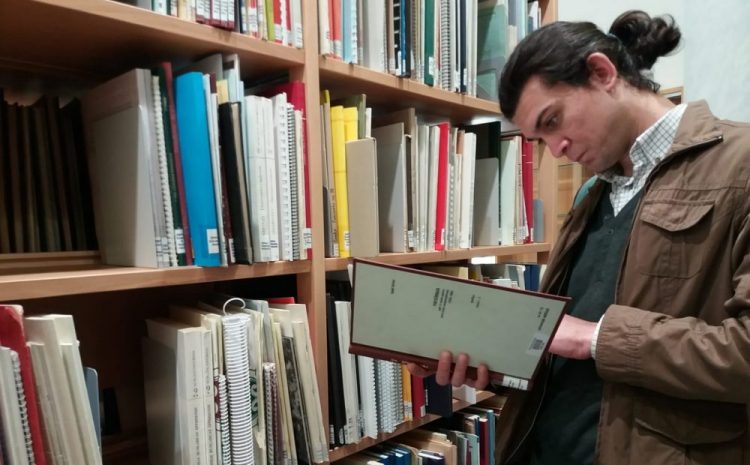
Tahir Ibishov composes music in different genres. He is the author of such pieces as “Poem-Existential”, “Chocolate Blues”, “Imitations”, “Link”, “Three Interpretations: Epos, Logos, Mythos”, “Absheron Dimensions”, “Ein kleiner Abschnitt von Linie 1 und 7”, “Ensembele Stück/A Piece for an Ensemble”, “Klavierstück”,“Shebeke”, “Elusive Silhouettes of a Dancing Dervish”, “Leakage”, “Lines of the Image”, “Split from the Light” and many others for various instrumental setups. In 2018, he wrote music for the performance The Inspector General based on the play of the same name by Gogol (Austria, Gymnasium und ORG Dachsberg). Participant and winner of various national and international competitions and festivals.
How did you see your future while studying in Austria? “I’ll come back to Azerbaijan and…”?
I’ll come back to Azerbaijan and eat plenty of delicious national dishes cooked by my mom… I never thought about either returning to Azerbaijan or staying in Austria. The workload at the university was too intense, and my priority was to digest all the new knowledge in the best, deepest way possible. I also realized that I had a great responsibility, because I was studying at the expense of the Azerbaijani state.
The name of Gara Garayev as the founder of our composition school has always been seen as a sort of brand—to the point of some of his last students presenting this fact as some moral advantage. Did you choose Beat Furrer as your mentor because it was prestigious?
“Brand”… I hate this word. It makes you think of jeans and shirts… Ashigs used to begin a dastan with a song dedicated to their master, teacher, and I, thinking of myself as a modern ashig and staying faithful to this tradition, must say that I value the name of the teacher of my teachers, Gara Garayev, above all. So, I understand those who emphasize that they were his students. The light of people like Gara Garayev shines so brightly. He himself was a student of Uzeyir Hajibeyov’s, then Dmitri Shostakovich’s in Moscow. As for me, my teachers at the Baku Academy of Music were professional composers and educators, such as Khayyam Mirzazade, Nazim Mirishli and others. I am happy to have been a student of many of them, and I always do my best to be worthy of them.
I ended up in Beat Furrer’s class because of one incident. It happened in 2009, when I came back from the army. I had been isolated from music a whole year, and when I got together with my friends, we often discussed new contemporary composers and musical pieces. So, a funny thing happened once with one of the scores I was going through. I didn’t think it was difficult at all when I first looked at it, but when the music started to play, I didn’t understand what was happening. Familiar orchestra instruments sounded completely different, speaking to me in some unfamiliar musical language. It was Beat Furrer’s “Konzert, for piano and orchestra”. That was when I started following this composer’s work, and I found out in 2011 that he was Swiss by origin and that he was teaching at the University of Arts in Austria. Although being Beat Furrer’s student felt like a real miracle to me back then.
So, bearing in mind my own teaching experience, I can say that even our enemies contribute to the shaping of our personality. But the people we should be most grateful to are our parents and teachers.
Beat Furrer is indeed a prominent figure today. Did you get teaching job offers as someone who graduated from his class?
Not many students of “prominent figures”, as you put it, become “prominent figures” themselves. When you deal with stars like Beat Furrer, you can easily get stuck in their shadow or burn out. There are many mediocre musicians among the professor’s students; there are also those who only imitate him all their life. I was lucky because by the time I got into Furrer’s class, I was already grown up enough and had four years of teaching experience. So, I was fully aware to whom I was going and what I wanted. After getting my Master’s degree in 2017, I entered the Faculty of Education in Composition and Music Theory. I was interested in the Austrian teaching methods, and I believe I have accumulated enough knowledge and experience in this field. I’ll let you in on a secret: not only is our system of musical education keeping up with the Austrian one, it even leaves it behind in some areas. I can say in all certainty that our only problem is understaffing.
As for teaching job offers… After coming home from Austria, I visited the Ministry of Education to formally notify them of my return and discuss some ideas I had. But I was told that neither music in particular nor arts in general were the Ministry’s priority at the time. We have to understand one very important thing… Any society is like human body: the healthcare system takes care of physical health, education—intellectual, and the arts—spiritual.
Did moving from Azerbaijan to Austria break any of your “creative taboos”?
Apart from teaching their subjects, some of the professors there also try to influence the deepest recesses of students’ minds. It’s like tapping every inch of a seemingly elegant and beautiful building with a small hammer—the cladding eventually crumbles, revealing the inner structure. This is an extremely painful process. It’s not easy to accept all your accumulated stereotypes becoming meaningless and your self consisting of voids. But I like that saying of Vladimir Kargopolov, “a perfect void creates a perfect form”…
Professor Hessler once invited me for coffee after class, and I happily accepted. We had a long conversation, about them, about us… Saying goodbye, he dropped, “Arnold Schoenberg dedicated his book on harmony to his students.” These words came out at such a moment and in such a context that a cold blank smile appeared on my face. It wasn’t until a while later (probably several months) that I realized why the professor had said that.
How did you get through the adaptation period after coming back to Azerbaijan? Did you have a sort of creative crisis?
I came back from Austria into the same room I had left. The place where I spent all my academy years, my books, my sheet music, all my work are there. I still spend most of my day in that room. It’s also the place where great people live: Johann Sebastian Bach, Webern, Chekhov, Aristotle, Nizami Ganjavi, Herman Hesse, Mikail Mushfig, Uzeyir Hajibeyov and others… Sometimes their presence in the room fills me with fear and awe, and it is an invigorating feeling. This atmosphere must have helped me through the adaptation.
But creative crisis passed me by, because immediately upon return I sat down to compose “Split from the Light” to be performed at “In Memoriam Nasimi – 650 Jahre Imadeddin Nasimi” Festival devoted to the 650th Anniversary of Imadeddin Nasimi in Berlin.
While you were away, a variety of brilliant opportunities opened up for local composers. It was proposed that certified composers should be members of artistic councils at TV channels and that singing teacher positions should be created for composers at secondary schools. Which option would you go for, if you, a young promising composer, faced this choice?
Of course, teaching is more like me. If knowledge a teacher gives schoolchildren or students contributes to the shaping and development of their personality, it doesn’t matter if it’s singing, physics or shop class. Be it as it may, all disciplines are learned from books, and teachers are not knowledge transfer machines—they raise individuals and useful members of society.
As for artistic councils, I believe that caution should be exercised as new ways to acquire information appear: there is radio, TV and internet in every household. There is no country in the world where new information media didn’t trigger changes even in the most important government agencies. Infractions of the law seep into mass media, spreading from there into the core of society, gradually affecting people’s morals and habits, their business relations, and even the law itself. And the entire process is so incredibly licentious that it ultimately turns both private and public life upside down.
This is why the right setup of TV artistic councils also requires special knowledge and pedagogical talent. Every profession should have its functional role. In other words, I believe that citizens of the country should be interconnecting elements of a single common system. And I think that creative people are teachers of society. This idea is older than Nizami, Vecellio and Tolstoy, and younger than Hajibeyov, Maugham and Jarmush. Anyway, any job must be trusted to a professional.
What creative opportunities does membership in the Composers’ Union give you? And doesn’t it get in the way of your creative courage, doesn’t it prevent you from openly criticizing something?
I became a member of the Composers’ Union in 2015, following my teachers’ advice, and the membership doesn’t give me any creative or moral advantages or opportunities. Unless you count the several times that my pieces were performed at the Union’s plenary meetings, and last year, at the expense of funds allocated for the Nasimi Festival by the order of the President, we went to Berlin and gave a concert there. During my years in Graz, I received a monthly scholarship from the Composers’ Union—a token amount, but I think it should be mentioned.
Creative courage is being able to overcome oneself, one’s boundaries in art, and when it comes to that, no force, be it Composers’ Union or anything or anyone else, can stand in my way. As for open criticism… The education I received in Azerbaijan and Europe allows me to voice a critical opinion on any music-related subject from cultural policy, musical education system, textbooks to concert organization, the art of composition, conducting, performance, music theory, etc. If I’m not engaged in music criticism professionally and consistently today, it’s entirely because of my creative plans.
Don’t you think that such organizations as the Composers’ Union, the Artists’ Union of or the Writers’ Union were established in the USSR in the 1930s with the purpose of total censorship and contradict the nature of art itself?
I don’t know if the charters of these unions contain such a paragraph. And I don’t think that it is against the nature of art for creative people to unite in one organization and join any creative process, to meet and discuss art at concerts, festivals, plenary meetings. If these organizations are unable to do their job properly due to their incompetence, it’s not the system’s fault. It’s almost like electricity being useful if you use it properly and harmful if you use it incorrectly.
Because these organizations were established during the Soviet era, there are different opinions about them, and one of them echoes your question. But the purpose of these unions was actually to define the role and place of art in society in a compact way in accordance with the principles of Communism, and to build a strategy of meeting people’s spiritual needs through their leisure.
In an environment of financial capitalism, a person is perceived only as a business entity. It is believed that the work to be done simply requires sufficient funds and labor force. However, they forget how very important it is that a person is not only a physical object, but also a spiritual subject. That’s why all plants and factories in the USSR had amateur talent groups, clubs and libraries, that’s why there were culture centers in rural areas. Before the revolution, Russian tsarism had devastated the peoples who had once had rich cultures. The new ideology, therefore, faced the task of somehow pulling the completely devastated science and culture up to a certain level. Otherwise, the intellectual balance of society would be disturbed and deep “cracks” would appear. From this point of view, it did not seem appropriate for creative people to abstractly seek self-expression. No wonder that the USSR wanted composers like Shostakovich to write not “space music”, but music that would appeal to all Soviet citizens and serve their cultural progress, and created the necessary favorable conditions for it. When composers violated the principles of this cultural policy, they faced censorship.
Your question branches out, carrying us away… I’ll just say that we should not deny our past, but learn from it.
There is a popular opinion that a repressive environment helps create great works of art. Some masters, like American playwright Paddy Chayefsky and the Danish director Lars von Trier, support this opinion. Repression is not a foreign word to us. Do you think it facilitates the development of the arts in our country?
 If it worked, all Nobel laureates would be from African countries. Repressions are unacceptable and unforgivable at any time and in any context. How can being subjected to moral, financial, psychological and physical terror contribute to a creative person’s work?! One of the key conditions, or perhaps the key condition for quality works of art is the high level of education in society. Great works are created in libraries, not on the front lines, not in concentration camps. Of course, there are some works created against the complex historical background, but those are exceptions. For example, D. Shostakovich’s Symphony No. 7, “Leningrad”. But for all its iconic and symbolic status, it’s not one of Shostakovich’s best pieces. In my opinion, the role of hardship in a creative person’s life should be measured by majority and minority, not by exceptions.
Do you think “contemporary composer” and “composer of contemporary music” are two different thing?
I would like to start my answer with an epigraph of sorts, the famous Gustav Mahler quote: “Tradition is not the worship of ashes, but the preservation of fire”. Regardless of the time in which a composer lives and works, they have to be in the epicenter of social, political and cultural life of that time. Otherwise, their music, whatever kind it is, cannot be regarded as contemporary. A creative person has no right to be a hermit, an amateur, no right to distance themselves from society saying, “I write space music”.
I can accept the “art for art’s sake” principle only to some extent. As I said, every creative person is a teacher of society. The reason contemporary music lacks the audience today is because composers lean to excessive abstraction under the pretense of writing contemporary music. That’s how people rapidly break away from contemporary arts.
In the middle of the last century, the capitalist Western civilization, well versed in Plato’s statehood traditions, was waging a war against Soviet communist ideals in art. The Darmstadt Summer Course that opened in 1946 was funded by the United States. Also, the opening of IRCAM, the studio of electronic music in Paris, was a crushing blow to the ideals of Soviet creative people—and so were ecstatic “contemporary art orgies” in the West in general. Obsessed with the thoughts of what was going on in the West, what kind of art was being created there (“Do you know what they write there?”), they started doubting themselves and their views, eventually falling into depression—just a regular psychosomatic process.
The recently declassified archives prove that contemporary art was funded by some ambiguous “organizations”, which were, in turn, directly connected to the Western intelligence services. There is a topical quote about contemporary art in Boris Lukyanov’s In the World of Aesthetics. It says, “Most people can today no longer expect to receive consolation from art. The refined, the rich, the professional do-nothings, the distillers of quintessence desire only the peculiar and sensational, the eccentric, the scandalous in today’s art. And I, myself, since the advent of cubism have fed these fellows what they wanted and satisfied these critics with all the ridiculous ideas that have passed through my head. The less they understood, the more they admired me! By amusing myself with all these games, all this nonsense, all these picture puzzles, I became celebrated and rich.” These words belong to the famous painter Pablo Picasso.
Composers in Azerbaijan today are divided into castes: coryphaei, prominent, undistinguished, irreplaceable, relatively replaceable and so on. Being a talented, well-educated composer, in which caste do you see yourself in the future?
This is a very ironic question… Divisive thinking in our society is not a positive thing. In the second half of the twentieth century, there was a similar, albeit more radical monopolistic structure in the West. Pierre Boulez, Karlheinz Stockhausen, Luciano Berio, Brian Ferneyhough and other composers pursued the “Either you write like me, or you are no one” policy with respect to their younger colleagues. This monopoly is now headed by Helmut Lachenmann, whom I respect very much (although his mentor was a staunch Communist Luigi Nono). I think that a composer’s mission is to fill, at least in part, people’s need for art, beauty and aesthetics, or even awaken that need in them and to cultivate all-round individuals for the future.
Whom do you see as the avant-garde of national art music of the last 30 years?
At the beginning of the twentieth century, the word “avant-garde” found its way into art, changing its meaning: while in the military, it meant an advance detachment going ahead of the entire army, in contemporary art, this world began to mean the rejection of old values, breaking the limits, in short, new art created out of nowhere. For example, Stravinsky went through the Rimsky-Korsakov school and was shaped creatively by his operas. He knew his traditions very well, but in 1913, he wrote the ballet The Rite of Spring and made a revolution in the musical world. Let’s assume that he was an avant-garde composer, that is he was marching ahead of the others. But I assure you, there is nothing in that ballet that opposes the tradition. Each page of his score is written in compliance with Rimsky-Korsakov’s canons, and there is no question of breaking the limits. You might ask: what is so avant-garde about it? What changed? No, Stravinsky didn’t break the rules and limits set by his predecessors, but perfected and raised them to a new level. The same can be said about K. Stockhausen’s Gruppen. It doesn’t have anything contradicting the laws of total serialism either. But, just like in The Rite of Spring, the composer expands the old traditions, opening a new stage in the history of music. Both these pieces are performed often enough today and are considered classical. Hence, the “avant-garde” that took shape in the second half of the twentieth century can be likened to a blow of a hammer. I read somewhere that as it perfects itself, any system becomes so thin and weak that it eventually breaks. From this point of view, there are no “avant-garde” composers in Azerbaijan—there are just good composers, such as Elmir Mirzoyev, Firudin Allahverdi, Turker Gasimzade, Ayaz Gambarli, Said Gani and others.
“Link”, “Lines of the Image”, “Elusive silhouette of a Dancing Dervish”, “Split from the Light”… Did these pieces of yours come out of your search in Eastern literature and philosophy, or have you already found yourself in them?”
I wouldn’t say I have found myself there or in some other place, but the search always continues. I will resort to the Western literature, to the work of my favorite poets, such as Georg Trakl or Osip Mandelstam any time I want to.
But I am an Oriental man, I belong to the Eastern, Islamic culture and I believe it necessary and right for my work to speak the language of the culture I belong to.
The pieces you mentioned are directly linked to Nasimi’s poetry and ideas. I discovered one peculiarity of Nasimi’s work: he speaks of lofty matters, and either you accept his philosophy, or he pushes you aside. Through Nasimi’s work, I created a “passage” for myself and it led me to the foundations of Eastern philosophy. We were born in such attractive and fertile (in a broad sense of the word) land, that other cultures flocked here as well, contibuting their best. That’s why Azerbaijan, being small territorially, is a unique “source”. For example, moving from north to south, one can come across at least three different architectural style.
Whatever an Eastern composer may write, Europe will always find it exotic. I had the chance to experience that firsthand in the years I studied there. Even the professors who taught us thought that. Oddly enough, according to them, if an Italian composer writes something based on Indian ragas, it’s “European music”, while if an Eastern composer uses modern composing techniques, the piece is still perceived as exotic. And those believing that they have achieved success in Europe as contemporary composers should never lose the sense of reality, because the “contemporary elements” they use in their work do not save them from being exotic.
During your time in Austria, you also had a more applied, practical musical experience. You composed music on commission for The Inspector General. How is the relationship between the director and the composer, and the composer and the client in general, regulated in Europe? In Azerbaijan, for example, a composer gets the honorarium only three years after the performance has been staged.
It happens because incompetent people still hold certain offices, and I am not surprised. I heard once that the head of electrical grid operator office in one of the districts had been appointed the head of culture department in another district. If I’m not mistaken, that most trustworthy job transfer was between Imishli and Agstafa.
As for the relationship between the client and the composer, it may sound very strange in contrast to Azerbaijani realities, but for the score to The Inspector General, I was paid twice more than the contract said. After the performance, the client said that they liked the music very much and that they believed the contract amount was too small. Perhaps, they were so kind because they knew I was a student. I don’t know… Anyway, they even sent me a thank you note.
And finally, what are your plans for the future?
I have many plans and aspirations for the future that I would like to turn into reality. Lately, I have been thinking about Mikayil Mushfig’s poetry, and I am composing music for some of his poems, as well as for his essay “Oil Workers”. I also plan on composing a piano concerto, which I promised to my friend, pianist Zakir Asadov, a long time ago. And I want to get back to teaching, because to eliminate some negative phenomena we keep complaining about and to solve those problems, we need to work with the younger generations interactively. In general, if we don’t take on the field of musical education in earnest, if education is not organized at a high level, if there are no translations of important textbooks and research papers and if young, promising and well-educated composers and musicologists don’t get involved in this process, art music in Azerbaijan may lose its face completely in a few years. I hope that these issues will be resolved at least to some extent in the nearest future.
Interview by Shafagat Mammadova (musicologist)
Aze.Media