One thing is to flaunt biceps in front of the camera, pathetically enhanced by Photoshop and widely circulated around the world (which provided a lot of amusement), but it’s quite another to quell colonies rebelling against the diktat of France, which destroys their right to ethnic identity and self-determination. This is the kind of situation that Emmanuel Macron has once again encountered. If dealing with Niger, Gabon, and other countries was beyond the capability of this pseudo-Napoleon, “bringing to heel” New Caledonia might be simpler for him. The question, however, is how France will ultimately pay for Macron’s “steel biceps.”
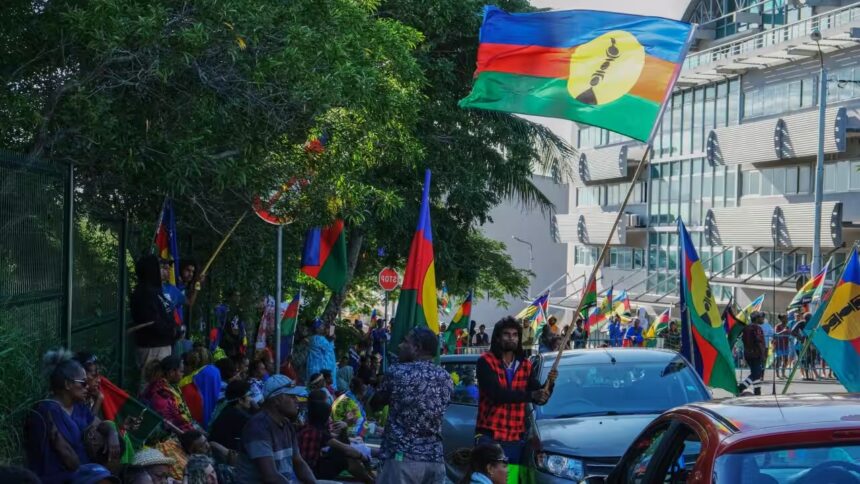
The revolt in French New Caledonia is gaining momentum: Macron had to convene a meeting of the Defense Council of the Republic, postpone the weekly government meeting, and cancel a trip to Fécamp, where he was supposed to participate in the opening of a wind farm marine park. But – inconveniently – the former French colony, now officially its overseas territory in the Pacific Ocean, has risen up. And not just risen up – its protests against French policies have escalated into violent clashes with the police (hundreds injured, three killed), arson of cars, stores, pharmacies, and industrial enterprises. The situation is particularly uncontrollable in the capital of the archipelago, Nouméa, where a curfew has been imposed. Macron declared a state of emergency in New Caledonia, banning the carrying of weapons (which, as it turned out during the unrest, are plentiful) and the sale of alcohol.
What sparked the protests that turned into a revolt against the metropole? The sticking point was a bill proposed by France to grant voting rights in local elections to those who have lived in New Caledonia for more than ten years. Currently, only those who were on the electoral list in 1998 and their children have the right to vote. Thus, those who moved to New Caledonia later do not have the right to participate in elections.
The indigenous people – the Kanaks, and supporters of New Caledonian independence (primarily the Kanak and Socialist National Liberation Front) strongly opposed this arrangement, as newcomers – who are mostly French and descendants of other Europeans – greatly reduce the chances of New Caledonia gaining independence. There is a clear disparity – indigenous Kanaks now make up only 40% of their native land’s population. It is easy to imagine that a future referendum on New Caledonian independence, with the inclusion of these new voters (about 25,000), would fail again (there have already been three unsuccessful referendums).
In the genetic memory of the Kanaks, whose economic situation is much better than the socio-economic situation of other French colonies and overseas territories, the colonial greed and cruelty of France remain alive, despite the fact that since 1957, the Kanaks have had all the rights of French citizens, with France officially apologizing for the atrocities committed against them.
New Caledonia became a French colony in 1853 – the island was initially seized by the French to build a penal colony. But a century later, the French discovered that the archipelago was rich in nickel, gold, cobalt, and chrome, and it could be turned into an exporter of tropical fruits and vegetables and develop tourism. The Kanaks began to receive some profits from the development of mineral resources. However, this “new era” did not overshadow the fact that the Kanaks were once driven into reservations, deprived of any civil rights, and their uprisings were brutally suppressed by the French. Now they face a new “surprise.”
The global decolonization movement gained strength after World War II, although much blood was shed: the example of Algeria, which ultimately broke away from France, is sufficient. The Kanaks raised their voice again, united in the Socialist National Liberation Front led by Jean-Marie Tjibaou (later assassinated by a Kanak), and demanded independence for New Caledonia – the creation of a Kanak state. But is this possible if the electoral lists and the prevalence on the island of non-Kanaks, mainly ethnic French and other “whites,” expand in favor of the latter?
The answer is obvious. French Interior Minister Gérald Darmanin ordered the deployment of an elite gendarmerie unit to New Caledonia to support the local police forces, but this has not changed the situation: according to French High Commissioner Louis Le Franc, “Calm has not returned, the situation remains extremely tense, not only in Nouméa but also in its suburbs, including three outlying communes.” According to him, the rebels are shooting at the gendarmes with large-caliber weapons and hunting rifles.
Jean-Luc Mélenchon, leader of the France Insoumise party, condemned the government’s “incendiary project,” which is currently being considered in parliament, but his political opponent – Republican secretary Éric Ciotti – defends the bill in favor of “applying forms of democracy” on the archipelago. This, essentially, is the position of the official French authorities.
Now in Paris, opponents of New Caledonian independence talk about the “ingratitude of these savages” whom the French catapulted from the Stone Age into the era of high technology, conveniently omitting the fact that they took New Caledonia with bloodshed. They also fail to understand that the Kanaks have not abandoned their customs and ancestral culture. In short, a “primitive people.”
Meanwhile, the chances of the “savages” overcoming the French legislative initiative are minimal: first, they lack external support and have not yet joined the global anti-colonial movement; they are far from united in their aspirations, and ideological incompatibility is present within their ranks: some do not want to give up the “benefits of French citizenship,” others are guilty of racism, and still others promote ideas similar to Russian populism. Thus, a coordinated strategy and tactics for liberation from France are absent. Consequently, for now, this plays into Paris’s hands. However, amid the escalating violence, which, by definition, cannot be endless, it might eventually backfire.
High Commissioner Louis Le Franc called on the leaders of the independence movement to use their influence and warned that “if this does not stop, there will be casualties” (and there already are). But it is unlikely to cease – the situation may calm down for a while, only to flare up again, as Macron, who could not have failed to foresee the situation in New Caledonia due to the legislative changes, tries to play the “first violin” in the Pacific region, where the US and China are vying for dominance. If Paris loses New Caledonia and French Polynesia, it will lose its strongholds in the Pacific and significant income from the rich resources of the archipelago. This, after failures in Africa, would mean complete political fiasco.
Paris should focus on its internal problems, ceasing interference in the internal politics of “its” overseas territories and sovereign states, such as the South Caucasus, where it destabilizes the situation in concert with other countries – the “champions of democracy.” It should also ensure the safety of France itself, where there have already been 32 attempts to disrupt the Olympic torch relay.
Recently, French Interior Minister Gérald Darmanin confirmed this number but stated that the attempts were foiled because “The security surrounding the festivities associated with the Olympic torch relay is in good hands.” More than 330,000 administrative investigations were conducted, identifying nearly 1,200 individuals posing a threat, he said.
Recall that the Olympic flame was delivered to Marseille on May 8. It is expected to arrive in Paris by July 26, when the opening ceremony of the Olympics will take place. During this time, it will travel through 400 cities and towns. The delivery will be ensured by about 10,000 torchbearers. However, there are no guarantees that incidents will not occur during the Olympics. Not only due to the tense domestic political situation but also because Paris has managed to antagonize many political forces in various countries and entire regions, including the Middle East.
Thus, drones – extremely dangerous “birds” – might attack not only the skies over Paris but other French cities as well. And the Parade system (anti-drone defense), as French media (including France24) report, has been failing repeatedly because it turned out to be “leaky.” This, however, is not the only flaw in France’s security, which, nonetheless, breaks holes in the security of other countries.
Therefore, the safety of the Games is hardly assured, and now there’s New Caledonia to contend with. Who’s next?
Irina Dzhorbenadze
Translated from minval.az