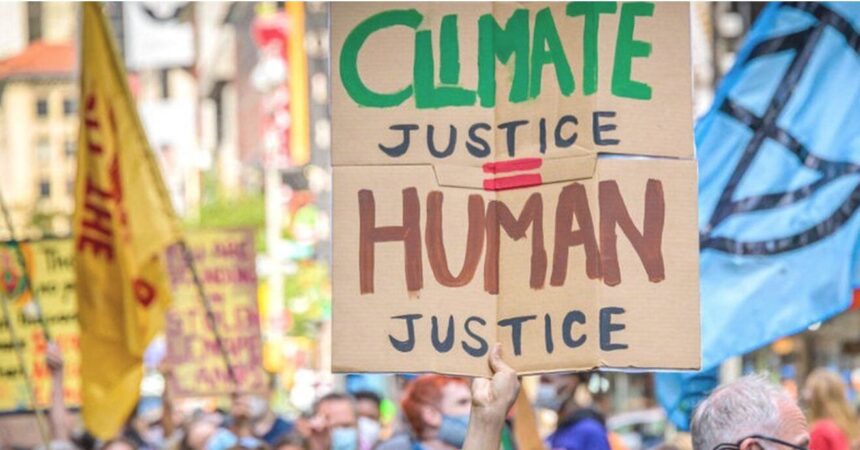
Since the Industrial Revolution in the late 1700s, human beings have been the primary drivers of changes in the Earth’s climate. Countries that greatly benefitted from industrialization, e.g., America, the UK, Japan, Germany, etc., did so at the cost of pumping more and more carbon into the atmosphere. China and India are the only countries in the Global South, who have greatly contributed to climate change. Most of the main polluters are in the Global North.
Between 1850 and 2011, the United States and EU were responsible for 79% of climate-changing emissions. However, the countries expected to suffer the most from climate change are all in the Global South and are not top contributors to the problem. One of the most visible victims of climate change are the people who live on coral atoll islands.
According to various studies, about a million people live in coral atoll islands like those in the Maldives, Tuvalu, Kiribati, and the Marshall Islands. These islands are just a few feet in elevation, making them some of the places most at-risk from the rising sea levels that will result from climate change. Five uninhabited islands in the Solomon Islands have already vanished underwater in the past century. The Maldives, Kiribati, Tuvalu, and the Marshall Islands have the highest percentage of their land area at risk because they are all atolls; other countries also have low lying islands, but have more higher ground available to flee to and thus are less vulnerable than these islands.
Nevertheless, all of the island countries are expected to suffer due to climate change. Some of these islands, such as Guadeloupe, Martinique, Saint-Martin, Saint-Barthélemy, Saint Pierre and Miquelon, which are located in the Atlantic Ocean; Reunion, Mayotte and the French Southern and Antarctic Territories in the Indian Ocean; French Polynesia, New Caledonia, Wallis and Futuna are located in the Pacific Ocean; French Guiana is in South America, are colonized by France to date. Aruba, Curaçao, Sint Maarten, Bonaire, Sint Eustatius and Saba are still controlled by the Netherlands. In the West, people think that colonialism remains a thing of the past, yet unfortunately that is not the case. French and Dutch colonialism is still alive and well.
Yet according to a ranking that was performed recently, the countries that are not island nations yet are likely to suffer the most from climate change are the Democratic Republic of Congo, the Central African Republic, Nigeria, Chad, Ethiopia, Bangladesh, Syria, Afghanistan, Somalia and South Sudan. It is critical to note that most of these countries are in Africa and have suffered under the yoke of European colonialism.
A Greenpeace UK report claims that there is a link between colonialism and global warming: “The environmental emergency is the legacy of colonialism. This was because colonialism had established a model through which the air and lands of the global south have been … used as places to dump waste the global north does not want.”
Abbas Abbasov, the Executive Director of the Baku Initiative Group (BIG), recently gave an interview to the Azerbaijani press, where he highlighted the importance of the international community addressing the long-lasting impacts of colonial exploitation on the environment: “At COP29, we held a conference dedicated to the environmental impacts of colonial exploitation, particularly France and other European colonial powers. We believe these issues have been largely overlooked in global climate discussions. Our organization is committed to shedding light on how colonial legacies continue to affect the political, economic, and environmental landscapes of these regions.”
Abbasov continued: “We as an international NGO have repeatedly called for intergovernmental organizations to take stronger actions to address the specific needs of small island nations and colonized regions. We hope that through increased global solidarity, there will be meaningful progress in securing the financial resources these regions urgently need. With the participation of global leaders and organizations, we are hopeful that the call for a greener and more equitable world will not go unheard.”
For the first time in more than three decades since its inception, the Intergovernmental Panel on Climate Change (IPCC) mentioned the term “colonialism” in a 2022 report. Leading climate scientists acknowledged that colonialism is a historic and ongoing driver of the climate crisis. “Present development challenges causing high vulnerability are influenced by historical and ongoing patterns of inequity such as colonialism, especially for many Indigenous peoples and local communities,” the report said. “Officials and scientists from around the globe now recognize the significant role colonialism has played in heating our planet and destroying its many gifts.”
“Instead of treating the Earth like a precious entity that gives us life, Western colonial legacies operate within a paradigm that assumes they can extract its natural resources as much as they want, and the Earth will regenerate itself,” Hadeel Assali, a lecturer and postdoctoral scholar at the Center for Science and Society, a Columbia Climate School affiliate, proclaimed. “We cannot have environmental justice without reversing the harms of colonialism.”
If one visits the war-torn Karabakh region, one can witness how Armenian settler colonialism created a grave ecological crisis in the region. Six months after the conclusion of the Second Karabakh War, I visited the region together with a Russian delegation and witnessed polluted rivers with no fish in them, uprooted trees, burnt agricultural fields and mile after mile of ruined homes, surrounded by landmines and dirt roads full of potholes. The situation was so grave from an environmental perspective that the region, once known as the “Black Garden” for its ecologically beautiful ecosystem has been dubbed “the Hiroshima of the Caucuses,” after enduring thirty years of Armenian settler colonialism in violation of four UN Security Council resolutions.
However, after hosting COP29, Azerbaijan seeks to rebuild Karabakh as a green zone, thus inspiring other countries in the Global South who have witnessed the devastating effects of colonialism and how it has adversely affected the environment. Last spring, I toured around Zangilan and saw that Azerbaijan recently built a green village with a beautiful fountain in the hopes of making Karabakh green again. Around the clock, Azerbaijan is busy rebuilding homes, mosques, cultural heritage sites, and setting up agricultural and other green environmentally sound communities, so that Karabakh can be made great again.
Indeed, the Karabakh of 2024 is not the Karabakh I first witnessed in 2021, thus showing to the world community that Karabakh can recover from the ecological disaster that it experienced and be rebuilt, smart village after smart village, with lush greenery being planted to replace the trees and other natural areas that the Armenians destroyed. Indeed, under the leadership of Azerbaijani President Ilham Aliyev, Armenian settler colonialism has been relegated to the dustbins of history. May the other colonial powers soon follow.
Rachel Avraham