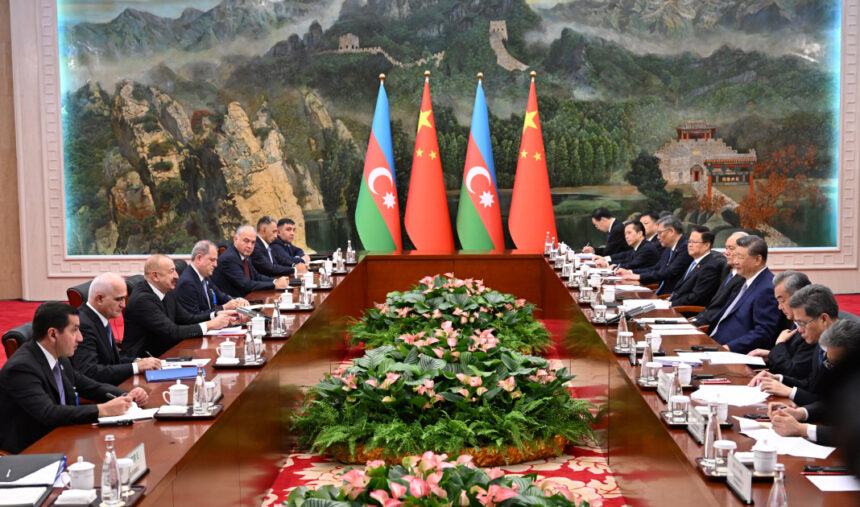
Theater, as is well known, begins with the cloakroom. A visit begins with the airport welcome. Even the smallest details of protocol carry deep meaning and food for thought. This was fully evident during Azerbaijani President Ilham Aliyev’s recent visit to China—especially when compared with the much more modest receptions given to other politicians fond of puffing out their cheeks and stressing their “superpower” status.
Aliyev had visited China not long ago, when a series of important agreements were signed. But much has changed since then—most notably, the Washington negotiations. Azerbaijan managed, let’s call things by their name, to push through decisive progress in the peace process with Armenia on its own terms, while also making serious advances in relations with the United States.
This is precisely where “red lines” matter. The difficulties in U.S.–China relations—tariff wars, Taiwan, and more—have been discussed by everyone. Yet one of the strongest features of Azerbaijan’s foreign policy under President Aliyev has always been its ability to find balance: pursuing a genuinely multi-vector diplomacy without “friendship against,” without forming coalitions against others, but instead reconciling interests. This is exactly what is taking shape now, as relations with China rise to a strategic level. That is why the Washington talks and the Armenia peace process were part of the discussions between Aliyev and Xi Jinping. Political stability and security are priceless in today’s world—and Azerbaijan has managed to secure both, elevating its foreign policy to a new level in which the Chinese direction plays a special role.
It is not only Azerbaijan choosing the “China vector” as an important course in foreign policy. What is especially noteworthy is how high China’s interest in Azerbaijan is. For Beijing, Azerbaijan is a vital link in logistics corridors and an attractive investment field. Aliyev’s series of meetings with Chinese company heads leave no doubt about this. Azerbaijan’s logistical potential will expand even further once the long-awaited Zangezur Corridor opens—and the fact that it happens under U.S. auspices will hardly stop China from using it. Beijing dislikes escalation and prefers “soft power”—and it has plenty of that.
One such global instrument of Chinese policy today is the Shanghai Cooperation Organization (SCO)—the very body where Azerbaijan has applied for full membership, with China’s support. For Azerbaijan, the SCO is a highly promising platform: first, as part of China’s growing political weight; second, because many of Azerbaijan’s partners in the Organization of Turkic States are already members; and third, because China’s role in global politics is bound to keep increasing. No wonder Azerbaijan not only adapts to these trends but also plays ahead of them.
It is worth recalling events from before the 44-day Patriotic War—what entered history under the name of the “infrastructure revolution.” The war in Ukraine had not yet begun and was not even foreseen. Traditional transport routes through Russia and Ukraine were working at full capacity. But Azerbaijan was already reviving the historic Silk Road: modernizing railways and highways, building the Baku–Tbilisi–Kars line, opening a new Caspian port and ferry line, launching a shipyard capable of producing tankers, freighters, and ferries. All of this was accomplished in record time—with astonishing foresight. Today Aliyev and Xi discuss logistics cooperation. Amid the war in Ukraine, sanctions, and other geopolitical upheavals, corridors running through Azerbaijan are of strategic importance.
And another point: this year’s expanded SCO summit in China coincides with celebrations marking the 80th anniversary of the end of World War II, including a Victory Parade.
History, too, is full of ironies. In the former USSR (except perhaps the Baltics), it is customary to date the “Great Patriotic War” from June 22, 1941—Nazi Germany’s attack on the USSR—to May 9, 1945, Germany’s capitulation. Europe remembers that the war began two years earlier, on September 1, 1939, with Germany’s attack on Poland. Many nations also mark their own dates of Nazi invasion. Yet this stage of Germany’s blitzkrieg was erased from Soviet popular history—pushed into the background.
Even less remembered are the Far Eastern battles, where Japan, not Germany, was the main actor. Japan attacked China in 1937, two years before Germany invaded Poland. World War II in the Pacific ended only in September 1945 with Japan’s surrender aboard the USS Missouri. Eurocentrism, clearly, was no accident. What happened in Asia interested the wider public far less than events in Europe—except for the United States, which fought actively in the Pacific.
This was one of many expressions of “Euro-arrogance” toward the East, including China. The same China whose “economic miracle” shocked the world: how could a country that so recently struggled to feed its own people suddenly achieve record growth rates, a technological breakthrough, and a leading role in global production chains?
Now another process is underway. China is converting its economic weight into global politics. It is not promoting a “Chinese world.” Beijing acts smarter and subtler—that is the secret of its appeal. This again came as a surprise to many—but not to Azerbaijan, which knows how to play ahead of the curve.
Nurani
Translated from minval.az