The debts of global diplomacy in the face of the community’s just expectations continue to accumulate to a critical mass. Today, the global system counts more than 120 large, medium, and local conflicts. Hopes for their swift resolution look illusory in most cases.
The annual sessions of the UN General Assembly in New York each September demonstrate the inability of existing institutions to overcome current contradictions. The main reason lies in the position of certain countries that block consensus on painful issues. At the same time, the UN, the most authoritative international body, has no levers or mechanisms to ensure the implementation of its decisions. A striking example is the fate of the four UN Security Council resolutions on the Karabakh conflict adopted in 1992–1993.
The most difficult and seemingly unsolvable crisis remains the Middle East issue, which continues to expand geographically. A growing number of actors are becoming involved, yet the activity of some states does not translate into decisions that could end a crisis that has persisted since the end of World War II.
Nevertheless, this imbalance does not prevent some countries from taking the only correct and principled position in supporting decisions adopted at the UN Security Council level. Azerbaijan has consistently supported the Palestinian people’s right to establish their own state.
Once again, during the adoption of the “New York Declaration for Palestine” at the ongoing 80th anniversary UN General Assembly, Baku expressed its support for the creation of a Palestinian state within the 1967 borders. Azerbaijan’s respectful approach to international law demonstrates the importance of adhering to legality and maintaining norms that remain valid and binding.
Azerbaijan’s position also reflects the importance of diplomatic etiquette. Although the principle of reciprocity underlies the granting of immunities and privileges in many countries’ legislation, and Azerbaijan is no exception, Baku has shown leniency toward the Palestinian people, whose will is represented internationally by the Palestinian Authority.
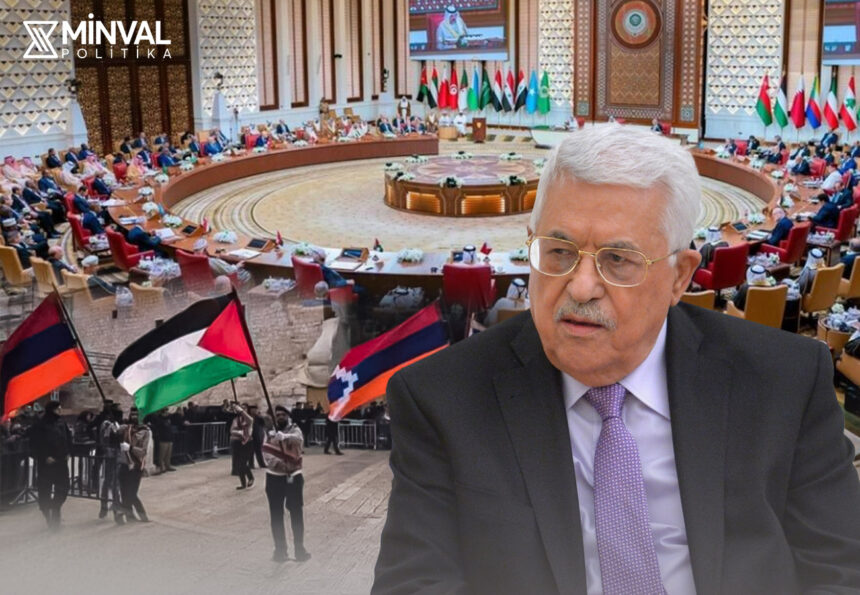
During the years when 20% of Azerbaijani territories were under Armenian occupation, the Palestinian leadership openly cultivated close relations with Armenia. Ramallah provided Yerevan not only with boundless political support on the international stage but also encouraged horizontal ties with the occupying state.
Palestinian leader Mahmoud Abbas repeatedly showed public signs of support to the Armenian state and its institutions, even as they pursued an aggressive policy against Baku and violated the rights of hundreds of thousands of Azerbaijani refugees and IDPs.
Ramallah made no secret of its close ties with the Armenian diaspora worldwide. Abbas personally expressed solidarity with Armenians and informally supported Yerevan in its unjust struggle against Azerbaijan. Photographs of Abbas with Armenian activists and organizations that denied support to Azerbaijan in its just fight for territorial integrity were widely circulated in global media.
In principle, official Baku had every right—based on reciprocity, a cornerstone of diplomatic practice—to refuse political and international support to Palestine. The biased position of Ramallah regarding Azerbaijan’s needs and demands was repeatedly discussed at a serious level. Ramallah took the side of the aggressor in the Armenian–Azerbaijani conflict, openly showing sympathy for Armenia.
Issuing postage stamps in support of Armenians and creating other propaganda materials underscored how Palestinian organizations integrated into Armenian narratives—destructive to peace and stability.
Despite this hostility and the Palestinian–Armenian solidarity against Azerbaijan’s interests, Baku continued to support Ramallah in the name of Islamic solidarity. At all OIC summits, Azerbaijan consistently backed resolutions on Gaza and the Palestinian Authority.
At the most recent extraordinary summit of Arab and Islamic states in Qatar, Azerbaijan once again reaffirmed its unchanging position on the Palestinian issue and supported decisions condemning Israel’s missile strike on the Hamas headquarters in Doha.
The Gaza tragedy, in its geopolitical essence, is primarily a direct concern of the Arab world. It is no coincidence that in recent days, demonstrations in support of Gaza residents have swept across the globe, with activists criticizing not only Israel but also leading Arab states such as Egypt, Saudi Arabia, and Jordan.
These and other Arab states must play a decisive role in peacefully resolving the Gaza issue and ending the blockade of its two million inhabitants.
However, the Arab world shows little real zeal in this matter, limiting itself to formal statements and routine propaganda actions, which have no impact on the situation in one of the world’s hottest conflict zones. In such a sensitive matter, demanding special support from non-Arab states for the Palestinian issue seems, at the very least, unreasonable.
If Arab actors sincerely wish to support Palestinians, they must start with themselves and demonstrate determination to achieve a breakthrough in one of the most complex issues of our time.
Tofig Abbasov
Translated from minval.az