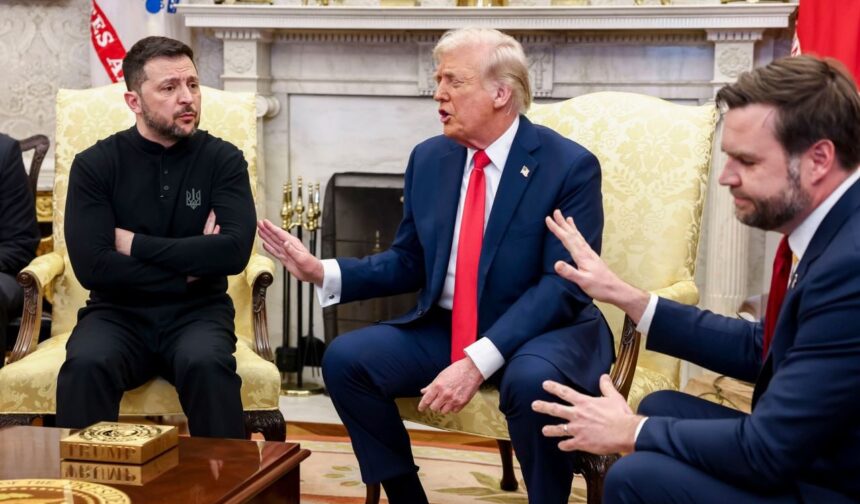
The content and style of the verbal battle between Presidents Donald Trump and Volodymyr Zelensky at the White House provided ample food for thought for a long time. It makes sense to carefully analyze individual arguments, statements, and key points.
Politicians, experts, and rhetoric specialists have been given valuable material that can serve as a live and illustrative resource for methodological purposes. It contains many meanings relevant to politicians endowed with authority.
“You are in a disadvantaged position right now, you have no trump cards, and you are in no position to dictate terms to us or predict how we should feel,”—this excerpt from the American leader’s address to his Ukrainian counterpart speaks volumes. Indeed, Kyiv’s vulnerability is alarmingly worsening, and the intrigue is not just that it faces great difficulties due to a lack of strategic resources. In unfavorable military-political conditions, subtle diplomatic maneuvers become crucial for survival.
In this regard, Kyiv has faced serious challenges in the past and continues to do so in the present. V. Zelensky has, in a way, gone too far, succumbing to the blackmail of Europe, which is set on waging war with Russia. This is precisely why D. Trump bluntly told his counterpart an unpleasant but truthful statement: “You are gambling with the lives of millions of people; you are playing World War III… What you are doing is highly disrespectful to a country that has done so much for Ukraine.” The White House host was referring to America, which now seeks clarity on ending the military campaign.
In short, the U.S. president proposes a terrible end instead of unending horror, which, under the current conditions, is not the worst possible scenario for Kyiv. But will the head of Ukraine, who has fallen deeply under the influence of European allies, agree with Trump’s plan? He is still considering conditions to regain the initiative, but the success of his endeavor seems not only unlikely but also utopian.
The past holds missed opportunities for ceasefire agreements and the search for compromise solutions. Through its stubbornness, Zelensky’s team has suffered a tactical fiasco.
By losing opportunities to achieve a ceasefire earlier, it has only driven itself deeper into a debt trap. Simultaneously, it has lost even more territory. It is now clear that the counteroffensive toward Russia’s Kursk was a trap. If the military leadership had focused on organizing active defense without entering Russian territory, Kyiv would have a much stronger geopolitical position today.
The conflict has acquired all the characteristics of a full-scale war, which is why the White House host intends to intervene decisively in the process while also benefiting his own country. Joe Biden’s America has spent enormous amounts of money under the guise of aid to a suffering Ukraine. Washington now wants to find a formula to solve a problem with multiple unknowns.
The meeting and the tense conversation between the two leaders, by genre standards, resembled a well-prepared performance with elements of a show. Even if that is the case, both sides achieved their goals. Trump gained the image of a peacemaker and a pragmatic leader, while Zelensky emerged from the battle as a weak but unyielding figure—although his stubborn resistance is unlikely to change the current situation.
“Your country is in big trouble,” Trump said, implying that in such difficult circumstances, it is necessary to moderate one’s zeal and defiance. It is essential to listen to others, especially those who hold the levers of real influence over the current situation. That is why the American president stated that “Ukraine can get out of this difficult situation.”
Undoubtedly, a way out will be found, regardless of the associated costs. However, Ukraine’s tragic experience—as a country that has been living on the edge of disaster since the early 2000s—should serve as a stark warning.
First, there was a series of revolutions that painfully affected millions of lives, bringing them new anxieties and hardships. The intervention of Western political institutions in the country’s internal affairs, the brutal incorporation of foreign actors into government structures, led to a divided society. The country effectively split into two irreconcilable camps, accumulating an explosive charge of civil confrontation. This initially threatened internal stability and later escalated into an interstate conflict.
The West’s ironclad strategy of pulling Ukraine out of Russia’s sphere of influence, provoking a military confrontation with its eastern neighbor, has done its damage.
The war, which Western political strategists had been preparing for years, has become a reality. For three years, it has taken lives, caused massive destruction of cities and infrastructure, and offers no promise of swift stabilization. Many aspects and facts indicate how Western centers, treating Ukraine as an experimental base, continue to inject destructive forces into ongoing military and socio-political processes, pushing back the possibility of peace. As a result, Ukraine has become highly destabilized, leading to a massive outflow of its citizens.
Millions of people are forced to accept the fate of refugees and displaced persons, losing not only their homes and possessions but also their peace of mind and confidence in the future. It is no secret that a similar fate was planned for other post-Soviet states. This brings to mind the so-called “color revolution train,” which made stops at various national stations, unloading its foreign-made destructive payload.
If life in some places has taken on new colors, they are by no means bright but rather dark. The people of Georgia, for example, have suffered greatly, experiencing firsthand the hardships of a color revolution and a full-scale war. Fortunately, the country’s current leadership has timely chosen the path of national salvation, which the Western centers strongly oppose.
Since the last parliamentary elections, they have refused to accept the choice of the Georgian people, attempting to impose foreign templates. However, Tbilisi remains firm in defending the will of its national electorate.
Azerbaijan was the first to experience the heavy burden of external interference. President Aliyev did not entrust his country’s fate to outsiders. There were numerous attempts to use Azerbaijani territory as a platform for dangerous actions against third-party states. But the country’s leadership did not allow itself to be manipulated, nor did it succumb to the sweet promises of Western institutions and centers, which offered assistance in building what they called a democratic society.
Foreign models and frameworks fail for one reason—they do not take root in unfamiliar environments. No hastily imposed projects for European integration or NATO accession—these are merely pieces of cheese in a mousetrap, ordinary traps designed to lure compromised national elites.
Balancing national traditions with modernity is the responsibility of national forces who understand the specifics of their people’s lives, desires, and preferences. Adaptation to changing conditions should not happen under external dictates but should remain the prerogative of the ruling elites.
Ukraine lost because it trusted external forces, deceived by the promises of liberal groups about building a new democratic Ukraine. Today, its fate is being decided by foreign players because its national forces failed to resist temptation at the right moment. The West’s pull proved fatal and heavy. And that is a pity.
Tofig Abbasov