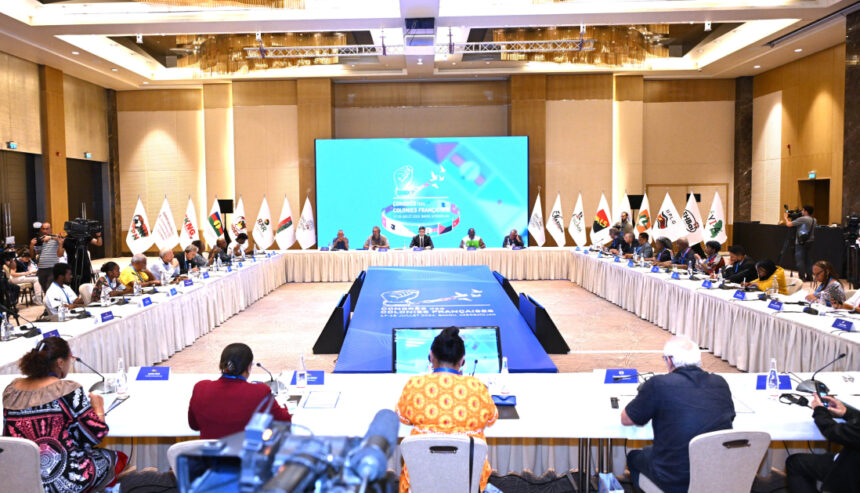
Delegates from Africa, Melanesia, Polynesia, as well as groups from the Caribbean and Antillean islands affected by French colonialism, participated in the event. Three organizations from the islands of Bonaire and Saint Martin — colonies of the Netherlands — attended as honorary guests. The congress was organized by the People’s Liberation Union of Guadeloupe with the support of the Baku Initiative Group.
The media covered the congress in detail. However, the overall political context deserves just as much attention.
The choice of Baku as the venue for the congress was no coincidence. Azerbaijan, a member of the Non-Aligned Movement (NAM), has played a leading role in the struggle against colonialism and neocolonialism, especially during its chairmanship in the NAM. The historical memory of Azerbaijan’s own struggle for independence may have influenced this role. Many NAM member countries understand colonialism and neocolonialism not just from textbooks or foreign journalists’ reports but from direct experience. The peak of the colonial empires’ dissolution is commonly believed to have occurred in the mid-20th century, starting in the 1940s when former colonies in Africa, Asia, and Oceania gained independence. It seemed, and still seems to many, that colonialism is a thing of the past, of interest only to historians. Unfortunately, this is not the case. French “overseas territories” remain a deplorable “relic” of classic colonialism, complete with “colonial” currencies. Colonialism manifests in various ways: restricting the rights of indigenous populations, shamelessly exploiting natural resources, and attempting to turn the “natives” into minorities in their own land. The “information blockade” under which the peoples of the French colonies live plays a significant role. Recent uprisings in New Caledonia, where the French media remained silent about the abuses and brutality of French security forces, highlight this issue. Against this backdrop, it’s unsurprising that activists from national movements in French “overseas territories” seek help from Azerbaijan to share the truth about their homeland with the world.
Furthermore, it should be noted that in May of this year, Azerbaijan participated for the first time in the annual event of the UN Special Committee on Decolonization (C-24). Azerbaijan not only demonstrated its commitment to the stance that colonialism and neocolonialism are unacceptable in the 21st century but also showed that it would continue hosting regional C-24 events and supporting the fight against colonialism and neocolonialism.
This fight, it should be clarified, has nothing to do with separatism. Recognized borders must be respected; this is not up for discussion. However, the need for the decolonization of various “overseas departments” remains. The decolonization process is fully consistent with international law, as evidenced by extensive legal documents. If France pretends that this issue does not concern it, this characterizes France, but it does not undermine the legitimacy of the demands of the peoples of its colonies and Azerbaijan’s support for their anti-colonial movement. Azerbaijani President Ilham Aliyev has repeatedly spoken against manifestations of colonialism and neocolonialism, and his speeches have been disseminated as official UN documents.
It is not surprising that within the framework of Azerbaijan’s membership in the Non-Aligned Movement, the Baku Initiative Group was created. This was an important step in Azerbaijan’s new anti-colonial strategy. Today, the Baku Initiative Group essentially acts as a coordination center for parties and movements fighting for their countries’ independence. It is no coincidence that in its first year, the Baku Initiative Group held around fifteen international conferences in various countries, involving representatives from regions under French colonial rule. Moreover, the activities of the Baku Initiative Group and events in French colonies have inspired representatives from regions under Dutch colonial rule to reach out. As a result, representatives from Dutch colonies participated in the international conference held at the UN headquarters in June and in the current congress.
All this leads to one conclusion: the political technologies of colonialism and neocolonialism in the 21st century are unacceptable. This is not just a political issue; it is a matter of decency.