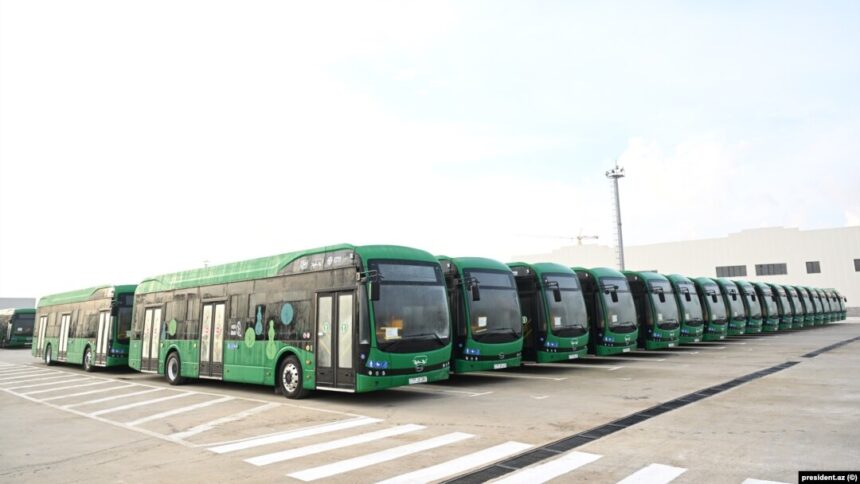
Moreover, the country is aligning its logistics initiatives with a key global trend—the decarbonization of the transport sector.
As part of its commitment to the UN climate agenda, since mid-2019, the Alat Port has participated in the OSCE project “Promoting Green Ports and Connectivity in the Caspian Region.” Furthermore, since 2023, Azerbaijan Railways (ADY) has been a member of the UN Global Compact. The prospects of “green” transport tracks in Azerbaijan were recently discussed in Baku during the COP29 conference
In recent years, there has been a noticeable increase in applications from freight forwarders and logistics companies in Europe and China seeking alternative Trans-Caspian routes of the “Great Silk Road,” where Azerbaijan holds a strong position. Baku is an active participant in the EU-initiated Europe-Caucasus-Asia Transport Corridor (TRACECA), as well as the Trans-Caspian International Transport Route (TITR) and the Lapis Lazuli route. Together with Bucharest, Tbilisi, and Ashgabat, Azerbaijan is involved in the development of the promising Black Sea-Caspian Sea route.
The potential of this direction is supported by data presented during a high-level roundtable at COP29 on the topic “Sustainable and Digital Middle Corridor and Beyond.” Azerbaijan’s Minister of Digital Development and Transport, Rashad Nabiyev, who participated in the forum, highlighted that the total volume of cargo transit through Azerbaijan reached 13.4 million tons in 2023, of which 4.3 million tons were transported via the Middle Corridor.
“Since the beginning of 2024, we have been simplifying the movement of block trains from China along the Middle Corridor, and by the end of the year, we expect more than 300 block trains to transit through our country, with an average transfer time of 10 days to Azerbaijani ports and 12 days to Georgia’s Poti and Batumi ports. Next year, we plan to increase the number of block trains to 600, with the ultimate goal of reaching 1,000 block trains in the coming years,” Nabiyev noted.
These plans are supported by Azerbaijan’s partners in the Trans-Caspian International Transport Route (TITR) as well as European Union countries interested in expanding Trans-Caspian transit. For instance, Kazakhstan’s Deputy Minister of Transport, Talgat Lastaev, reminded the forum that Kazakhstan had reached an agreement with China to increase the number of container block trains along the Middle Corridor to 600 per year.
“The dominance of multimodal transportation and the numerous border crossing points along the Middle Corridor require an increase in logistics digitization for direct container shipments from China to Europe. To this end, on November 16, 2023, the railway administrations of Kazakhstan, Azerbaijan, and Georgia jointly established the Middle Corridor Multimodal Limited enterprise on an equal partnership basis,” said the deputy minister. He added that Kazakhstan has already implemented a system for exchanging permit forms with 42 countries, including electronic permit mechanisms with Uzbekistan and China, which will allow a significant portion of documentation to be digitized.
“The Middle Corridor has taken on a pivotal role amidst the current geopolitical instability,” said Alfredo Storto, the Head of the Secretariat at Italy’s Ministry of Infrastructure and Transport, during the ministerial roundtable in Baku on the topic “Sustainable, Digital Middle Corridor and Beyond.” Storto emphasized that the long-term goal should be to accelerate the shift from road to more environmentally friendly rail transport, which requires digital innovations in rail transport as well as the decarbonization of ports, the creation of new and efficient “dry” ports, and intermodal cargo terminals.
Meanwhile, another participant in the roundtable, Maja Bakran Marčić, Deputy Director-General of the European Commission’s Directorate-General for Mobility and Transport (MOVE), believes that given its 2,000 km length, the Middle Corridor is recognized as a shorter and more efficient route, significantly reducing transportation time compared to the Northern Corridor. “Over the past six years, the volume of transport along the Middle Corridor has tripled, and since February 2022, it has doubled,” emphasized the Deputy Director-General of MOVE. “Investments of around 18.5 billion euros will be needed in the transport infrastructure of Central Asian countries, which is expected to result in a projected volume of 1.3 million TEU along the Middle Corridor by 2040.”
The development of these trends is expected to expand further, with the European Union’s intention to allocate $10 billion for the development of port and rail infrastructure along the Middle Corridor in the Caspian region, as well as support for the implementation of digital solutions to ensure seamless cargo transit, and to increase the container and ferry fleets. In its long-term plans, the European Commission aims to expand cooperation with Eastern European and Asian TRACECA member states within the framework of the Trans-European Transport Network (TEN-T), with the creation of a Southeast Axis to increase multimodal transportation and the convergence of the TEN-T network with the infrastructural potential of the Trans-Caspian International Transport Route (TITR).
In particular, Azerbaijan’s key maritime hub, the Baku International Sea Trade Port, has long been actively involved in many initiatives launched by its European partners. For instance, in mid-2019, the port joined the project “Promoting Green Ports and Connectivity in the Caspian Region”—a crucial component of the TEN-T strategy. The initiative focuses on the use of renewable energy sources (RES) in port operations, the digitalization and simplification of trade and transport procedures to ensure sustainable connectivity, the development of a “roadmap” for port automation and the digitalization of documentation processes, and the creation of a unified digital platform for data exchange between Caspian Sea ports—Aktau and Turkmenbashi.
Having implemented all the necessary reforms in line with European standards, in 2022, the Port of Baku became the first port in the Caspian Sea to receive “green” status and was also included in the list of Europe’s 30 Green Ports with the same designation. “Baku Port is an important gateway between the West and the East, Asia and Europe, and has already earned the ‘green’ port certificate from the European Ports Association,” said the port’s International Relations Manager, Natavan Agayeva, during COP29. “Our goal is to achieve zero net emissions, and we aim to reach this by 2035.”
Similar objectives are being addressed by the Azerbaijan Caspian Sea Shipping Company (ASCO). “In the area of decarbonization, ASCO has achieved a 20% reduction in emissions compared to 2012, which allows us to meet the International Maritime Organization’s (IMO) 2030 target ahead of schedule,” said ASCO Chairman Rauf Valiyev during the discussion “Journey to the Future: Decarbonization in the Maritime Sector for a Sustainable Tomorrow.” According to the head of the shipping company, these goals were achieved through investments in new vessels, modernization, and improved energy efficiency of the fleet, as well as the decommissioning of older ships. The ultimate goal is to reach zero emissions by 2050, in line with IMO objectives.
Reducing the carbon footprint is also a priority for the Azerbaijan Railways JSC (ADY). Rovshan Rustamov, Chairman of ADY, who participated in the COP29 forum “Towards a Sustainable Future with Transport Corridors: Railways in Climate Policy,” noted that in 2023, ADY became a member of the UN Global Climate Pact and conducted a corresponding assessment based on international standards such as GRI and SASB. The company is now preparing to present its first “Sustainability Report” based on the results of this assessment.
Rustamov emphasized that approximately 63% of the country’s railway network is electrified, and renewable energy sources (RES) are widely used within the department’s structures. Additionally, since 2023, ADY has managed to reduce electricity consumption by 5%, natural gas by 16%, water by 23%, and CO2 emissions by 9%. Last year, 100% of passengers and about four-fifths of freight were transported using modern electric locomotives.
Overall, Azerbaijan’s transport infrastructure is committed to the principles of environmental sustainability and contributes to the country’s efforts to reduce greenhouse gas emissions by 35% by 2030. As Transportation Minister Nabiyev stated, this work will be further intensified: starting in 2025, Azerbaijan plans to significantly expand the use of renewable energy sources (RES) in its transport sector.
Khazar Akhundov
Caliber.Az